On This Day / February 11, 1921
Go BackReproduced with permission from The Irish News.
19210211
Reference Date
19210211
Publication Date
Summary: On This Day – 11th February 1921, A Times of London commentator warned Partition would exclude Nationalists from power, questioned Joe Devlin’s leadership, and doubted whether Catholics would receive equal citizenship under the new Northern Parliament. Edited by Éamon Phoenix.
Nationalists and Partition | On This Day – 11th February 1921
THE special correspondent of the Times writes: The Government of Ireland Bill throughout its chequered career suffered from a general belief in its reality.
If, as expected, the elections are fixed for April and the opening of Parliament for June, this disbelief may be shaken.
Its existence strengthens the probability that the elected House will represent only one political element with from 12 to 18 vacant seats. …
[The new Parliament] will be fiercely pressed to undertake drastic liquor legislation. The liquor trade is mainly in Catholic hands. Further, it is certain that the education question must be dealt with at once.
The strongest inducement for Catholics to come in from the first and make the new institutions representative of the whole community would be the offer of a compromise which Catholics could accept.
Unionists and Nationalists alike ask: ‘What is Devlin going to do?’ and neither can answer, probably for the excellent reason that Mr Devlin does not know himself.
No longer a leader, he is the only man capable of creating a party which would be an alternative to Sinn Féin.
Yet, in so far as leadership of the Ulster Catholics exist, it has apparently passed to the Hierarchy. Probably they will advise voting for candidates pledged not to recognise the new Parliament. …
As to the prospects of a strong independent Labour group… they are down and out.
The reaction against Sinn Féin has been so strong that working men… say they will not work with others who justify murder.
This, again, lessens the probability that Nationalists will take an active part in the [forthcoming] elections or the work of Parliament.
On the face of it, Catholics cannot believe that full privileges of citizenship will be actually accorded to them so long as a Catholic is refused employment because of his religion.
The employers are not the cause; it is fanaticism among the workmen. Employers cannot guarantee safety to men at their work.
The British government cannot guarantee it and makes no attempt to. The disability today imposed on many Catholics as such is a crucial test of Unionist sincerity.
Can the Unionists remove it? If they can and do, now, that would be a powerful argument of good faith.
(Éamon Phoenix editor’s note: Incredibly, the northern nationalists – themselves bitterly divided between Devlin and Sinn Féin – were the only major interest group not consulted about partition.
Devlin’s appeals for minority safeguards were serially voted down by Craig and Lloyd George in Parliament while Catholic anger at the fate of the ‘expelled workers’ was creating ‘a ghetto mentality’, as one nationalist businessman informed Winston Churchill in 1922.)
On This Day – 11th February 1921
Further Reading on Irish History:
Government of Ireland Act 1920
List of other On This Day columns
Other resources: National Library of Ireland Irish News CAIN Archive
19210211
Reference Date
19210211
Publication Date
Listen Along in Éamons Voice
Summary: On This Day – 11th February 1921, A Times of London commentator warned Partition would exclude Nationalists from power, questioned Joe Devlin’s leadership, and doubted whether Catholics would receive equal citizenship under the new Northern Parliament. Edited by Éamon Phoenix.
Nationalists and Partition | On This Day – 11th February 1921
THE special correspondent of the Times writes: The Government of Ireland Bill throughout its chequered career suffered from a general belief in its reality.
If, as expected, the elections are fixed for April and the opening of Parliament for June, this disbelief may be shaken.
Its existence strengthens the probability that the elected House will represent only one political element with from 12 to 18 vacant seats. …
[The new Parliament] will be fiercely pressed to undertake drastic liquor legislation. The liquor trade is mainly in Catholic hands. Further, it is certain that the education question must be dealt with at once.
The strongest inducement for Catholics to come in from the first and make the new institutions representative of the whole community would be the offer of a compromise which Catholics could accept.
Unionists and Nationalists alike ask: ‘What is Devlin going to do?’ and neither can answer, probably for the excellent reason that Mr Devlin does not know himself.
No longer a leader, he is the only man capable of creating a party which would be an alternative to Sinn Féin.
Yet, in so far as leadership of the Ulster Catholics exist, it has apparently passed to the Hierarchy. Probably they will advise voting for candidates pledged not to recognise the new Parliament. …
As to the prospects of a strong independent Labour group… they are down and out.
The reaction against Sinn Féin has been so strong that working men… say they will not work with others who justify murder.
This, again, lessens the probability that Nationalists will take an active part in the [forthcoming] elections or the work of Parliament.
On the face of it, Catholics cannot believe that full privileges of citizenship will be actually accorded to them so long as a Catholic is refused employment because of his religion.
The employers are not the cause; it is fanaticism among the workmen. Employers cannot guarantee safety to men at their work.
The British government cannot guarantee it and makes no attempt to. The disability today imposed on many Catholics as such is a crucial test of Unionist sincerity.
Can the Unionists remove it? If they can and do, now, that would be a powerful argument of good faith.
(Éamon Phoenix editor’s note: Incredibly, the northern nationalists – themselves bitterly divided between Devlin and Sinn Féin – were the only major interest group not consulted about partition.
Devlin’s appeals for minority safeguards were serially voted down by Craig and Lloyd George in Parliament while Catholic anger at the fate of the ‘expelled workers’ was creating ‘a ghetto mentality’, as one nationalist businessman informed Winston Churchill in 1922.)
On This Day – 11th February 1921
Further Reading on Irish History:
Government of Ireland Act 1920
List of other On This Day columns
Other resources: National Library of Ireland Irish News CAIN Archive
19210211
Reference Date
February 11, 2021
Publication Date
Listen Along in Éamons Voice *
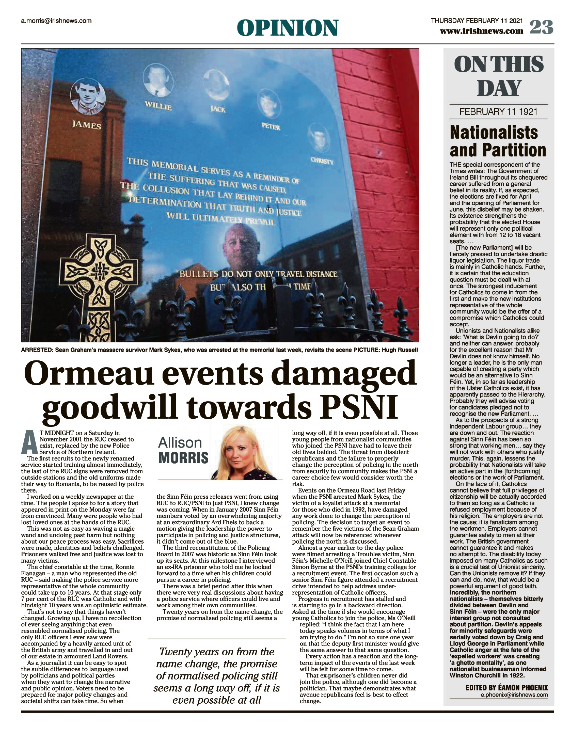
Summary: On This Day – 11th February 1921, A Times of London commentator warned Partition would exclude Nationalists from power, questioned Joe Devlin’s leadership, and doubted whether Catholics would receive equal citizenship under the new Northern Parliament. Edited by Éamon Phoenix.
Nationalists and Partition | On This Day – 11th February 1921
THE special correspondent of the Times writes: The Government of Ireland Bill throughout its chequered career suffered from a general belief in its reality.
If, as expected, the elections are fixed for April and the opening of Parliament for June, this disbelief may be shaken.
Its existence strengthens the probability that the elected House will represent only one political element with from 12 to 18 vacant seats. …
[The new Parliament] will be fiercely pressed to undertake drastic liquor legislation. The liquor trade is mainly in Catholic hands. Further, it is certain that the education question must be dealt with at once.
The strongest inducement for Catholics to come in from the first and make the new institutions representative of the whole community would be the offer of a compromise which Catholics could accept.
Unionists and Nationalists alike ask: ‘What is Devlin going to do?’ and neither can answer, probably for the excellent reason that Mr Devlin does not know himself.
No longer a leader, he is the only man capable of creating a party which would be an alternative to Sinn Féin.
Yet, in so far as leadership of the Ulster Catholics exist, it has apparently passed to the Hierarchy. Probably they will advise voting for candidates pledged not to recognise the new Parliament. …
As to the prospects of a strong independent Labour group… they are down and out.
The reaction against Sinn Féin has been so strong that working men… say they will not work with others who justify murder.
This, again, lessens the probability that Nationalists will take an active part in the [forthcoming] elections or the work of Parliament.
On the face of it, Catholics cannot believe that full privileges of citizenship will be actually accorded to them so long as a Catholic is refused employment because of his religion.
The employers are not the cause; it is fanaticism among the workmen. Employers cannot guarantee safety to men at their work.
The British government cannot guarantee it and makes no attempt to. The disability today imposed on many Catholics as such is a crucial test of Unionist sincerity.
Can the Unionists remove it? If they can and do, now, that would be a powerful argument of good faith.
(Éamon Phoenix editor’s note: Incredibly, the northern nationalists – themselves bitterly divided between Devlin and Sinn Féin – were the only major interest group not consulted about partition.
Devlin’s appeals for minority safeguards were serially voted down by Craig and Lloyd George in Parliament while Catholic anger at the fate of the ‘expelled workers’ was creating ‘a ghetto mentality’, as one nationalist businessman informed Winston Churchill in 1922.)
On This Day – 11th February 1921
Further Reading on Irish History:
Government of Ireland Act 1920
List of other On This Day columns
Other resources: National Library of Ireland Irish News CAIN Archive
On This Day is a daily column in the Irish News looking back either 50 or 100 years. The column was compiled by Dr Éamon Phoenix from the mid 1980s until autumn, 2022. The Foundation is very grateful to the Irish News for giving permission to reproduce Eamon’s columns. Funding gratefully received from Ireland’s Department of Foreign Affairs and the Magill Trust.
* The Foundation has worked hard to recreate Eamon’s distinctive voice through AI. Since this is an emerging technology, occasional imperfections may be audible.