

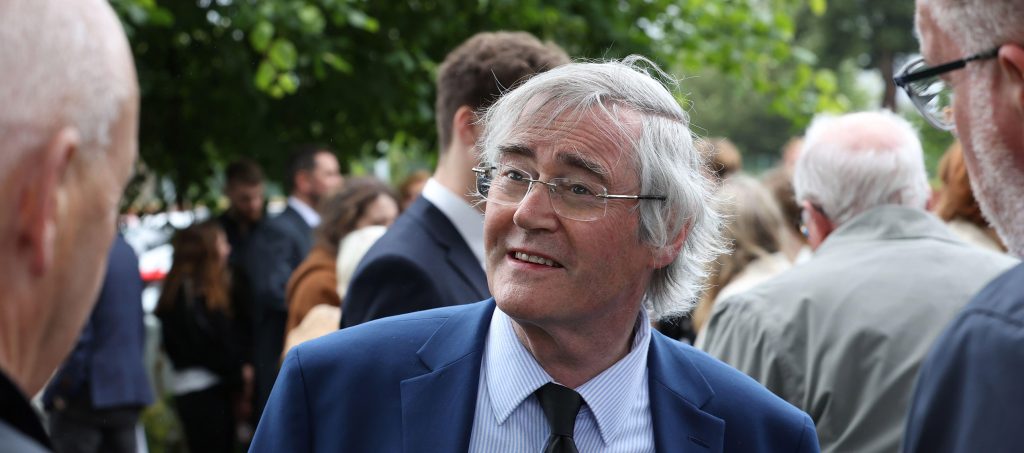
The following is a transcript of Noel Doran’s memorial lecture at the West Belfast Historical meeting in St Michael’s Hall on Friday the 9th January 2026.
It’s a great privilege to speak to you tonight about Éamon Phoenix, and his work with The Irish News over the years, and I was delighted to receive the invitation from such a well regarded group as the West Belfast Historical Society.
I’m also pleased to be here at the St Michael’s parish centre as my wife, Anne, who is with us this evening, is originally from just across the street in Greenan, at the bottom of Shaw’s Road, so I know the area pretty well.
Anne tells me she was never out of St Michael’s when growing up but a little research suggests she was referring to the disco in this centre rather than daily mass in the church next door.
Anyway, I’m delighted to get the chance to offer some thoughts about Éamon because in all my time with The Irish News, including a quarter of a century as editor, there was no columnist who had a closer bond with our readers.
I can only speak for our paper but I honestly believe that there has also been no contributor to any Irish daily title, north or south, who was ever held in higher esteem by their audience.
The reason for that is that history matters here, and there was no one else who could set out past developments with the flair, and the passion, and above all the insight which Éamon brought to his role.
One of the most remarkable aspects of Éamon’s approach was that he could not only describe with unique clarity what had happened in previous years but, drawing on his unrivalled expertise, he would tell you with amazing accuracy what was likely to happen in the future.
That was quite a gift, and helps to explain why he was such a revered figure, and why to people from both main traditions and on both sides of the border he was rightly regarded as one of Ireland’s national treasures.
I’m mainly here to talk about his writing but I should also confirm from an early stage that he was one of our pre-eminent broadcasters and lecturers, not just because of what he said but also the way in which he said it.
That voice was unmistakable, with its honeyed tones and rhetorical flourishes causing many people to conclude that he must have had upmarket connections at some level in the Anglo Irish aristocracy.
It’s all the more striking that he actually grew up in what he himself described as modest circumstances, with his family running a boarding house on Cromwell Road, just off Botanic Avenue, which was a tough vocation.
I have discussed Éamon’s articulation with his widow, Alice, and she is quite clear that it was down to his education with the Christian Brothers which extended overall for some 14 years and helped to shape him in many different ways.
He started off at the old St Bride’s primary off the Malone Road but even at such an early age he wanted to set his sights higher and moved quickly to the care of the Brothers firstly at the now sadly departed Oxford Street primary in the city centre and eventually to St Mary’s Grammar.
Most of his teachers were from the deep south of Ireland, and he picked up some of their accents to compliment his own Belfast tones and develop his unique and entirely unmistakeable style.
It all came together with Éamon’s wonderful use of language to create the full package which made him such an iconic figure through both his spoken and written work of all kinds over so many years.
Éamon had a distinguished academic career, initially with St Malachy’s College before he moved on to Stranmillis University College where he eventually became head of Livelong Learning and was a huge influence on his students at both institutions.
He was also an acclaimed author, with his seminal 1994 book Northern Nationalism: Nationalist Politics, Partition and the Catholic Minority in Northern Ireland 1890-1940, regarded as one of the most significant Irish historical works in living memory.
However, you will forgive me if I concentrate on his role with The Irish News, where it would probably be fair to say that successive editors were completely in awe of him.
When our late chairman, Jim Fitzpatrick, first brought him into the paper back in the 1980s, he regularly wrote editorials on key issues as well as providing advice during periods of turmoil, which at that stage stretched for years rather than weeks, but he will be best remembered for his On This Day column, which ran for over three decades and was simply essential reading for anyone with an interest in how our past has shaped our future.
Éamon was not some kind of distant analyst, but instead visited the office every couple of weeks to go through the old bound files of The Irish News, and made sure that he spoke to us about the latest news stories and all their precedents.
For the benefit of younger members of the audience, I should explain that there was a time when all the information on the entire history of the world was not instantly available simply by touching a button on your phone and instead you actually had to go out and find it.
The bound files included copies of every edition of The Irish News going back to 1891, some of them in such poor condition that only Éamon, wearing his trademark blue plastic gloves, was allowed to handle them.
They were fortunately also transferred to micro film in both the Linenhall and Central Libraries, to form a permanent record, but Éamon believed in what was quite literally hands on research.
It was part of the fabric of The Irish News to see Éamon sitting quietly at a corner table with those bulky, yellowing files in front of him, taking his detailed notes to prepare for a series of forthcoming columns.
He didn’t just consider the main stories of the day, but he looked at the smaller reports, sent in by local correspondents across the country, as well as the advertisements, which provided fascinating insights into every aspect of daily life.
The result was that, in addition to his unrivalled academic knowledge, Éamon had an intimate understanding of the full human context of every subject before he filed his pieces.
Éamon was also noted for his ground-breaking work on the state papers, the confidential records of decisions taken by governments in previous decades, sections of which which are released annually towards the end of December, and which depending on their sensitivity may go back to the 70s, the 60s or even earlier.
News reporters would struggle to understand the reams of documentation, written in the dense language of civil servants, but Éamon would cut to the chase, identity the key points and present it all in a form which made sense of the whole process as well as comparing it to the events of today.
What made Éamon even more in a field of his own that was that he always reached out beyond his columns and engaged personally through emails, letters and even personal conversations with readers.
On many occasions at gatherings connected to The Irish News, I witnessed members of the public approaching Éamon with queries over events about which he had written and had direct or even slightly obscure links to their families.
They probably expected that he would refer them in a particular direction for further inquiries, but almost invariably he would sit down, and without hesitation give them a precise summary of an episode from perhaps fifty or one hundred years ago or more.
He would then immediately establish the identity of their relative, and their precise role in the proceedings, before offering further thoughts about who had lived, died or was central to the drama, in a way which frequently left the original questioner saying that they had thought they knew everything about the incident until they spoke to Éamon.
It’s something of a cliche to describe someone as a walking encyclopaedia, but that is really what he was, accompanying the cold facts with his natural warmth on all occasions.
I had the experience of finding my grandfather popping up in one of Éamon’s columns, mentioning it to him and receiving a mesmerising and personalised assessment of the subtleties of the era, and I would say that hundreds of Irish News readers could provide a similar testimony.
Éamon believed in providing equal respect to everyone he encountered but I would suggest there was one individual outside his immediate family whom he placed on a pedestal, and that was the legendary Irish News journalist James Kelly.
I think you had to see Éamon and Jimmy together to appreciate the closeness of their relationship, and it was a great privilege for me to join Éamon on a couple of his many visits Jimmy’s home off the Lisburn Road.
What Éamon would point out is that he could retrospectively study the seminal events of 20th century Ireland but Jimmy had actually lived through most of them, so together they made a formidable partnership.
Jimmy was born on the Falls Road in 1911, and had astonishingly vivid memories from his earliest days which he would share initially with Éamon and ultimately with their readers.
Looking back, I should have insisted that Éamon’s conversations with Jimmy were recorded at some stage, either for a documentary or for the benefit of groups like this society.
However, I could also quote my late father, a primary school principal who firmly reminded his pupils of the Latin phrase “Verba volant, scripta manent”, or Spoken Words Fly Away, Written Ones Endure.
Fortunately, their conversations helped to directly form the basis for two key books back in the 1990s, which were A Century of Northern Life – The Irish News and 100 Years of Ulster History, edited by Éamon, and Bonfires on the Hillside, Jimmy’s biography.
In my mind’s eye, I can still hear their incredibly in-depth conversations and see them shaking their heads as they recalled the dark days, laughing and occasionally grimacing as they looked back at the great characters they encountered.
Jimmy’s memories were at the heart of Éamon’s work, because it is one thing reading the text books about the 1916 Easter Rising but when you can speak to someone who as a child walked along what was then Sackville Street, now O’Connell Street, in Dublin in the days after the rebellion which began at the GPO there, you are taken to a different level.
Jimmy told Éamon how he grasped his father’s hand as they picked their way through the rubble of the devastated city centre, after travelling south from Belfast to support family members who had survived the turmoil, and Éamon noted it all down.
After living through two world wars, the partition of Ireland and the troubles which regularly gripped the north throughout the century, Jimmy had witnessed everything and was able to inform all Éamon’s undertakings.
They were soul mates but the big difference between them was that Éamon as an academic was scrupulously neutral at all times while Jimmy as a journalist was prepared to either praise or more likely criticise in trenchant terms those in positions of authority.
It’s probably not a secret that Jimmy was less than impressed with many of the Stormont ministers he encountered while working initially for The Irish News, then for the now departed Irish Press and then The Irish Independent before in semi retirement he came back to his spiritual home in Donegall Street, so he regarded it as a delicious irony that the venue we were able to pick for a 2004 dinner celebrating his 75 years in journalism was indeed Parliament Buildings.
Jimmy’s peers were there in force but we were also joined by a range of senior politicians, including John Hume, Seamus Mallon, Gerry Adams and Martin McGuinness, as well as John Taylor who to his credit was happy to exchange quite a few jokes with Jimmy about what we might regard as their different perspectives on constitutional matters.
However, the highlight of the evening came when Éamon took to the podium, and, while I have been fortunate enough to enjoy many talented speakers in high profile circumstances down the years, the address which he delivered was the single best I have ever heard.
His lecture entwined the history of the state with the life and times of his great friend Jimmy, right from the opening of Parliament Buildings in 1932, and all the upheavals which followed, including the fire which nearly destroyed it in 1995, and its restoration in time for the new institutions created by the1998 Good Friday Agreement, all of which were reported on by Jimmy.
Éamon had an engrossed audience as he stood in the Long Gallery and discussed the many intrigues played out in the surrounding corridors, particularly when he told us about the amazing tale of the artwork entitled officially but not as it turned out accurately entitled The Entry Of King William To Ireland.
It was painted by the 17th century Dutch artist, Pieter van der Meulen and later purchased for a huge sum by the then prime minister James Craig before it was unveiled at Stormont in 1933.
Craig had not actually seen it when he bought it, but was led to believe that it depicted the Prince of Orange himself on his way to the Battle of the Boyne in 1690.
However, consternation followed when it was more closely inspected while hanging on the wall and it was found to also include a figure said to be Pope Innocent the Eleventh bestowing a papal blessing on King Billy.
This was too much for some Scottish loyalists to accept, and so a group of them travelled to Stormont and threw a pot of red paint on the canvas.
An official from the Scottish Protestant League, a Mrs Mary Ratcliffe, then went further and stabbed it with a knife, although as it happened the main damage she caused was to the Duke of Schomberg’s horse.
Three of the protestors were brough to court, and fined £65 each, in a case of course covered by Jimmy, but that was far from the end of the story, as Éamon confirmed.
He set out how that painting was taken away to be repaired, but, when it arrived back, it was discovered that a set of rosary beads held by a figure in the background had somehow disappeared in what we must regard as an early example of photoshopping.
The uproar meant that it never returned to its original location, and was held in the vaults, apart from a period when Ian Paisley insisted that it should be hung in his office in the 1980s before Stormont was suspended, not for the last time, and it was again placed in storage and almost forgotten until Éamon intervened and highlighted it specifically during the celebration for Jimmy Kelly.
All the attention put a further spotlight on the painting and there was was one final twist, when a BBC documentary called Britain’s Lost Masterpieces investigated the saga in 2016 and concluded that Carson, Paisley and a few others had got it wrong and the subject of the painting was not Prince William of Orange at all but rather Saint George of England.
It has now belatedly been given a proper place of honour at Stormont, outside the First Minister’s office no less, with a caption briefly describing its truly bizarre chronology.
Thanks to the professional advice of Éamon, Parliament Buildings now has an impressive permanent exhibition of political portraits around its floors. If they ever look beyond the ranks of elected representatives, I would suggest that a painting or photograph of Éamon would be a fitting addition to the collection.
Éamon was in his element considering all of this, and I only wish that he was still around today to demonstrate that for example rows over damage to paintings in public places have happened more than once, and prove that history is well capable of repeating itself in many other ways in our part of the world and elsewhere.
I suspect that one of Éamon’s key messages would be that events are not necessarily what they seem at the time, and it is the responsibility certainly of journalists, possibly politicians and definitely historians to eventually get to the truth of the matter.
We could make the same observation about the latest rows at Stormont just as much as at a completely different level we could about what is happening in Venezuela and Greenland and the Ukraine, and there would be no one better placed than Éamon to explain how badly these adventures usually end for those who instigate them and everyone else.
The night we spent with Éamon and Jimmy at Stormont was wonderful and gave us all great memories which we were able to look back on when Jimmy died seven years later in 2011, shortly after appropriately filing his farewell column on his 100th birthday.
I wish we could have organised a similar tribute specifically for Éamon, but none of us realised that his health would decline so suddenly before he died in November, 2022, with his own final piece, with the agreement of his family, running in the paper the day after his death.
He leaves an outstanding legacy within the chronicles of The Irish News alone but it is absolutely brilliant that his work also lives on in much more definitive form through the Éamon Phoenix Foundation.
It’s a great tribute to Alice, Mary Alice, Paul Connolly and all those involved in developing it that it has reached such outstanding standards, and, as its mission statement says, brings together the strands of his life to preserve and enhance his memory.
To hear Éamon’s voice again, through the wonders of Artificial Intelligence, recreating his columns is incredibly moving, and means that Éamon, and all that he represented, will always be with us.
There is a tremendous range of material on the website, and one of the simplest and most effective aspects at the top of the home page is the evocative picture of Éamon, surrounded by his books in a darkened study symbolically illuminated by a single lamp, in an image captured by another old friend, Hugh Russell, who sadly died less than a year after Éamon.
In conclusion, I would say that I reflect on Éamon, and his work, regularly, and I have been doing so again in recent days after last Saturday when we buried my younger brother, Paul, who like Éamon died from a cruel and aggressive form of cancer.
Éamon and Paul did not know each other, and came from different backgrounds, but I relied heavily on them both for good counsel over the years, because I trusted their judgment implicitly and they were truly exceptional individuals.
Éamon’s judgment was unparalleled, and revealed itself through every project with which he was associated throughout a magnificent career which has moulded our understanding of Ireland, past, present and future.
It’s an honour to be able to talk about him tonight and to know that, through the endeavours of historical societies like this one and above all through the Éamon Phoenix Foundation, he will always be with us.