

On This Day / November 1, 1921
Go BackReproduced with permission from The Irish News.
November 1, 2021
Publication Date
Listen Along in Éamons Voice *
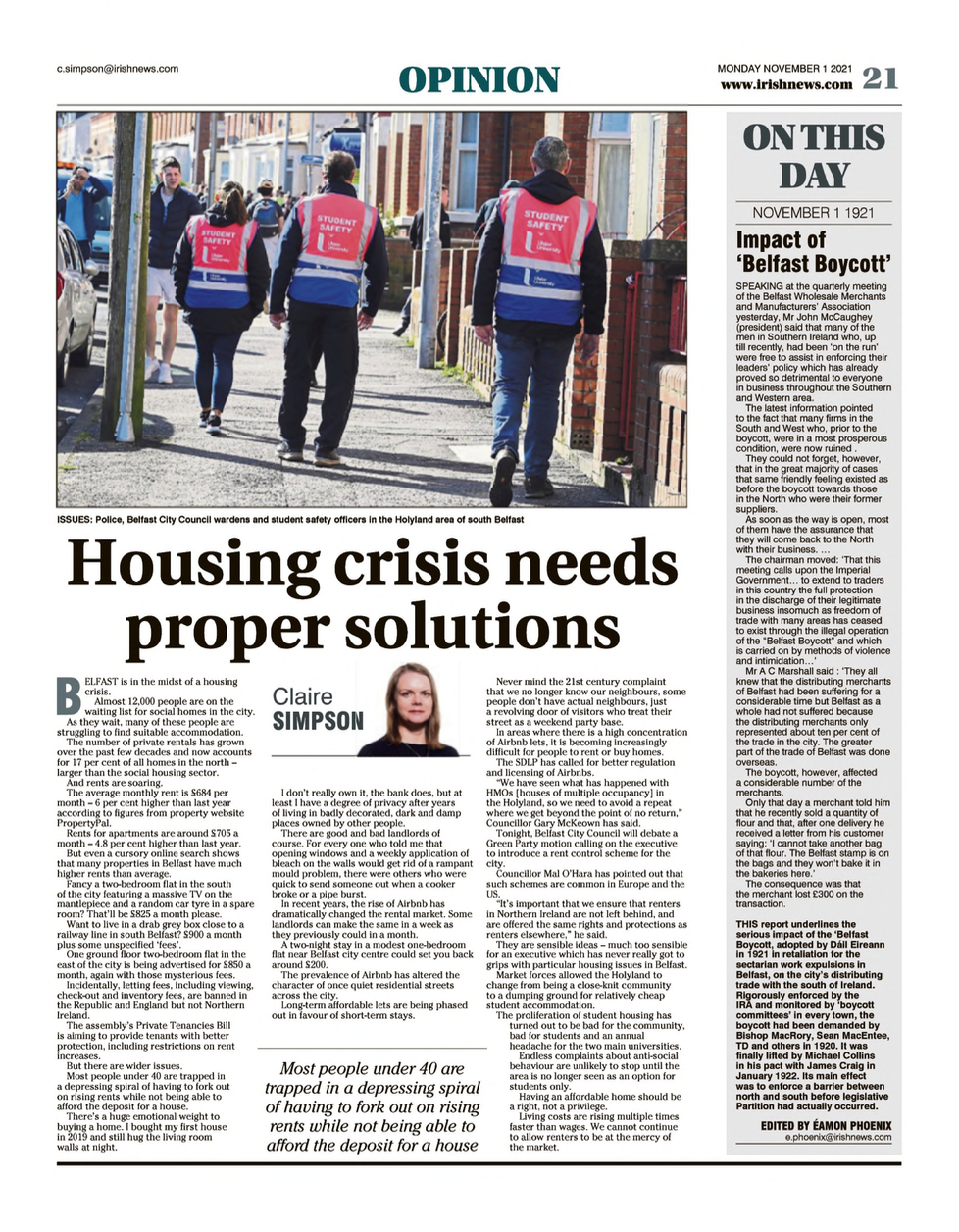
Summary: On This Day – 1st November 1921, Belfast merchants highlighted the damaging effects of the ‘Belfast Boycott’ on trade with southern Ireland, calling for government protection against intimidation. Edited by Éamon Phoenix.
Impact of ‘Belfast Boycott’ | On This Day – 1st November 1921
SPEAKING at the quarterly meeting of the Belfast Wholesale Merchants and Manufacturers’ Association yesterday, Mr John McGaughey (president) said that many of the men in Southern Ireland who, up till recently, had been ‘on the run’ were free to assist in enforcing their leaders’ policy which has already proved so detrimental to everyone in business throughout the Southern and Western area.
The latest information pointed to the fact that many firms in the South and West who, prior to the boycott, were in a most prosperous condition, were now ruined.
They could not forget, however, that in the great majority of cases that same friendly feeling existed as before the boycott towards those in the North who were their former suppliers.
As soon as the way is open, most of them have the assurance that they will come back to the North with their business….
The chairman moved: ‘That this meeting calls upon the Imperial Government… to extend to traders in this country the full protection in the discharge of their legitimate business insomuch as freedom of trade with many areas has ceased to exist through the illegal operation of the “Belfast Boycott” and which is carried on by methods of violence and intimidation…’
Mr A C Marshall said: ‘They all knew that the distributing merchants of Belfast had been suffering for a considerable time but Belfast as a whole had not suffered because the distributing merchants only represented about ten per cent of the trade in the city.
The greater part of the trade of Belfast was done overseas. The boycott, however, affected a considerable number of the merchants.
Only that day a merchant told him that he recently sold a quantity of flour and that, after one delivery he received a letter from his customer saying:
‘I cannot take another bag of that flour. The Belfast stamp is on the bags and they won’t bake it in the bakeries here.’
The consequence was that the merchant lost £300 on the transaction.
(Éamon Phoenix editor’s note: THIS report underlines the serious impact of the ‘Belfast Boycott, adopted by Dáil Eireann in 1921 in retaliation for the sectarian work expulsions in Belfast, on the city’s distributing trade with the south of Ireland.
Rigorously enforced by the IRA and monitored by ‘boycott committees’ in every town, the boycott had been demanded by Bishop MacRory, Sean MacEntee, TD and others in 1920.
It was finally lifted by Michael Collins in his pact with James Craig in January 1922.
Its main effect was to enforce a barrier between north and south before legislative Partition had actually occurred.)
On This Day – 1st November 1921
Further Reading on Irish History:
List of other On This Day columns
Other resources: National Library of Ireland Irish News CAIN Archive
On This Day is a daily column in the Irish News looking back either 50 or 100 years. The column was compiled by Dr Éamon Phoenix from the mid 1980s until autumn, 2022. The Foundation is very grateful to the Irish News for giving permission to reproduce Eamon’s columns. Funding gratefully received from Ireland’s Department of Foreign Affairs and the Magill Trust.
* The Foundation has worked hard to recreate Eamon’s distinctive voice through AI. Since this is an emerging technology, occasional imperfections may be audible.