

On This Day / October 28, 1921
Go BackReproduced with permission from The Irish News.
October 28, 2021
Publication Date
Listen Along in Éamons Voice *
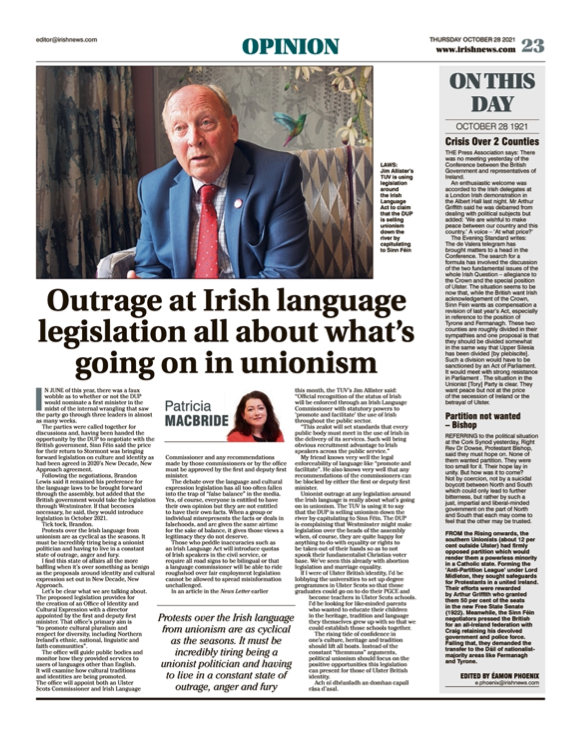
Summary: On This Day – 28th October 1921, the status of Fermanagh and Tyrone threatened the Irish peace negotiations as allegiance to the Crown and partition remained contentious issues. Edited by Éamon Phoenix.
Crisis Over 2 Counties | On This Day – 28th October 1921
THE Press Association says: There was no meeting yesterday of the Conference between the British Government and representatives of Ireland.
An enthusiastic welcome was accorded to the Irish delegates at a London Irish demonstration in the Albert Hall last night.
Mr Arthur Griffith said he was debarred from dealing with political subjects but added:
‘We are wishful to make peace between our country and this country.’ A voice – ‘At what price?’
The Evening Standard writes: The de Valera telegram has brought matters to a head in the Conference.
The search for a formula has involved the discussion of the two fundamental issues of the whole Irish Question – allegiance to the Crown and the special position of Ulster.
The situation seems to be now that, while the British want Irish acknowledgement of the Crown, Sinn Fein wants as compensation a revision of last year’s Act, especially in reference to the position of Tyrone and Fermanagh.
These two counties are roughly divided in their sympathies and one proposal is that they should be divided somewhat in the same way that Upper Silesia has been divided [by plebiscite].
Such a division would have to be sanctioned by an Act of Parliament. It would meet with strong resistance in Parliament.
The situation in the Unionist [Tory] Party is clear. They want peace but not at the price of the secession of Ireland or the betrayal of Ulster.
Partition not wanted – Bishop
REFERRING to the political situation at the Cork Synod yesterday, Right Rev Dr Dowse, Protestant Bishop, said they must hope on.
None of them wanted partition. They were too small for it. Their hope lay in unity. But how was it to come?
Not by coercion, not by a suicidal boycott between North and South which could only lead to further bitterness, but rather by such a just, impartial and liberal-minded government on the part of North and South that each may come to feel that the other may be trusted.
(Éamon Phoenix editor’s note: FROM the Rising onwards, the southern Unionists (about 12 per cent outside Ulster) had firmly opposed partition which would render them a powerless minority in a Catholic state.
Forming the ‘Anti-Partition League’ under Lord Midleton, they sought safeguards for Protestants in a united Ireland.
Their efforts were rewarded by Arthur Griffith who granted them 50 per cent of the seats in the new Free State Senate (1922).
Meanwhile, the Sinn Féin negotiators pressed the British for an all-Ireland federation with Craig retaining his devolved government and police force.
Failing that, they demanded the transfer to the Dáil of nationalist-majority areas like Fermanagh and Tyrone.)
On This Day – 28th October 1921
Further Reading on Irish History:
List of other On This Day columns
Other resources: National Library of Ireland Irish News CAIN Archive
On This Day is a daily column in the Irish News looking back either 50 or 100 years. The column was compiled by Dr Éamon Phoenix from the mid 1980s until autumn, 2022. The Foundation is very grateful to the Irish News for giving permission to reproduce Eamon’s columns. Funding gratefully received from Ireland’s Department of Foreign Affairs and the Magill Trust.
* The Foundation has worked hard to recreate Eamon’s distinctive voice through AI. Since this is an emerging technology, occasional imperfections may be audible.