

On This Day / October 22, 1921
Go BackReproduced with permission from The Irish News.
October 22, 2021
Publication Date
Listen Along in Éamons Voice *
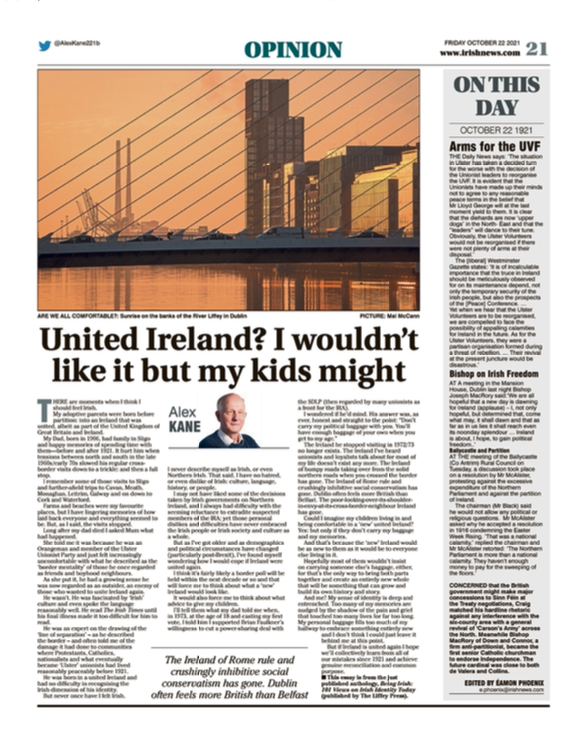
Summary: On This Day – 22nd October 1921, the planned reorganisation of the Ulster Volunteer Force raised fears for the Irish truce, while Bishop Joseph MacRory voiced hopes for Irish political freedom. Edited by Éamon Phoenix.
Arms for the UVF | On This Day – 22nd October 1921
THE Daily News says: ‘The situation in Ulster has taken a decided turn for the worse with the decision of the Unionist leaders to reorganise the UVF.
It is evident that the Unionists have made up their minds not to agree to any reasonable peace terms in the belief that Mr Lloyd George will at the last moment yield to them.
It is clear that the diehards are now ‘upper dogs’ in the North- East and that the “leaders’’ will dance to their tune.
Obviously, the Ulster Volunteers would not be reorganised if there were not plenty of arms at their disposal.’
The [liberal] Westminster Gazette states: ‘It is of incalculable importance that the truce in Ireland should be meticulously observed for on its maintenance depend, not only the temporary security of the Irish people, but also the prospects of the [Peace] Conference….
Yet when we hear that the Ulster Volunteers are to be reorganised, we are compelled to face the possibility of appalling calamities for Ireland in the future.
As for the Ulster Volunteers, they were a partisan organisation formed during a threat of rebellion…. Their revival at the present juncture would be disastrous.’
Bishop on Irish Freedom
AT A meeting in the Mansion House, Dublin last night Bishop Joseph MacRory said:
‘We are all hopeful that a new day is dawning for Ireland (applause) – I, not only hopeful, but determined that, come what may, it shall dawn and that as far as in us lies it shall reach even its noonday splendour… Ireland is about, I hope, to gain political freedom…’
Ballycastle and Partition
AT THE meeting of the Ballycastle (Co Antrim) Rural Council on Tuesday, a discussion took place on a resolution by Mr McAlister, protesting against the excessive expenditure of the Northern Parliament and against the partition of Ireland.
The chairman (Mr Black) said he would not allow any political or religious questions. Mr McAlister asked why he accepted a resolution in 1916 condemning the Easter Week Rising.
‘That was a national calamity,’ replied the chairman and Mr McAlister retorted: ‘The Northern Parliament is more than a national calamity. They haven’t enough money to pay for the sweeping of the floors.’
(Éamon Phoenix editor’s note: CONCERNED that the British government might make major concessions to Sinn Fein at the Treaty negotiations, Craig matched his hardline rhetoric against any interference with the six-county area with a general revival of ‘Carson’s Army’ across the North.
Meanwhile Bishop MacRory of Down and Connor, a firm anti-partitionist, became the first senior Catholic churchman to endorse independence. The future cardinal was close to both de Valera and Collins.)
On This Day – 22nd October 1921
Further Reading on Irish History:
List of other On This Day columns
Other resources: National Library of Ireland Irish News CAIN Archive
On This Day is a daily column in the Irish News looking back either 50 or 100 years. The column was compiled by Dr Éamon Phoenix from the mid 1980s until autumn, 2022. The Foundation is very grateful to the Irish News for giving permission to reproduce Eamon’s columns. Funding gratefully received from Ireland’s Department of Foreign Affairs and the Magill Trust.
* The Foundation has worked hard to recreate Eamon’s distinctive voice through AI. Since this is an emerging technology, occasional imperfections may be audible.