

1976 State Papers (page 1)
December 29 2006
Publication Date
LEGAL: REDACTED PDF AND EDITOR'S NOTE Politicians struggled to curb sectarian killings, Proscription of UVF highlighted
State Paper Snippet
Politicians struggled to curb sectarian killings
THE year 1976 broke violently in Northern Ireland with a spate of sectarian assassinations in counties Down and Armagh.
On January 4 five Catholics were murdered by loyalists at Whitecross and Ballydugan.
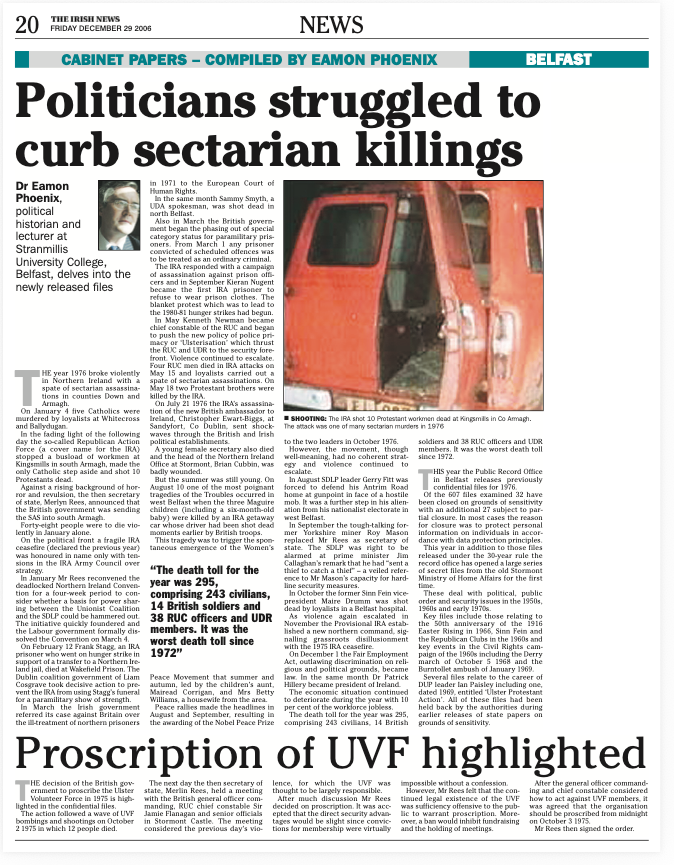
In the fading light of the following day the so-called Republican Action Force (a cover name for the IRA) stopped a busload of workmen at Kingsmills in south Armagh, made the only Catholic step aside and shot 10 Protestants dead.
Against a rising background of horror and revulsion, the then secretary of state, Merlyn Rees, announced that the British government was sending the SAS into south Armagh.
Forty-eight people were to die violently in January alone.
On the political front a fragile IRA ceasefire (declared the previous year) was honoured in name only with tensions in the IRA Army Council over strategy.
In January Mr Rees reconvened the deadlocked Northern Ireland Convention for a four-week period to consider whether a basis for power sharing between the Unionist Coalition and the SDLP could be hammered out. The initiative quickly foundered and the Labour government formally dissolved the Convention on March 4.
On February 12 Frank Stagg, an IRA prisoner who went on hunger strike in support of a transfer to a Northern Ireland jail, died at Wakefield Prison. The Dublin coalition government of Liam Cosgrave took decisive action to prevent the IRA from using Stagg’s funeral for a paramilitary show of strength.
In March the Irish government referred its case against Britain over the ill-treatment of northern prisoners in 1971 to the European Court of Human Rights.
In the same month Sammy Smyth, a UDA spokesman, was shot dead in north Belfast.
Also in March the British government began the phasing out of special category status for paramilitary prisoners. From March 1 any prisoner convicted of scheduled offences was to be treated as an ordinary criminal.
The IRA responded with a campaign of assassination against prison officers and in September Kieran Nugent became the first IRA prisoner to refuse to wear prison clothes. The blanket protest which was to lead to the 1980-81 hunger strikes had begun.
In May Kenneth Newman became chief constable of the RUC and began to push the new policy of police primacy or ‘Ulsterisation’ which thrust the RUC and UDR to the security forefront. Violence continued to escalate. Four RUC men died in IRA attacks on May 15 and loyalists carried out a spate of sectarian assassinations. On May 18 two Protestant brothers were killed by the IRA.
On July 21 1976 the IRA’s assassination of the new British ambassador to Ireland, Christopher Ewart-Biggs, at Sandyfort, Co Dublin, sent shockwaves through the British and Irish political establishments.
A young female secretary also died and the head of the Northern Ireland Office at Stormont, Brian Cubbin, was badly wounded.
But the summer was still young. On August 10 one of the most poignant tragedies of the Troubles occurred in west Belfast when the three Maguire children (including a six-month-old baby) were killed by an IRA getaway car whose driver had been shot dead moments earlier by British troops.
This tragedy was to trigger the spontaneous emergence of the Women’s Peace Movement that summer and autumn, led by the children’s aunt, Mairead Corrigan, and Mrs Betty Williams, a housewife from the area.
Peace rallies made the headlines in August and September, resulting in the awarding of the Nobel Peace Prize to the two leaders in October 1976.
However, the movement, though well-meaning, had no coherent strategy and violence continued to escalate.
In August SDLP leader Gerry Fitt was forced to defend his Antrim Road home at gunpoint in face of a hostile mob. It was a further step in his alienation from his nationalist electorate in west Belfast.
In September the tough-talking former Yorkshire miner Roy Mason replaced Mr Rees as secretary of state. The SDLP was right to be alarmed at prime minister Jim Callaghan’s remark that he had “sent a thief to catch a thief” – a veiled reference to Mr Mason’s capacity for hardline security measures.
In October the former Sinn Fein vice-president Maire Drumm was shot dead by loyalists in a Belfast hospital.
As violence again escalated in November the Provisional IRA established a new northern command, signalling grassroots disillusionment with the 1975 IRA ceasefire.
On December 1 the Fair Employment Act, outlawing discrimination on religious and political grounds, became law. In the same month Dr Patrick Hillery became president of Ireland.
The economic situation continued to deteriorate during the year with 10 per cent of the workforce jobless.
The death toll for the year was 295, comprising 243 civilians, 14 British soldiers and 38 RUC officers and UDR members. It was the worst death toll since 1972.
– This year the Public Record Office in Belfast releases previously confidential files for 1976.
Of the 607 files examined 32 have been closed on grounds of sensitivity with an additional 27 subject to partial closure. In most cases the reason for closure was to protect personal information on individuals in accordance with data protection principles.
This year in addition to those files released under the 30-year rule the record office has opened a large series of secret files from the old Stormont Ministry of Home Affairs for the first time.
These deal with political, public order and security issues in the 1950s, 1960s and early 1970s.
Key files include those relating to the 50th anniversary of the 1916 Easter Rising in 1966, Sinn Fein and the Republican Clubs in the 1960s and key events in the Civil Rights campaign of the 1960s including the Derry march of October 5 1968 and the Burntollet ambush of January 1969.
Several files relate to the career of DUP leader Ian Paisley including one, dated 1969, entitled ‘Ulster Protestant Action’. All of these files had been held back by the authorities during earlier releases of state papers on grounds of sensitivity.
Proscription of UVF highlighted
THE decision of the British government to proscribe the Ulster Volunteer Force in 1975 is highlighted in the confidential files.
The action followed a wave of UVF bombings and shootings on October 2 1975 in which 12 people died.
The next day the then secretary of state, Merlin Rees, held a meeting with the British general officer commanding, RUC chief constable Sir Jamie Flanagan and senior officials in Stormont Castle. The meeting considered the previous day’s violence, for which the UVF was thought to be largely responsible.
After much discussion Mr Rees decided on proscription. It was accepted that the direct security advantages would be slight since convictions for membership were virtually impossible without a confession.
However, Mr Rees felt that the continued legal existence of the UVF was sufficiency offensive to the public to warrant proscription. Moreover, a ban would inhibit fundraising and the holding of meetings.
After the general officer commanding and chief constable considered how to act against UVF members, it was agreed that the organisation should be proscribed from midnight on October 3 1975.
Mr Rees then signed the order.
(Editor’s note: certain content on this page has been removed in line with our publishing guidelines and privacy standards.)