

1979 State Papers (page 8)
December 31 2009
Publication Date
New light on kidnapping and death of German industrialist, Concerns at soccer hooliganism
State Paper Snippet
New light on kidnapping and death of German industrialist
CONFIDENTIAL files shed chilling new light on the abduction and subsequent death in IRA custody of Thomas Niedermayer, the managing director of the Grundig electronics factory, in Dunmurry in 1973.
A secret RUC report records that on December 27 1973 Mr Niedermayer (then aged 45) was bundled into a car outside his Glengoland bungalow at about 11pm.
Two men, who called at his home, lured him outside on the pretext that they had damaged his car.
He was last seen being driven off towards the Andersonstown area of west Belfast.
Initial reports suggested that the German industrialist, who was also West German Honorary Consul in Northern Ireland, was being held hostage by paramilitaries in exchange for the Price sisters, recently sentenced at Winchester for bombing offences.
In February 1978, solicitors acting for the businessman’s widow sought compensation from the Northern Ireland Office.
In 1976, the West German government gave Ingeborg Niedermayer leave to assume her husband was dead for the purposes of winding up his affairs.
By this stage, the file shows that her health had seriously deteriorated as a result of her husband’s disappearance.
In a note on the file dated August 9 1978, E Dalzell, an NIO official, informed colleagues that he had checked all records held by the RUC Special Branch concerning Niedermayer’s abduction and said: “On the balance of probabilities he was kidnapped by members of the Provisional IRA and murdered by them.
“There are no reports which would suggest that he either went voluntarily with the PIRA or that he disappeared for any other reason.”
Dalzell referred to a report in June 1978 from “a reliable informer” stating that the industrialist was “kidnapped and murdered by three known members of the Provisional IRA and has been buried somewhere in the First Battalion area – Upper Andersonstown”.
The official said that there had been other reports indicating that Mr Niedermayer was buried else where but the police were more inclined to believe this recent report.
The official also referred to a report that “following the kidnap Mr Niedermayer died of a heart attack and was buried by the Provisional IRA”.
However, this report was “not considered reliable”.
There were no reports to suggest that the industrialist was still alive, he said.
In the event, Mrs Niedermayer was awarded 5100,000 compensation in respect of her criminal injuries claim in May 1979.
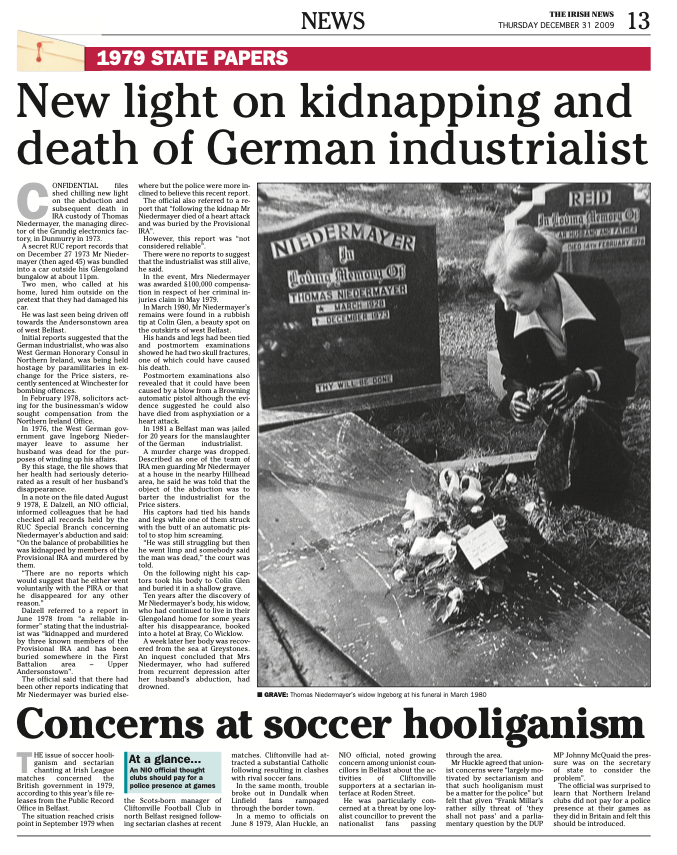
In March 1980, Mr Niedermayer’s remains were found in a rubbish tip at Colin Glen, a beauty spot on the outskirts of west Belfast.
His hands and legs had been tied and postmortem examinations showed he had two skull fractures, one of which could have caused his death.
Postmortem examinations also revealed that it could have been caused by a blow from a Browning automatic pistol although the evidence suggested he could also have died from asphyxiation or a heart attack.
In 1981 a Belfast man was jailed for 20 years for the manslaughter of the German industrialist.
A murder charge was dropped. Described as one of the team of IRA men guarding Mr Niedermayer at a house in the nearby Hillhead area, he said he was told that the object of the abduction was to barter the industrialist for the Price sisters.
His captors had tied his hands and legs while one of them struck with the butt of an automatic pistol to stop him screaming.
“He was still struggling but then he went limp and somebody said the man was dead,” the court was told.
On the following night his captors took his body to Colin Glen and buried it in a shallow grave.
Ten years after the discovery of Mr Niedermayer’s body, his widow, who had continued to live in their Glengoland home for some years after his disappearance, booked into a hotel at Bray, Co Wicklow.
A week later her body was recovered from the sea at Greystones. An inquest concluded that Mrs Niedermayer, who had suffered from recurrent depression after her husband’s abduction, had drowned.
Concerns at soccer hooliganism
THE issue of soccer hooliganism and sectarian chanting at Irish League matches concerned the British government in 1979, according to this year’s file releases from the Public Record Office in Belfast.
The situation reached crisis point in September 1979 when the Scots-born manager of Cliftonville Football Club in north Belfast resigned following sectarian clashes at recent
matches. Cliftonville had attracted a substantial Catholic following resulting in clashes with rival soccer fans.
In the same month, trouble broke out in Dundalk when Linfield fans rampaged through the border town.
In a memo to officials on June 8 1979, Alan Huckle, an NIO official, noted growing concern among unionist councillors in Belfast about the activities of Cliftonville supporters at a sectarian interface at Roden Street.
He was particularly concerned at a threat by one loyalist councillor to prevent the nationalist fans passing through the area.
Mr Huckle agreed that unionist concerns were “largely motivated by sectarianism and that such hooliganism must be a matter for the police” but felt that given “Frank Millar’s rather silly threat of ‘they shall not pass’ and a parliamentary question by the DUP MP Johnny McQuaid the pressure was on the secretary of state to consider the problem”.
The official was surprised to learn that Northern Ireland clubs did not pay for a police presence at their games as they did in Britain and felt this should be introduced.