

1979 State Papers (page 6)
December 30 2009
Publication Date
Prisoners were kept inside over theft fears, Bullet-proof glass was ruled out in bid to safeguard Pope, Concerns meeting IRA might have sparked violence
State Paper Snippet
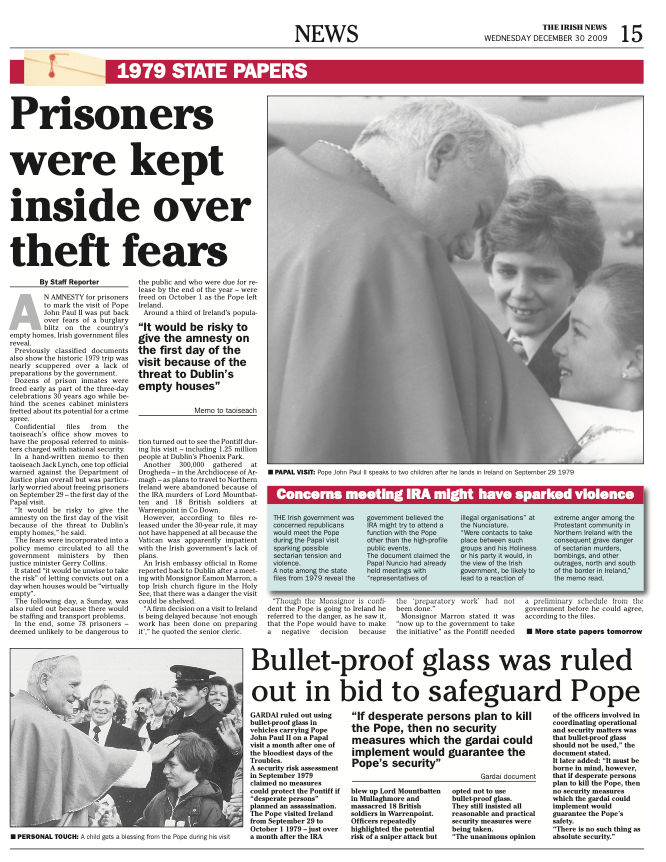
Prisoners were kept inside over theft fears
An amnesty for prisoners to mark the visit of Pope John Paul II was put back over fears of a burglary blitz on the country’s empty homes, Irish government files reveal.
Previously classified documents also show the historic 1979 trip was nearly scuppered over a lack of preparations by the government.
Dozens of prison inmates were freed early as part of the three-day celebrations 30 years ago while behind the scenes cabinet ministers fretted about its potential for a crime spree.
Confidential files from the taoiseach’s office show moves to have the proposal referred to ministers charged with national security.
In a hand-written memo to then taoiseach Jack Lynch, one top official warned against the Department of Justice plan overall but was particularly worried about freeing prisoners on September 29 – the first day of the Papal visit.
“It would be risky to give the amnesty on the first day of the visit because of the threat to Dublin’s empty homes,” he said. The fears were incorporated into a policy memo circulated to all the government ministers by then justice minister Gerry Collins.
It stated “it would be unwise to take the risk” of letting convicts out on a day when houses would be “virtually empty”.
The following day, a Sunday, was also ruled out because there would be staffing and transport problems.
In the end, some 78 prisoners – deemed unlikely to be dangerous to the public and who were due for release by the end of the year – were freed on October 1 as the Pope left Ireland.
Around a third of Ireland’s population turned out to see the Pontiff during his visit – including 1.25 million people at Dublin’s Phoenix Park.
Another 300,000 gathered at Drogheda – in the Archdiocese of Armagh – as plans to travel to Northern Ireland were abandoned because of the IRA murders of Lord Mountbatten and 18 British soldiers at Warrenpoint in Co Down.
However, according to files released under the 30-year rule, it may not have happened at all because the Vatican was apparently impatient with the Irish government’s lack of plans.
An Irish embassy official in Rome reported back to Dublin after a meeting with Monsignor Eamon Marron, a top Irish church figure in the Holy See, that there was a danger the visit could be shelved.
“A firm decision on a visit to Ireland is being delayed because ‘not enough work has been done on preparing it’,” he quoted the senior cleric.
“Though the Monsignor is confident the Pope is going to Ireland he referred to the danger, as he saw it, that the Pope would have to make a negative decision because the ‘preparatory work’ had not been done.”
Monsignor Marron stated it was “now up to the government to take the initiative” as the Pontiff needed a preliminary schedule from the government before he could agree, according to the files.
Bullet-proof glass was ruled out in bid to safeguard Pope
Gardai ruled out using bullet-proof glass in vehicles carrying Pope John Paul II on a Papal visit a month after one of the bloodiest days of the Troubles.
A security risk assessment in September 1979 claimed no measures could protect the Pontiff if “desperate persons” planned an assassination.
The Pope visited Ireland from September 29 to October 1 1979 – just over a month after the IRA blew up Lord Mountbatten in Mullaghmore and massacred 18 British soldiers in Warrenpoint.
Officers repeatedly highlighted the potential risk of a sniper attack but opted not to use bullet-proof glass.
They still insisted all reasonable and practical security measures were being taken.
“The unanimous opinion of the officers involved in coordinating operational and security matters was that bullet-proof glass should not be used,” the document stated.
“It must be borne in mind, however, that if desperate persons plan to kill the Pope, then no security measures which the gardai could implement would guarantee the Pope’s security.”
It later added: “There is no such thing as absolute security.”
Concerns meeting IRA might have sparked violence
The Irish government was concerned republicans would meet the Pope during the Papal visit sparking possible sectarian tension and violence.
A note among the state files from 1979 reveal the government believed the IRA might try to attend a function with the Pope other than the high-profile public events.
The document claimed the Papal Nuncio had already held meetings with “representatives of illegal organisations” at the Nunciature.
“Were contacts to take place between such groups and his Holiness or his party it would, in the view of the Irish government, be likely to lead to a reaction of extreme anger among the Protestant community in Northern Ireland with the consequent grave danger of sectarian murders, bombings, and other outrages, north and south of the border in Ireland,” the memo read.