

1977 State Papers (page 6)
December 29 2007
Publication Date
IRA killing businessmen cut US investment hopes, Nairac murder ‘Provo scoop’, Gusty ‘banned jail booze-ups’,
State Paper Snippet
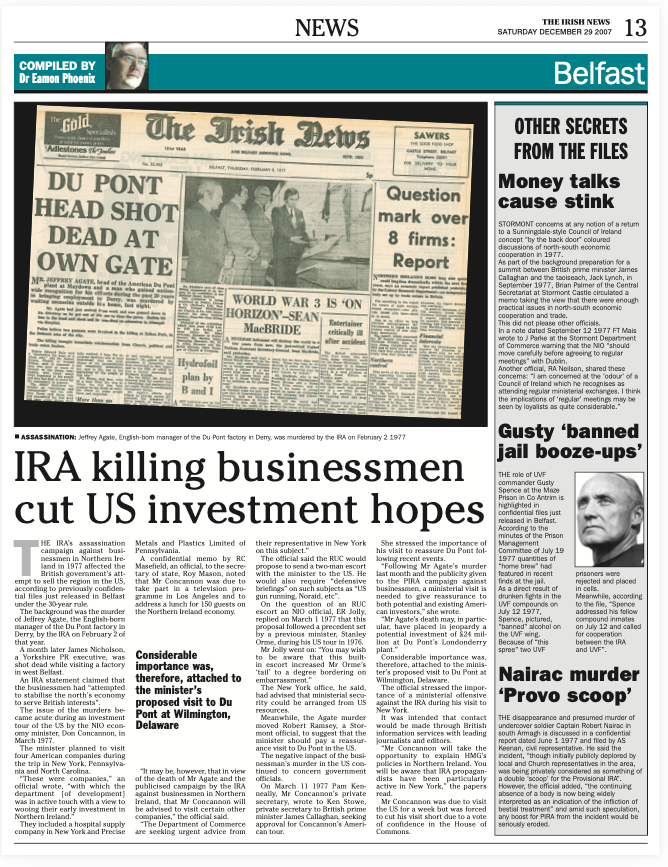
IRA killing businessmen cut US investment hopes
The IRA’s assassination campaign against businessmen in Northern Ireland in 1977 affected the British government’s attempt to sell the region in the US, according to previously confidential files just released in Belfast under the 30-year rule.
The background was the murder of Jeffrey Agate, the English-born manager of the Du Pont factory in Derry, by the IRA on February 2 of that year.
A month later James Nicholson, a Yorkshire PR executive, was shot dead while visiting a factory in west Belfast.
An IRA statement claimed that the businessmen had “attempted to stabilise the north’s economy to serve British interests”.
The issue of the murders became acute during an investment tour of the US by the NIO economy minister, Don Concannon, in March 1977.
The minister planned to visit four American companies during the trip in New York, Pennsylvania and North Carolina.
“These were companies,” an official wrote, “with which the department [of development] was in active touch with a view to wooing their early investment in Northern Ireland.”
They included a hospital supply company in New York and Precise Metals and Plastics Limited of Pennsylvania.
A confidential memo by RC Masefield, an official, to the secretary of state, Roy Mason, noted that Mr Concannon was due to take part in a television programme in Los Angeles and to address a lunch for 150 guests on the Northern Ireland economy.
“It may be, however, that in view of the death of Mr Agate and the publicised campaign by the IRA against businessmen in Northern Ireland, that Mr Concannon will be advised to visit certain other companies,” the official said.
“The Department of Commerce are seeking urgent advice from their representative in New York on this subject.”
The official said the RUC would propose to send a two-man escort with the minister to the US. He would also require “defensive briefings” on such subjects as “US gun running, Noraid, etc”.
On the question of an RUC escort an NIO official, ER Jolly, replied on March 1 1977 that this proposal followed a precedent set by a previous minister, Stanley Orme, during his US tour in 1976.
Mr Jolly went on: “You may wish to be aware that this built-in escort increased Mr Orme’s ‘tail’ to a degree bordering on embarrassment.”
The New York office, he said, had advised that ministerial security could be arranged from US resources.
Meanwhile, the Agate murder moved Robert Ramsey, a Stormont official, to suggest that the minister should pay a reassurance visit to Du Pont in the US.
The negative impact of the businessman’s murder in the US continued to concern government officials.
On March 11 1977 Pam Kenneally, Mr Concannon’s private secretary, wrote to Ken Stowe, private secretary to British prime minister James Callaghan, seeking approval for Concannon’s American tour.
She stressed the importance of his visit to reassure Du Pont following recent events.
“Following Mr Agate’s murder last month and the publicity given to the PIRA campaign against businessmen, a ministerial visit is needed to give reassurance to both potential and existing American investors,” she wrote.
“Mr Agate’s death may, in particular, have placed in jeopardy a potential investment of £24 million at Du Pont’s Londonderry plant.”
Considerable importance was, therefore, attached to the minister’s proposed visit to Du Pont at Wilmington, Delaware.
The official stressed the importance of a ministerial offensive against the IRA during his visit to New York.
It was intended that contact would be made through British information services with leading journalists and editors.
“Mr Concannon will take the opportunity to explain HMG’s policies in Northern Ireland. You will be aware that IRA propagandists have been particularly active in New York,” the papers read.
Mr Concannon was due to visit the US for a week but was forced to cut his visit short due to a vote of confidence in the House of Commons.
Nairac murder ‘Provo scoop’
The disappearance and presumed murder of undercover soldier Captain Robert Nairac in south Armagh is discussed in a confidential report dated June 1 1977 and filed by AS Keenan, civil representative.
He said the incident, “though initially publicly deplored by local and Church representatives in the area, was being privately considered as something of a double ‘scoop’ for the Provisional IRA”.
However, the official added, “the continuing absence of a body is now being widely interpreted as an indication of the infliction of bestial treatment” and amid such speculation, any boost for PIRA from the incident would be seriously eroded.
Gusty ‘banned jail booze-ups’
The role of UVF commander Gusty Spence at the Maze Prison in Co Antrim is highlighted in confidential files just released in Belfast. According to the minutes of the Prison Management Committee of July 19 1977 quantities of “home brew” had featured in recent finds at the jail.
As a direct result of drunken fights in the UVF compounds on July 12 1977, Spence “banned” alcohol on the UVF wing. Because of “this spree” two UVF prisoners were rejected and placed in cells. Meanwhile, according to the file, “Spence addressed his fellow compound inmates on July 12 and called for cooperation between the IRA and UVF”.
Money talks cause stink
Stormont concerns at any notion of a return to a Sunningdale-style Council of Ireland concept “by the back door” coloured discussions of north-south economic cooperation in 1977.
As part of the background preparation for a summit between British prime minister James Callaghan and the taoiseach, Jack Lynch, in September 1977, Brian Palmer of the Central Secretariat at Stormont Castle circulated a memo taking the view that there were enough practical issues in north-south economic cooperation and trade.
This did not please other officials. In a note dated September 12 1977 FT Mais wrote to J Parke at the Stormont Department of Commerce warning that the NIO “should move carefully before agreeing to regular meetings” with Dublin.
Another official, RA Neilson, shared these concerns: “I am concerned at the ‘odour’ of a Council of Ireland which he recognises as attending regular ministerial exchanges. I think the implications of ‘regular’ meetings may be seen by loyalists as quite considerable.”