

1977 State Papers (page 5)
December 29 2007
Publication Date
Churchmen met peer to oppose integrated schools, Paisley ‘galloped to aid of besieged community’, Secretary of State wanted good image of direct rule
State Paper Snippet
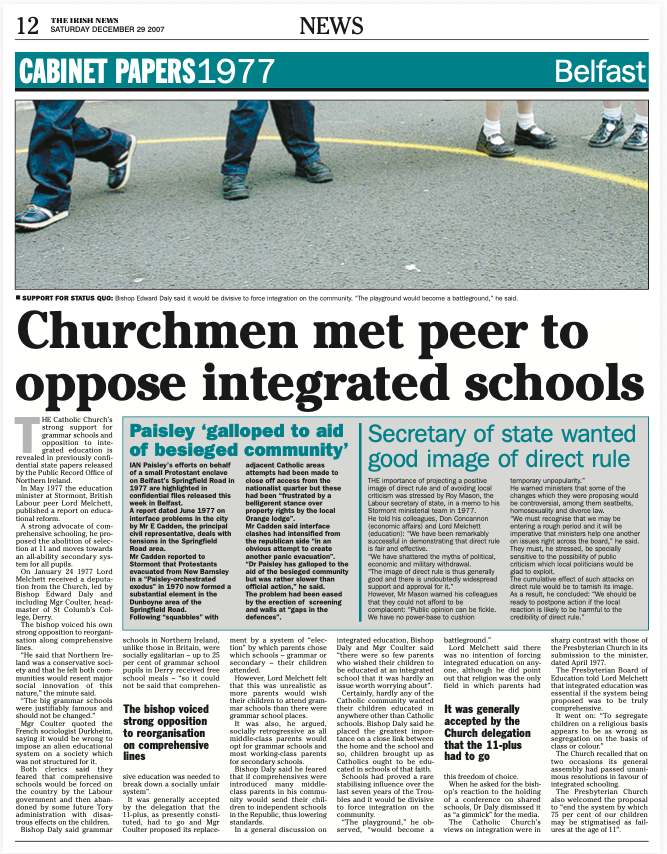
Churchmen met peer to oppose integrated schools
The Catholic Church’s strong support for grammar schools and opposition to integrated education is revealed in previously confidential state papers released by the Public Record Office of Northern Ireland.
In May 1977 the education minister at Stormont, British Labour peer Lord Melchett, published a report on educational reform.
A strong advocate of comprehensive schooling, he proposed the abolition of selection at 11 and moves towards an all-ability secondary system for all pupils.
On January 24 1977 Lord Melchett received a deputation from the Church, led by Bishop Edward Daly and including Mgr Coulter, headmaster of St Columb’s College, Derry.
The bishop voiced his own strong opposition to reorganisation along comprehensive lines.
“He said that Northern Ireland was a conservative society and that he felt both communities would resent major social innovation of this nature,” the minute said.
“The big grammar schools were justifiably famous and should not be changed.”
Mgr Coulter quoted the French sociologist Durkheim, saying it would be wrong to impose an alien educational system on a society which was not structured for it.
Both clerics said they feared that comprehensive schools would be forced on the country by the Labour government and then abandoned by some future Tory administration with disastrous effects on the children.
Bishop Daly said grammar schools in Northern Ireland, unlike those in Britain, were socially egalitarian – up to 25 per cent of grammar school pupils in Derry received free school meals – “so it could not be said that comprehensive education was needed to break down a socially unfair system”.
It was generally accepted by the delegation that the 11-plus, as presently constituted, had to go and Mgr Coulter proposed its replacement by a system of “election” by which parents chose which schools – grammar or secondary – their children attended.
However, Lord Melchett felt that this was unrealistic as more parents would wish their children to attend grammar schools than there were grammar school places.
It was also, he argued, socially retrogressive as all middle-class parents would opt for grammar schools and most working-class parents for secondary schools.
Bishop Daly said he feared that if comprehensives were introduced many middle-class parents in his community would send their children to independent schools in the Republic, thus lowering standards.
In a general discussion on integrated education, Bishop Daly and Mgr Coulter said “there were so few parents who wished their children to be educated at an integrated school that it was hardly an issue worth worrying about”.
Certainly, hardly any of the Catholic community wanted their children educated in anywhere other than Catholic schools. Bishop Daly said he placed the greatest importance on a close link between the home and the school and so, children brought up as Catholics ought to be educated in schools of that faith.
Schools had proved a rare stabilising influence over the last seven years of the Troubles and it would be divisive to force integration on the community.
“The playground,” he observed, “would become a battleground.”
Lord Melchett said there was no intention of forcing integrated education on anyone, although he did point out that religion was the only field in which parents had this freedom of choice.
When he asked for the bishop’s reaction to the holding of a conference on shared schools, Dr Daly dismissed it as “a gimmick” for the media.
The Catholic Church’s views on integration were in sharp contrast with those of the Presbyterian Church in its submission to the minister, dated April 1977.
The Presbyterian Board of Education told Lord Melchett that integrated education was essential if the system being proposed was to be truly comprehensive.
It went on: “To segregate children on a religious basis appears to be as wrong as segregation on the basis of class or colour.”
The Church recalled that on two occasions its general assembly had passed unanimous resolutions in favour of integrated schooling.
The Presbyterian Church also welcomed the proposal to “end the system by which 75 per cent of our children may be stigmatised as failures at the age of 11”.
Paisley ‘galloped to aid of besieged community’
Ian Paisley’s efforts on behalf of a small Protestant enclave on Belfast’s Springfield Road in 1977 are highlighted in confidential files released this week in Belfast.
A report dated June 1977 on interface problems in the city by Mr E Cadden, the principal civil representative, deals with tensions in the Springfield Road area.
Mr Cadden reported to Stormont that Protestants evacuated from New Barnsley in a “Paisley-orchestrated exodus” in 1970 now formed a substantial element in the Dunboyne area of the Springfield Road.
Following “squabbles” with adjacent Catholic areas attempts had been made to close off access from the nationalist quarter but these had been “frustrated by a belligerent stance over property rights by the local Orange lodge”.
Mr Cadden said interface clashes had intensified from the republican side “in an obvious attempt to create another panic evacuation”.
“Dr Paisley has galloped to the aid of the besieged community but was rather slower than official action,” he said.
The problem had been eased by the erection of screening and walls at “gaps in the defences”.
Secretary of State wanted good image of direct rule
The importance of projecting a positive image of direct rule and of avoiding local criticism was stressed by Roy Mason, the Labour secretary of state, in a memo to his Stormont ministerial team in 1977.
He told his colleagues, Don Concannon (economic affairs) and Lord Melchett (education): “We have been remarkably successful in demonstrating that direct rule is fair and effective.
“We have shattered the myths of political, economic and military withdrawal. The image of direct rule is thus generally good and there is undoubtedly widespread support and approval for it.”
However, Mr Mason warned his colleagues that they could not afford to be complacent: “Public opinion can be fickle. We have no power-base to cushion temporary unpopularity.”
He warned ministers that some of the changes which they were proposing would be controversial, among them seatbelts, homosexuality and divorce law.
“We must recognise that we may be entering a rough period and it will be imperative that ministers help one another on issues right across the board,” he said.
They must, he stressed, be specially sensitive to the possibility of public criticism which local politicians would be glad to exploit.
The cumulative effect of such attacks on direct rule would be to tarnish its image.
As a result, he concluded: “We should be ready to postpone action if the local reaction is likely to be harmful to the credibility of direct rule.”