

1976 State Papers (page 8)
December 30 2006
Publication Date
Civil Rights march was banned after loyalist made threats in ’69, RUC rejected claims that it led marchers into an ambush at Burntollet in 1969
State Paper Snippet
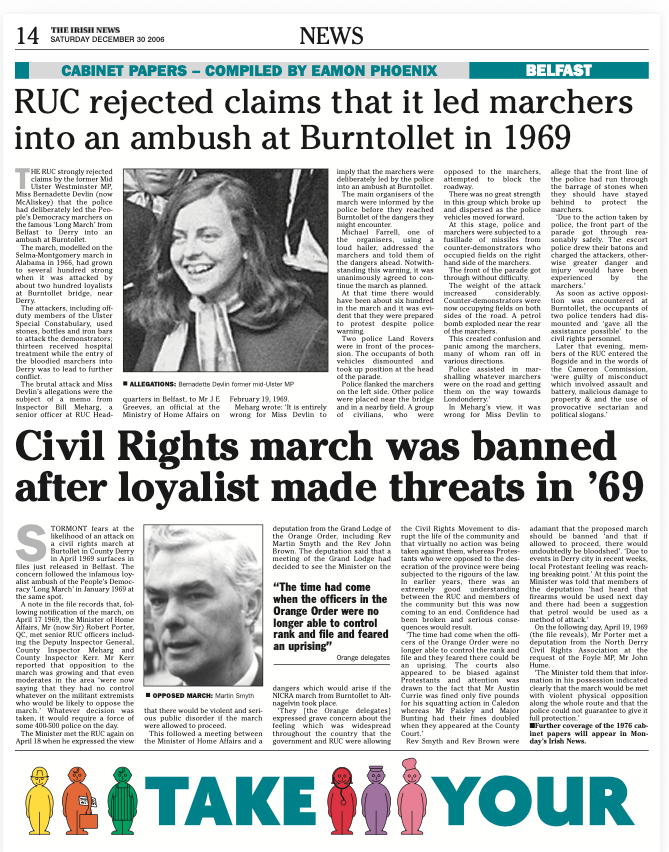
Civil Rights march was banned after loyalist made threats in ’69
Civil Rights march was banned after loyalist made threats in ’69
Stormont fears at the likelihood of an attack on a civil rights march at Burtollet in County Derry in April 1969 surfaces in files just released in Belfast. The concern followed the infamous loyalist ambush of the People’s Democracy ‘Long March’ in January 1969 at the same spot.
A note in the file records that, following notification of the march, on April 17 1969, the Minister of Home Affairs, Mr (now Sir) Robert Porter, QC, met senior RUC officers including the Deputy Inspector General, County Inspector Meharg and County Inspector Kerr. Mr Kerr reported that opposition to the march was growing and that even moderates in the area ‘were now saying that they had no control whatever on the militant extremists who would be likely to oppose the march.’ Whatever decision was taken, it would require a force of some 400-500 police on the day.
The Minister met the RUC again on April 18 when he expressed the view that there would be violent and serious public disorder if the march were allowed to proceed.
This followed a meeting between the Minister of Home Affairs and a deputation from the Grand Lodge of the Orange Order, including Rev Martin Smyth and the Rev John Brown. The deputation said that a meeting of the Grand Lodge had decided to see the Minister on the dangers which would arise if the NICRA march from Burntollet to Altnagelvin took place.
‘They [the Orange delegates] expressed grave concern about the feeling which was widespread throughout the country that the government and RUC were allowing the Civil Rights Movement to disrupt the life of the community and that virtually no action was being taken against them, whereas Protestants who were opposed to the desecration of the province were being subjected to the rigours of the law. In earlier years, there was an extremely good understanding between the RUC and members of the community but this was now coming to an end. Confidence had been broken and serious consequences would result.
‘The time had come when the officers of the Orange Order were no longer able to control the rank and file and they feared there could be an uprising. The courts also appeared to be biased against Protestants and attention was drawn to the fact that Mr Austin Currie was fined only five pounds for his squatting action in Caledon whereas Mr Paisley and Major Bunting had their fines doubled when they appeared at the County Court.’
Rev Smyth and Rev Brown were adamant that the proposed march should be banned ‘and that if allowed to proceed, there would undoubtedly be bloodshed’. ‘Due to events in Derry city in recent weeks, local Protestant feeling was reaching breaking point.’ At this point the Minister was told that members of the deputation ‘had heard that firearms would be used next day and there had been a suggestion that petrol would be used as a method of attack.’
On the following day, April 19, 1969 (the file reveals), Mr Porter met a deputation from the North Derry Civil Rights Association at the request of the Foyle MP, Mr John Hume.
‘The Minister told them that information in his possession indicated clearly that the march would be met with violent physical opposition along the whole route and that the police could not guarantee to give it full protection.’
RUC rejected claims that it led marchers into an ambush at Burntollet in 1969
The RUC strongly rejected claims by the former Mid Ulster Westminster MP, Miss Bernadette Devlin (now McAliskey) that the police had deliberately led the People’s Democracy marchers on the famous ‘Long March’ from Belfast to Derry into an ambush at Burntollet.
The march, modelled on the Selma-Montgomery march in Alabama in 1966, had grown to several hundred strong when it was attacked by about two hundred loyalists at Burntollet bridge, near Derry.
The attackers, including off-duty members of the Ulster Special Constabulary, used stones, bottles and iron bars to attack the demonstrators; thirteen received hospital treatment while the entry of the bloodied marchers into Derry was to lead to further conflict.
The brutal attack and Miss Devlin’s allegations were the subject of a memo from Inspector Bill Meharg, a senior officer at RUC Headquarters in Belfast, to Mr J E Greeves, an official at the Ministry of Home Affairs on February 19, 1969.
Meharg wrote: ‘It is entirely wrong for Miss Devlin to imply that the marchers were deliberately led by the police into an ambush at Burntollet. The main organisers of the march were informed by the police before they reached Burntollet of the dangers they might encounter.
‘Michael Farrell, one of the organisers, using a loud hailer, addressed the marchers and told them of the dangers ahead. Notwithstanding this warning, it was unanimously agreed to continue the march as planned.
‘At that time there would have been about six hundred in the march and it was evident that they were prepared to protest despite police warning.
‘Two police Land Rovers were in front of the procession. The occupants of both vehicles dismounted and took up position at the head of the parade.
‘Police flanked the marchers on the left side. Other police were placed near the bridge and in a nearby field. A group of civilians, who were opposed to the marchers, attempted to block the roadway.
‘There was no great strength in this group which broke up and dispersed as the police vehicles moved forward.
‘At this stage, police and marchers were subjected to a fusillade of missiles from counter-demonstrators who occupied fields on the right hand side of the marchers.
‘The front of the parade got through without difficulty.
‘The weight of the attack increased considerably. Counter-demonstrators were now occupying fields on both sides of the road. A petrol bomb exploded near the rear of the marchers.
‘This created confusion and panic among the marchers, many of whom ran off in various directions.
‘Police assisted in marshalling whatever marchers were on the road and getting them on the way towards Londonderry.’
In Meharg’s view, it was wrong for Miss Devlin to allege that the front line of the police had run through the barrage of stones when they should have stayed behind to protect the marchers.
‘Due to the action taken by police, the front part of the parade got through reasonably safely. The escort police drew their batons and charged the attackers, otherwise greater danger and injury would have been experienced by the marchers.’
As soon as active opposition was encountered at Burntollet, the occupants of two police tenders had dismounted and ‘gave all the assistance possible’ to the civil rights personnel.
Later that evening, members of the RUC entered the Bogside and in the words of the Cameron Commission, ‘were guilty of misconduct which involved assault and battery, malicious damage to property and the use of provocative sectarian and political slogans.’