

1976 State Papers (page 4)
December 29 2006
Publication Date
Ambassador’s murder rocked government, Hunger striker’s death provoked firm response, Irish soldier harassed in Belfast, Bruton backed Dublin Orange Order exhibition, Troubles cost south €152m
State Paper Snippet
Ambassador’s murder rocked government
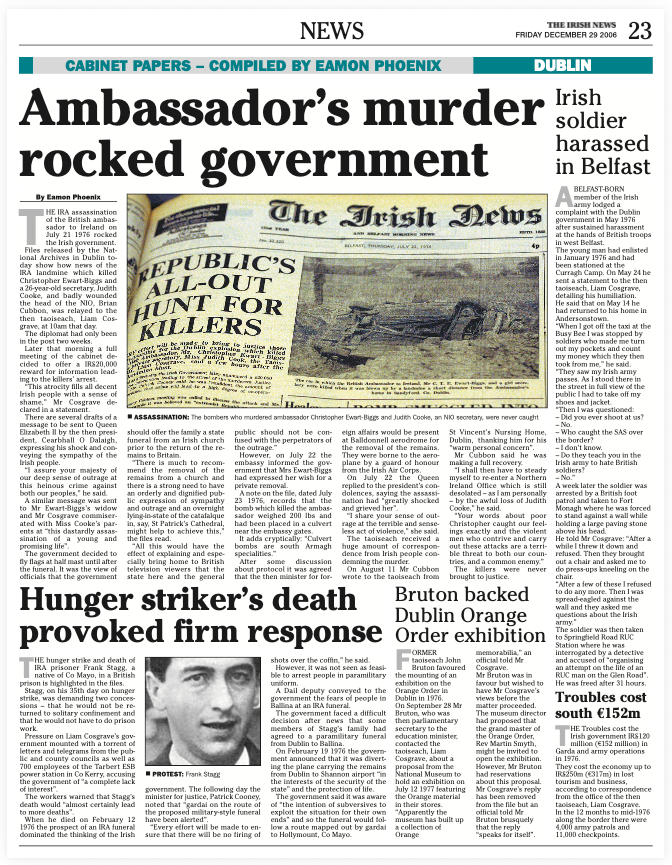
The IRA assassination of the British ambassador to Ireland on July 21 1976 rocked the Irish government.
Files released by the National Archives in Dublin today show how news of the IRA landmine which killed Christopher Ewart-Biggs and a 26-year-old secretary, Judith Cooke, and badly wounded the head of the NIO, Brian Cubbon, was relayed to the then taoiseach, Liam Cosgrave, at 10am that day.
The diplomat had only been in the post two weeks.
Later that morning a full meeting of the cabinet decided to offer a IR£20,000 reward for information leading to the killers’ arrest.
“This atrocity fills all decent Irish people with a sense of shame,” Mr Cosgrave declared in a statement.
There are several drafts of a message to be sent to Queen Elizabeth II by the then president, Cearbhall O Dalaigh, expressing his shock and conveying the sympathy of the Irish people.
“I assure your majesty of our deep sense of outrage at this heinous crime against both our peoples,” he said.
A similar message was sent to Mr Ewart-Biggs’s widow and Mr Cosgrave commiserated with Miss Cooke’s parents at “this dastardly assassination of a young and promising life”.
The government decided to fly flags at half mast until after the funeral. It was the view of officials that the government should offer the family a state funeral from an Irish church prior to the return of the remains to Britain.
“There is much to recommend the removal of the remains from a church and there is a strong need to have an orderly and dignified public expression of sympathy and outrage and an overnight lying-in-state of the catafalque in, say, St Patrick’s Cathedral, might help to achieve this,” the files read.
“All this would have the effect of explaining and especially bring home to British television viewers that the state here and the general public should not be confused with the perpetrators of the outrage.”
However, on July 22 the embassy informed the government that Mrs Ewart-Biggs had expressed her wish for a private removal.
A note on the file, dated July 23 1976, records that the bomb which killed the ambassador weighed 200 lbs and had been placed in a culvert near the embassy gates.
It adds cryptically: “Culvert bombs are south Armagh specialities.”
After some discussion about protocol it was agreed that the then minister for foreign affairs would be present at Balldonnell aerodrome for the removal of the remains. They were borne to the aeroplane by a guard of honour from the Irish Air Corps.
On July 22 the Queen replied to the president’s condolences, saying the assassination had “greatly shocked and grieved her”.
“I share your sense of outrage at the terrible and senseless act of violence,” she said.
The taoiseach received a huge amount of correspondence from Irish people condemning the murder.
On August 11 Mr Cubbon wrote to the taoiseach from St Vincent’s Nursing Home, Dublin, thanking him for his “warm personal concern”.
Mr Cubbon said he was making a full recovery.
“I shall then have to steady myself to re-enter a Northern Ireland Office which is still desolated – as I am personally – by the awful loss of Judith Cooke,” he said.
“Your words about poor Christopher caught our feelings exactly and the violent men who contrive and carry out these attacks are a terrible threat to both our countries, and a common enemy.”
The killers were never brought to justice.
Hunger striker’s death provoked firm response
The hunger strike and death of IRA prisoner Frank Stagg, a native of Co Mayo, in a British prison is highlighted in the files. Stagg, on his 35th day on hunger strike, was demanding two concessions – that he would not be returned to solitary confinement and that he would not have to do prison work.
Pressure on Liam Cosgrave’s government mounted with a torrent of letters and telegrams from the public and county councils as well as 700 employees of the Tarbert ESB power station in Co Kerry, accusing the government of “a complete lack of interest”.
The workers warned that Stagg’s death would “almost certainly lead to more deaths”.
When he died on February 12 1976 the prospect of an IRA funeral dominated the thinking of the Irish government. The following day the minister for justice, Patrick Cooney, noted that “gardai on the route of the proposed military-style funeral have been alerted”.
“Every effort will be made to ensure that there will be no firing of shots over the coffin,” he said. However, it was not seen as feasible to arrest people in paramilitary uniform.
A Dail deputy conveyed to the government the fears of people in Ballina at an IRA funeral.
The government faced a difficult decision after news that some members of Stagg’s family had agreed to a paramilitary funeral from Dublin to Ballina.
On February 19 1976 the government announced that it was diverting the plane carrying the remains from Dublin to Shannon airport “in the interests of the security of the state” and the protection of life.
The government said it was aware of “the intention of subversives to exploit the situation for their own ends” and so the funeral would follow a route mapped out by gardai to Hollymount, Co Mayo.
Irish soldier harassed in Belfast
A Belfast-born member of the Irish army lodged a complaint with the Dublin government in May 1976 after sustained harassment at the hands of British troops in west Belfast.
The young man had enlisted in January 1976 and had been stationed at the Curragh Camp. On May 24 he sent a statement to the then taoiseach, Liam Cosgrave, detailing his humiliation.
He said that on May 14 he had returned to his home in Andersonstown.
“When I got off the taxi at the Busy Bee I was stopped by soldiers who made me turn out my pockets and count my money which they then took from me,” he said. “They saw my Irish army passes. As I stood there in the street in full view of the public I had to take off my shoes and jacket.
“Then I was questioned: – Did you ever shoot at us? – No. – Who caught the SAS over the border? – I don’t know. – Do they teach you in the Irish army to hate British soldiers? – No.”
A week later the soldier was arrested by a British foot patrol and taken to Fort Monagh where he was forced to stand against a wall while holding a large paving stone above his head.
He told Mr Cosgrave: “After a while I threw it down and refused. Then they brought out a chair and asked me to do press-ups kneeling on the chair.
“After a few of these I refused to do any more. Then I was spread-eagled against the wall and they asked me questions about the Irish army.”
The soldier was then taken to Springfield Road RUC Station where he was interrogated by a detective and accused of “organising an attempt on the life of an RUC man on the Glen Road”. He was freed after 31 hours.
Bruton backed Dublin Orange Order exhibition
Former taoiseach John Bruton favoured the mounting of an exhibition on the Orange Order in Dublin in 1976. On September 28 Mr Bruton, who was then parliamentary secretary to the education minister, contacted the taoiseach, Liam Cosgrave, about a proposal from the National Museum to hold an exhibition on July 12 1977 featuring the Orange material in their stores.
“Apparently the museum has built up a collection of Orange memorabilia,” an official told Mr Cosgrave.
Mr Bruton was in favour but wished to have Mr Cosgrave’s views before the matter proceeded. The museum director had proposed that the grand master of the Orange Order, Rev Martin Smyth, might be invited to open the exhibition.
However, Mr Bruton had reservations about this proposal. Mr Cosgrave’s reply has been removed from the file but an official told Mr Bruton brusquely that the reply “speaks for itself”.
Troubles cost south €152m
The Troubles cost the Irish government IR£120 million (€152 million) in Garda and army operations in 1976. They cost the economy up to IR£250m (€317m) in lost tourism and business, according to correspondence from the office of the then taoiseach, Liam Cosgrave.
In the 12 months to mid-1976 along the border there were 4,000 army patrols and 11,000 checkpoints.