

1976 State Papers (page 3)
December 29 2006
Publication Date
Empey warned Rees: British must back us, Cardinal ‘intransigent’ on integrated schools, Areas with chronic problems analysed
State Paper Snippet
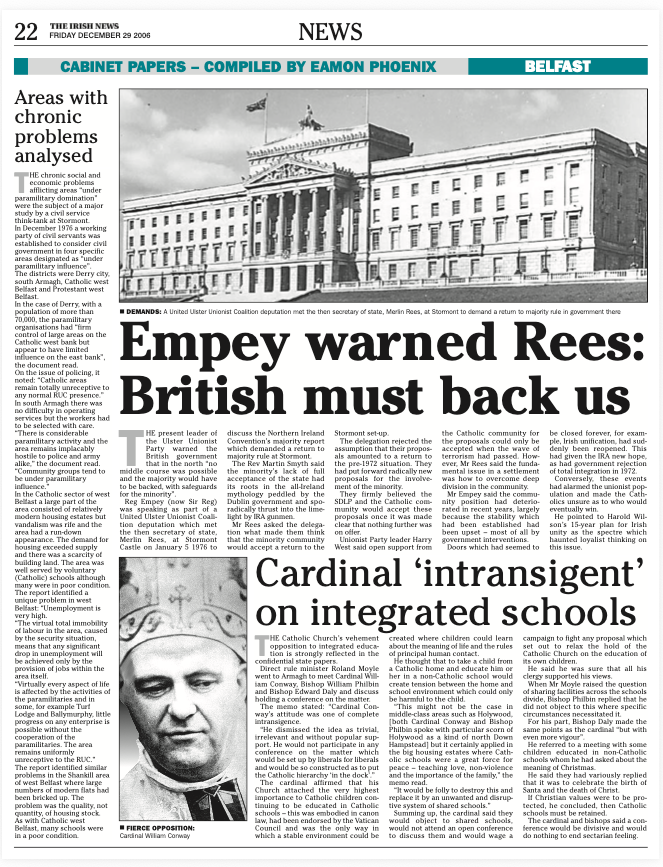
Empey warned Rees: British must back us
The present leader of the Ulster Unionist Party warned the British government that in the north “no middle course was possible and the majority would have to be backed, with safeguards for the minority”.
Reg Empey (now Sir Reg) was speaking as part of a United Ulster Unionist Coalition deputation which met the then secretary of state, Merlin Rees, at Stormont Castle on January 5 1976 to discuss the Northern Ireland Convention’s majority report which demanded a return to majority rule at Stormont.
The Rev Martin Smyth said the minority’s lack of full acceptance of the state had its roots in the all-Ireland mythology peddled by the Dublin government and sporadically thrust into the limelight by IRA gunmen.
Mr Rees asked the delegation what made them think that the minority community would accept a return to the Stormont set-up.
The delegation rejected the assumption that their proposals amounted to a return to the pre-1972 situation. They had put forward radically new proposals for the involvement of the minority.
They firmly believed the SDLP and the Catholic community would accept these proposals once it was made clear that nothing further was on offer.
Unionist Party leader Harry West said open support from the Catholic community for the proposals could only be accepted when the wave of terrorism had passed. However, Mr Rees said the fundamental issue in a settlement was how to overcome deep division in the community.
Mr Empey said the community position had deteriorated in recent years, largely because the stability which had been established had been upset – most of all by government interventions.
Doors which had seemed to be closed forever, for example, Irish unification, had suddenly been reopened. This had given the IRA new hope, as had government rejection of total integration in 1972.
Conversely, these events had alarmed the unionist population and made the Catholics unsure as to who would eventually win.
He pointed to Harold Wilson’s 15-year plan for Irish unity as the spectre which haunted loyalist thinking on this issue.
Cardinal ‘intransigent’ on integrated schools
The Catholic Church’s vehement opposition to integrated education is strongly reflected in the confidential state papers.
Direct rule minister Roland Moyle went to Armagh to meet Cardinal William Conway, Bishop William Philbin and Bishop Edward Daly and discuss holding a conference on the matter.
The memo stated: “Cardinal Conway’s attitude was one of complete intransigence. He dismissed the idea as trivial, irrelevant and without popular support. He would not participate in any conference on the matter which would be set up by liberals for liberals and would be so constructed as to put the Catholic hierarchy ‘in the dock’.”
The cardinal affirmed that his Church attached the very highest importance to Catholic children continuing to be educated in Catholic schools – this was embodied in canon law, had been endorsed by the Vatican Council and was the only way in which a stable environment could be created where children could learn about the meaning of life and the rules of principal human contact.
He thought that to take a child from a Catholic home and educate him or her in a non-Catholic school would create tension between the home and school environment which could only be harmful to the child.
“This might not be the case in middle-class areas such as Holywood, [both Cardinal Conway and Bishop Philbin spoke with particular scorn of Holywood as a kind of north Down Hampstead] but it certainly applied in the big housing estates where Catholic schools were a great force for peace – teaching love, non-violence and the importance of the family,” the memo read.
“It would be folly to destroy this and replace it by an unwanted and disruptive system of shared schools.”
Summing up, the cardinal said they would object to shared schools, would not attend an open conference to discuss them and would wage a campaign to fight any proposal which set out to relax the hold of the Catholic Church on the education of its own children. He said he was sure that all his clergy supported his views.
When Mr Moyle raised the question of sharing facilities across the schools divide, Bishop Philbin replied that he did not object to this where specific circumstances necessitated it.
For his part, Bishop Daly made the same points as the cardinal “but with even more vigour”. He referred to a meeting with some children educated in non-Catholic schools whom he had asked about the meaning of Christmas. He said they had variously replied that it was to celebrate the birth of Santa and the death of Christ.
If Christian values were to be protected, he concluded, then Catholic schools must be retained.
The cardinal and bishops said a conference would be divisive and would do nothing to end sectarian feeling.
Areas with chronic problems analysed
The chronic social and economic problems afflicting areas “under paramilitary domination” were the subject of a major study by a civil service think-tank at Stormont.
In December 1976 a working party of civil servants was established to consider civil government in four specific areas designated as “under paramilitary influence”. The districts were Derry city, south Armagh, Catholic west Belfast and Protestant west Belfast.
In the case of Derry, with a population of more than 70,000, the paramilitary organisations had “firm control of large areas on the Catholic west bank but appear to have limited influence on the east bank”, the document read. On the issue of policing, it noted: “Catholic areas remain totally unreceptive to any normal RUC presence.”
In south Armagh there was no difficulty in operating services but the workers had to be selected with care. “There is considerable paramilitary activity and the area remains implacably hostile to police and army alike,” the document read. “Community groups tend to be under paramilitary influence.”
In the Catholic sector of west Belfast a large part of the area consisted of relatively modern housing estates but vandalism was rife and the area had a run-down appearance. The demand for housing exceeded supply and there was a scarcity of building land. The area was well served by voluntary (Catholic) schools although many were in poor condition.
The report identified a unique problem in west Belfast: “Unemployment is very high. The virtual total immobility of labour in the area, caused by the security situation, means that any significant drop in unemployment will be achieved only by the provision of jobs within the area itself.
“Virtually every aspect of life is affected by the activities of the paramilitaries and in some, for example Turf Lodge and Ballymurphy, little progress on any enterprise is possible without the cooperation of the paramilitaries. The area remains uniformly unreceptive to the RUC.”
The report identified similar problems in the Shankill area of west Belfast where large numbers of modern flats had been bricked up. The problem was the quality, not quantity, of housing stock. As with Catholic west Belfast, many schools were in a poor condition.