

1976 State Papers (page 2)
December 29 2006
Publication Date
Backlash expected as special status was abolished, IRA leadership faced problems, Churches fought for bias law exemption
State Paper Snippet
Backlash expected as special status was abolished
Stormont officials did not rule out the possibility of ‘violent resistance’ following the ending of special category status for paramilitary prisoners in March 1976.
Special status had been introduced in June 1972 by the then secretary of state, William Whitelaw, after a hunger strike in Belfast Prison.
However, the Gardiner Committee in 1975 had come out strongly against it, leading Merlin Rees, as secretary of state, to announce its phasing out from March 1 1976.
A memo on the issue was circulated to the members of the Policy Coordinating Committee at Stormont on March 10 1976.
This explained that special status sought to distinguish between “ordinary criminals” and those serving sentences due to the “disturbed political situation”.
The document went on: “The demand for some form of special recognition of politically motivated offenders has been a recurring theme of troubled times in Irish history.
“The classification of special category introduced in 1972 is a purely administrative arrangement; it is not in any sense a legal classification.
“It is available only for convicted prisoners serving sentences of nine months or more.
“Prisoners apply to the governor for special category. [He] seeks advice from the security forces as to whether the prisoner was associated with the paramilitary group of which he claims membership. On the basis of this advice a decision is taken.
“Refusal of applications is comparatively rare.”
There were three elements in special category status: “First, they are not required to do work; second, they can wear their own clothing; thirdly, they are allowed weekly letters at public expense and weekly visits and parcels which may include food and tobacco.”
The memo revealed that the population of special category prisoners had grown rapidly both in numbers and as a proportion of the total population of convicted prisoners. In 1973 there were 379 special category prisoners, representing about 42 per cent of the convicted prison population.
By the time of writing (March 1976), there were 1,498 special category prisoners, amounting to 68 per cent of the population. By this stage the proportion of loyalist prisoners in this category had steadily increased.
Fifteen per cent of the special category group had been sentenced for murder or violence against the person while firearms and explosives offences comprised another 56 per cent.
The memo acknowledged the existence of paramilitary control structures in the north’s jails.
“Inevitably, the compounds have thrown up their own leaders who may in some cases exert considerable power and influence over the man,” the files state.
“Special category is in effect a declaration of continued allegiance to paramilitary groups which organise or condone violent crimes.
“The paramilitary groups themselves seek to improve their standing by providing financial and moral support for their members in prison and their families.
“Community attitudes to crime and to prison are blurred when offenders can be represented as loyalist or republican prisoners of war. Special category is regarded as a badge of respectability, particularly among young prisoners.”
The result was that families felt that they could “hold up their heads” in the community if their son enjoyed special status.
Moreover, “special category status encourages prisoners, their organisations and families to hold firmly to the mistaken belief that one day they will be the subject of an amnesty”.
In a final paragraph, the document admitted that there would be “difficult times ahead”.
“And above all, we may expect resistance, possibly violent resistance, to the ending of new admissions to special category,” it read.
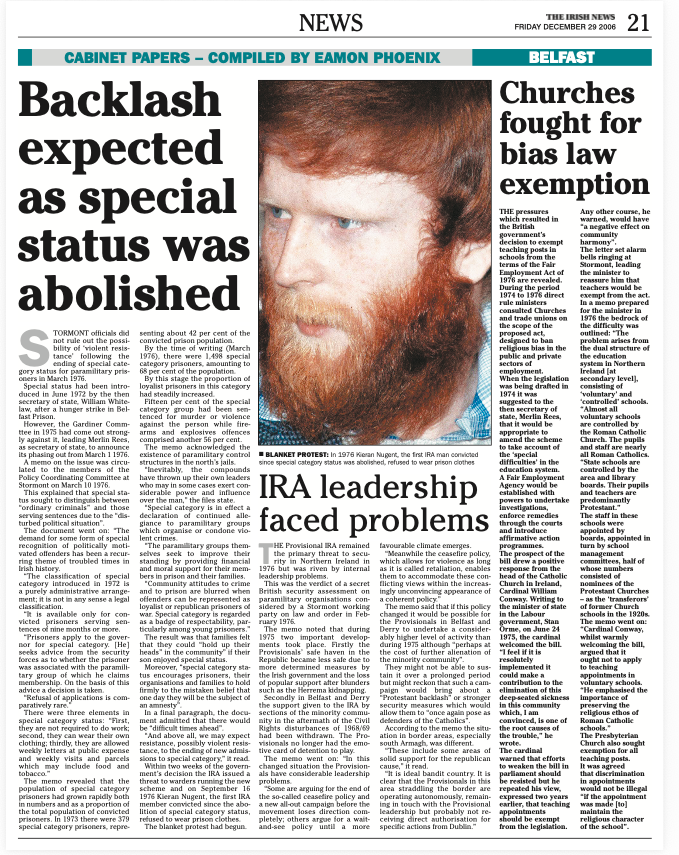
Within two weeks of the government’s decision the IRA issued a threat to warders running the new scheme and on September 16 1976 Kieran Nugent, the first IRA member convicted since the abolition of special category status, refused to wear prison clothes.
The blanket protest had begun.
IRA leadership faced problems
The Provisional IRA remained the primary threat to security in Northern Ireland in 1976 but was riven by internal leadership problems.
This was the verdict of a secret British security assessment on paramilitary organisations considered by a Stormont working party on law and order in February 1976.
The memo noted that during 1975 two important developments took place. Firstly the Provisionals’ safe haven in the Republic became less safe due to more determined measures by the Irish government and the loss of popular support after blunders such as the Herrema kidnapping.
Secondly in Belfast and Derry the support given to the IRA by sections of the minority community in the aftermath of the Civil Rights disturbances of 1968/69 had been withdrawn. The Provisionals no longer had the emotive card of detention to play.
The memo went on: “In this changed situation the Provisionals have considerable leadership problems.
“Some are arguing for the end of the so-called ceasefire policy and a new all-out campaign before the movement loses direction completely; others argue for a wait-and-see policy until a more favourable climate emerges.
“Meanwhile the ceasefire policy, which allows for violence as long as it is called retaliation, enables them to accommodate these conflicting views within the increasingly unconvincing appearance of a coherent policy.”
The memo said that if this policy changed it would be possible for the Provisionals in Belfast and Derry to undertake a considerably higher level of activity than during 1975 although “perhaps at the cost of further alienation of the minority community”.
They might not be able to sustain it over a prolonged period but might reckon that such a campaign would bring about a “Protestant backlash” or stronger security measures which would allow them to “once again pose as defenders of the Catholics”.
According to the memo the situation in border areas, especially south Armagh, was different.
“These include some areas of solid support for the republican cause,” it read.
“It is ideal bandit country. It is clear that the Provisionals in this area straddling the border are operating autonomously, remaining in touch with the Provisional leadership but probably not receiving direct authorisation for specific actions from Dublin.”
Churches fought for bias law exemption
The pressures which resulted in the British government’s decision to exempt teaching posts in schools from the terms of the Fair Employment Act of 1976 are revealed.
During the period 1974 to 1976 direct rule ministers consulted Churches and trade unions on the scope of the proposed act, designed to ban religious bias in the public and private sectors of employment.
When the legislation was being drafted in 1974 it was suggested to the then secretary of state, Merlin Rees, that it would be appropriate to amend the scheme to take account of the ‘special difficulties’ in the education system.
A Fair Employment Agency would be established with powers to undertake investigations, enforce remedies through the courts and introduce affirmative action programmes.
The prospect of the bill drew a positive response from the head of the Catholic Church in Ireland, Cardinal William Conway. Writing to the minister of state in the Labour government, Stan Orme, on June 24 1975, the cardinal welcomed the bill.
“I feel if it is resolutely implemented it could make a contribution to the elimination of this deep-seated sickness in this community which, I am convinced, is one of the root causes of the trouble,” he wrote.
The cardinal warned that efforts to weaken the bill in parliament should be resisted but he repeated his view, expressed two years earlier, that teaching appointments should be exempt from the legislation.
Any other course, he warned, would have “a negative effect on community harmony”.
The letter set alarm bells ringing at Stormont, leading the minister to reassure him that teachers would be exempt from the act.
In a memo prepared for the minister in 1976 the bedrock of the difficulty was outlined: “The problem arises from the dual structure of the education system in Northern Ireland [at secondary level], consisting of ‘voluntary’ and ‘controlled’ schools.
“Almost all voluntary schools are controlled by the Roman Catholic Church. The pupils and staff are nearly all Roman Catholics.
“State schools are controlled by the area and library boards. Their pupils and teachers are predominantly Protestant.
“The staff in these schools were appointed by boards, appointed in turn by school management committees, half of whose numbers consisted of nominees of the Protestant Churches – as the ‘transferors’ of former Church schools in the 1920s.
“The memo went on: ‘Cardinal Conway, whilst warmly welcoming the bill, argued that it ought not to apply to teaching appointments in voluntary schools. He emphasised the importance of preserving the religious ethos of Roman Catholic schools.’
“The Presbyterian Church also sought exemption for all teaching posts.
“It was agreed that discrimination in appointments would not be illegal ‘if the appointment was made [to] maintain the religious character of the school’.”