

1975 State Papers (page 10)
December 30 2005
Publication Date
Unionists feared secret deal between Britain and PIRA, Coalition plan revealed, Empey ‘could not agree’
State Paper Snippet
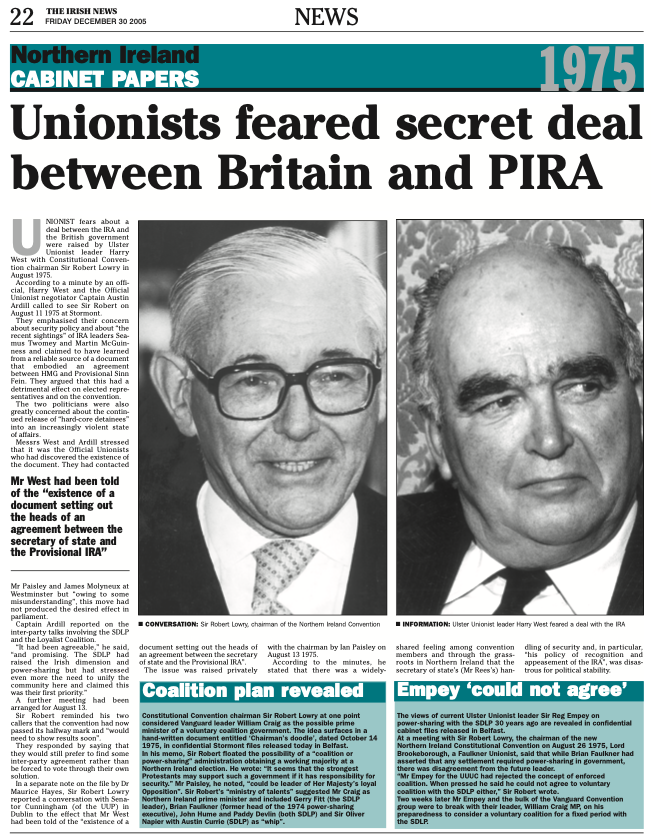
Unionists feared secret deal between Britain and PIRA
Unionist fears about a deal between the IRA and the British government were raised by Ulster Unionist leader Harry West with Constitutional Convention chairman Sir Robert Lowry in August 1975.
According to a minute by an official, Harry West and the Official Unionist negotiator Captain Austin Ardill called to see Sir Robert on August 11 1975 at Stormont.
They emphasised their concern about security policy and about “the recent sightings” of IRA leaders Seamus Twomey and Martin McGuinness and claimed to have learned from a reliable source of a document that embodied an agreement between HMG and Provisional Sinn Fein. They argued that this had a detrimental effect on elected representatives and on the convention.
The two politicians were also greatly concerned about the continued release of “hard-core detainees” into an increasingly violent state of affairs.
Messrs West and Ardill stressed that it was the Official Unionists who had discovered the existence of the document. They had contacted Mr Paisley and James Molyneux at Westminster but “owing to some misunderstanding”, this move had not produced the desired effect in parliament.
Captain Ardill reported on the inter-party talks involving the SDLP and the Loyalist Coalition.
“It had been agreeable,” he said, “and promising. The SDLP had raised the Irish dimension and power-sharing but had stressed even more the need to unify the community here and claimed this was their first priority.”
A further meeting had been arranged for August 13.
Sir Robert reminded his two callers that the convention had now passed its halfway mark and “would need to show results soon”.
They responded by saying that they would still prefer to find some inter-party agreement rather than be forced to vote through their own solution.
In a separate note on the file by Dr Maurice Hayes, Sir Robert Lowry reported a conversation with Senator Cunningham (of the UUP) in Dublin to the effect that Mr West had been told of the “existence of a document setting out the heads of an agreement between the secretary of state and the Provisional IRA”.
The issue was raised privately with the chairman by Ian Paisley on August 13 1975.
According to the minutes, he stated that there was a widely-shared feeling among convention members and through the grassroots in Northern Ireland that the secretary of state’s (Mr Rees’s) handling of security and, in particular, “his policy of recognition and appeasement of the IRA”, was disastrous for political stability.
Coalition plan revealed
Constitutional Convention chairman Sir Robert Lowry at one point considered Vanguard leader William Craig as the possible prime minister of a voluntary coalition government. The idea surfaces in a hand-written document entitled ‘Chairman’s doodle’, dated October 14 1975, in confidential Stormont files released today in Belfast.
In his memo, Sir Robert floated the possibility of a “coalition or power-sharing” administration obtaining a working majority at a Northern Ireland election. He wrote: “It seems that the strongest Protestants may support such a government if it has responsibility for security.” Mr Paisley, he noted, “could be leader of Her Majesty’s loyal Opposition”.
Sir Robert’s “ministry of talents” suggested Mr Craig as Northern Ireland prime minister and included Gerry Fitt (the SDLP leader), Brian Faulkner (former head of the 1974 power-sharing executive), John Hume and Paddy Devlin (both SDLP) and Sir Oliver Napier with Austin Currie (SDLP) as “whip”.
Empey ‘could not agree’
The views of current Ulster Unionist leader Sir Reg Empey on power-sharing with the SDLP 30 years ago are revealed in confidential cabinet files released in Belfast.
At a meeting with Sir Robert Lowry, the chairman of the new Northern Ireland Constitutional Convention on August 26 1975, Lord Brookeborough, a Faulkner Unionist, said that while Brian Faulkner had asserted that any settlement required power-sharing in government, there was disagreement from the future leader.
“Mr Empey for the UUUC had rejected the concept of enforced coalition. When pressed he said he could not agree to voluntary coalition with the SDLP either,” Sir Robert wrote.
Two weeks later Mr Empey and the bulk of the Vanguard Convention group were to break with their leader, William Craig MP, on his preparedness to consider a voluntary coalition for a fixed period with the SDLP.