

1975 State Papers (page 9)
December 30 2005
Publication Date
SDLP feared negotiations undermined convention, Election fails to yield an alternative to direct rule
State Paper Snippet
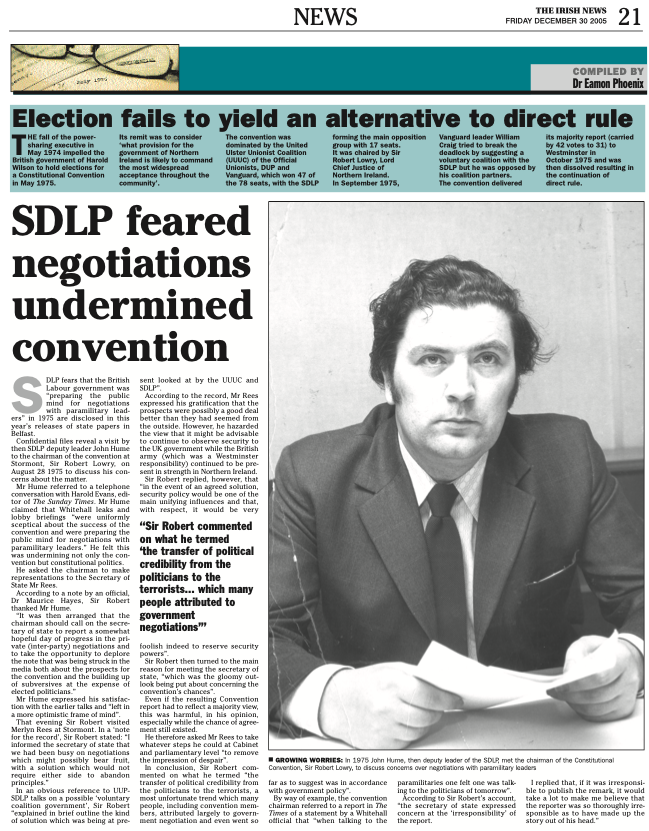
SDLP feared negotiations undermined convention
SDLP fears that the British Labour government was “preparing the public mind for negotiations with paramilitary leaders” in 1975 are disclosed in this year’s releases of state papers in Belfast.
Confidential files reveal a visit by then SDLP deputy leader John Hume to the chairman of the convention at Stormont, Sir Robert Lowry, on August 28 1975 to discuss his concerns about the matter.
Mr Hume referred to a telephone conversation with Harold Evans, editor of The Sunday Times. Mr Hume claimed that Whitehall leaks and lobby briefings “were uniformly sceptical about the success of the convention and were preparing the public mind for negotiations with paramilitary leaders”. He felt this was undermining not only the convention but constitutional politics.
He asked the chairman to make representations to the Secretary of State Mr Rees. According to a note by an official, Dr Maurice Hayes, Sir Robert thanked Mr Hume.
“It was then arranged that the chairman should call on the secretary of state to report a somewhat hopeful day of progress in the private (inter-party) negotiations and to take the opportunity to deplore the note that was being struck in the media both about the prospects for the convention and the building up of subversives at the expense of elected politicians.”
Mr Hume expressed his satisfaction with the earlier talks and “left in a more optimistic frame of mind”. That evening Sir Robert visited Merlyn Rees at Stormont. In a ‘note for the record’, Sir Robert stated: “I informed the secretary of state that we had been busy on negotiations which might possibly bear fruit, with a solution which would not require either side to abandon principles.”
In an obvious reference to UUP-SDLP talks on a possible ‘voluntary coalition government’, Sir Robert “explained in brief outline the kind of solution which was being at present looked at by the UUUC and SDLP”.
According to the record, Mr Rees expressed his gratification that the prospects were possibly a good deal better than they had seemed from the outside. However, he hazarded the view that it might be advisable to continue to observe security to the UK government while the British army (which was a Westminster responsibility) continued to be present in strength in Northern Ireland.
Sir Robert replied, however, that “in the event of an agreed solution, security policy would be one of the main unifying influences and that, with respect, it would be very foolish indeed to reserve security powers”. Sir Robert then turned to the main reason for meeting the secretary of state, “which was the gloomy outlook being put about concerning the convention’s chances”.
Even if the resulting convention report had to reflect a majority view, this was harmful, in his opinion, especially while the chance of agreement still existed. He therefore asked Mr Rees to take whatever steps he could at Cabinet and parliamentary level “to remove the impression of despair”.
In conclusion, Sir Robert commented on what he termed “the transfer of political credibility from the politicians to the terrorists, a most unfortunate trend which many people, including convention members, attributed largely to government negotiation and even went so far as to suggest was in accordance with government policy”.
By way of example, the convention chairman referred to a report in The Times of a statement by a Whitehall official that “when talking to the paramilitaries one felt one was talking to the politicians of tomorrow”.
According to Sir Robert’s account, “the secretary of state expressed concern at the ‘irresponsibility’ of the report. I replied that, if it was irresponsible to publish the remark, it would take a lot to make me believe that the reporter was so thoroughly irresponsible as to have made up the story out of his head.”
Election fails to yield an alternative to direct rule
The fall of the power-sharing executive in May 1974 impelled the British government of Harold Wilson to hold elections for a Constitutional Convention in May 1975.
Its remit was to consider ‘what provision for the government of Northern Ireland is likely to command the most widespread acceptance throughout the community’.
The convention was dominated by the United Ulster Unionist Coalition (UUUC) of the Official Unionists, DUP and Vanguard, which won 47 of the 78 seats, with the SDLP forming the main opposition group with 17 seats.
It was chaired by Sir Robert Lowry, Lord Chief Justice of Northern Ireland.
In September 1975, Vanguard leader William Craig tried to break the deadlock by suggesting a voluntary coalition with the SDLP but he was opposed by his coalition partners.
The convention delivered its majority report (carried by 42 votes to 31) to Westminster in October 1975 and was then dissolved resulting in the continuation of direct rule.