

1975 State Papers (page 7)
December 29 2005
Publication Date
Paisley and Powell wrecked hopes of voluntary coalition, Mountbatten’s offer to the nation rejected, Four per cent of RUC members Catholic
State Paper Snippet
Paisley and Powell wrecked hopes of voluntary coalition
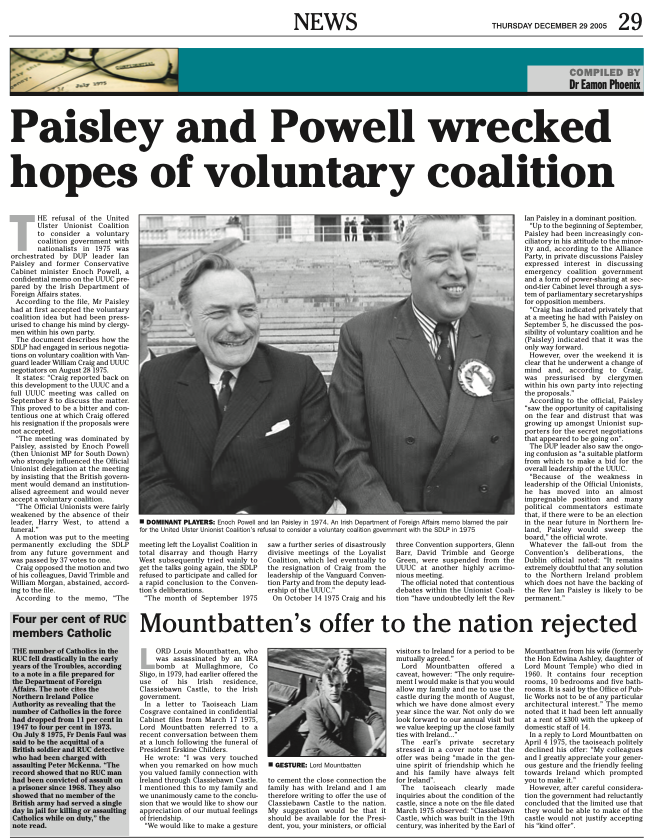
The refusal of the United Ulster Unionist Coalition to consider a voluntary coalition government with nationalists in 1975 was orchestrated by DUP leader Ian Paisley and former Conservative cabinet minister Enoch Powell, a confidential memo on the UUUC prepared by the Irish Department of Foreign Affairs states.
According to the file, Mr Paisley had at first accepted the voluntary coalition idea but had been pressurised to change his mind by clergymen within his own party.
The document describes how the SDLP had engaged in serious negotiations on voluntary coalition with Vanguard leader William Craig and UUUC negotiators on August 28 1975.
It states: “Craig reported back on this development to the UUUC and a full UUUC meeting was called on September 8 to discuss the matter. This proved to be a bitter and contentious one at which Craig offered his resignation if the proposals were not accepted.
“The meeting was dominated by Paisley, assisted by Enoch Powell (then Unionist MP for South Down) who strongly influenced the Official Unionist delegation at the meeting by insisting that the British government would demand an institutionalised agreement and would never accept a voluntary coalition.
“The Official Unionists were fairly weakened by the absence of their leader, Harry West, to attend a funeral.”
A motion was put to the meeting permanently excluding the SDLP from any future government and was passed by 37 votes to one.
Craig opposed the motion and two of his colleagues, David Trimble and William Morgan, abstained, according to the file.
According to the memo, “The meeting left the Loyalist Coalition in total disarray and though Harry West subsequently tried vainly to get the talks going again, the SDLP refused to participate and called for a rapid conclusion to the Convention’s deliberations.
“The month of September 1975 saw a further series of disastrously divisive meetings of the Loyalist Coalition, which led eventually to the resignation of Craig from the leadership of the Vanguard Convention Party and from the deputy leadership of the UUUC.”
On October 14 1975 Craig and his three Convention supporters, Glenn Barr, David Trimble and George Green, were suspended from the UUUC at another highly acrimonious meeting.
The official noted that contentious debates within the Unionist Coalition “have undoubtedly left the Rev Ian Paisley in a dominant position.
“Up to the beginning of September, Paisley had been increasingly conciliatory in his attitude to the minority and, according to the Alliance Party, in private discussions Paisley expressed interest in discussing emergency coalition government and a form of power-sharing at second-tier Cabinet level through a system of parliamentary secretaryships for opposition members.
“Craig has indicated privately that at a meeting he had with Paisley on September 5, he discussed the possibility of voluntary coalition and he (Paisley) indicated that it was the only way forward.
However, over the weekend it is clear that he underwent a change of mind and, according to Craig, was pressurised by clergymen within his own party into rejecting the proposals.”
According to the official, Paisley “saw the opportunity of capitalising on the fear and distrust that was growing up amongst Unionist supporters for the secret negotiations that appeared to be going on”.
The DUP leader also saw the ongoing confusion as “a suitable platform from which to make a bid for the overall leadership of the UUUC.
“Because of the weakness in leadership of the Official Unionists, he has moved into an almost impregnable position and many political commentators estimate that, if there were to be an election in the near future in Northern Ireland, Paisley would sweep the board,” the official wrote.
Whatever the fall-out from the Convention’s deliberations, the Dublin official noted: “It remains extremely doubtful that any solution to the Northern Ireland problem which does not have the backing of the Rev Ian Paisley is likely to be permanent.”
Mountbatten’s offer to the nation rejected
Lord Louis Mountbatten, who was assassinated by an IRA bomb at Mullaghmore, Co Sligo, in 1979, had earlier offered the use of his Irish residence, Classiebawn Castle, to the Irish government.
In a letter to Taoiseach Liam Cosgrave contained in confidential cabinet files from March 17 1975, Lord Mountbatten referred to a recent conversation between them at a lunch following the funeral of President Erskine Childers.
He wrote: “I was very touched when you remarked on how much you valued family connection with Ireland through Classiebawn Castle. I mentioned this to my family and we unanimously came to the conclusion that we would like to show our appreciation of our mutual feelings of friendship.
“We would like to make a gesture to cement the close connection the family has with Ireland and I am therefore writing to offer the use of Classiebawn Castle to the nation. My suggestion would be that it should be available for the President, you, your ministers, or official visitors to Ireland for a period to be mutually agreed.”
Lord Mountbatten offered a caveat, however: “The only requirement I would make is that you would allow my family and me to use the castle during the month of August, which we have done almost every year since the war. Not only do we look forward to our annual visit but we value keeping up the close family ties with Ireland…”
The earl’s private secretary stressed in a cover note that the offer was being “made in the genuine spirit of friendship which he and his family have always felt for Ireland”.
The taoiseach clearly made inquiries about the condition of the castle, since a note on the file dated March 1975 observed: “Classiebawn Castle, which was built in the 19th century, was inherited by the Earl of Mountbatten from his wife (formerly the Hon Edwina Ashley, daughter of Lord Mount Temple) who died in 1960. It contains four reception rooms, 10 bedrooms and five bathrooms. It is said by the Office of Public Works not to be of any particular architectural interest.” The memo noted that it had been left annually at a rent of £300 with the upkeep of domestic staff of 14.
In a reply to Lord Mountbatten on April 4 1975, the taoiseach politely declined his offer: “My colleagues and I greatly appreciate your generous gesture and the friendly feeling towards Ireland which prompted you to make it.”
However, after careful consideration the government had reluctantly concluded that the limited use that they would be able to make of the castle would not justify accepting his “kind offer”.
Four per cent of RUC members Catholic
The number of Catholics in the RUC fell drastically in the early years of the Troubles, according to a note in a file prepared for the Department of Foreign Affairs.
The note cites the Northern Ireland Police Authority as revealing that the number of Catholics in the force had dropped from 11 per cent in 1947 to four per cent in 1973.
On July 8 1975, Fr Denis Faul was said to be critical of the acquittal of a British soldier and RUC detective who had been charged with assaulting Peter McKenna.
“The record showed that no RUC man had been convicted of assault on a prisoner since 1968. They also showed that no member of the British army had served a single day in jail for killing or assaulting Catholics while on duty,” the note read.