

1975 State Papers (page 4)
December 29 2005
Publication Date
Fitt’s fears of bloody British withdrawal, SDLP concern over inaction on intimidation, Sinatra proposed as ‘morale booster’,
State Paper Snippet
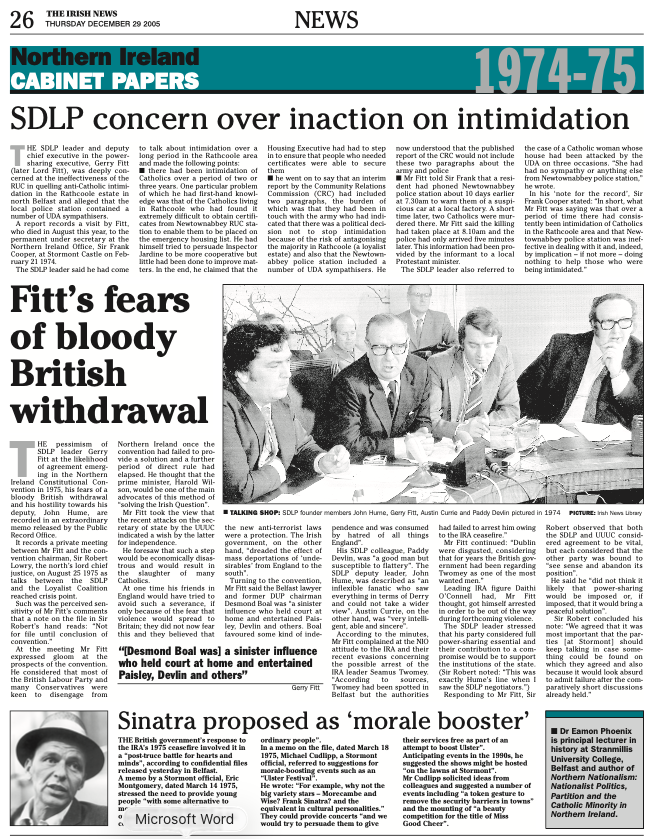
Fitt’s fears of bloody British withdrawal
The pessimism of SDLP leader Gerry Fitt at the likelihood of agreement emerging in the Northern Ireland Constitutional Convention in 1975, his fears of a bloody British withdrawal and his hostility towards his deputy, John Hume, are recorded in an extraordinary memo released by the Public Record Office.
It records a private meeting between Mr Fitt and the convention chairman, Sir Robert Lowry, the north’s lord chief justice, on August 25 1975 as talks between the SDLP and the Loyalist Coalition reached crisis point.
Such was the perceived sensitivity of Mr Fitt’s comments that a note on the file in Sir Robert’s hand reads: “Not for file until conclusion of convention.”
At the meeting Mr Fitt expressed gloom at the prospects of the convention. He considered that most of the British Labour Party and many Conservatives were keen to disengage from Northern Ireland once the convention had failed to provide a solution and a further period of direct rule had elapsed.
He thought that the prime minister, Harold Wilson, would be one of the main advocates of this method of “solving the Irish Question”.
Mr Fitt took the view that the recent attacks on the secretary of state by the UUUC indicated a wish by the latter for independence.
He foresaw that such a step would be economically disastrous and would result in the slaughter of many Catholics.
At one time his friends in England would have tried to avoid such a severance, if only because of the fear that violence would spread to Britain; they did not now fear this and they believed that the new anti-terrorist laws were a protection.
The Irish government, on the other hand, “dreaded the effect of mass deportations of ‘undesirables’ from England to the south”.
Turning to the convention, Mr Fitt said the Belfast lawyer and former DUP chairman Desmond Boal was “a sinister influence who held court at home and entertained Paisley, Devlin and others. Boal favoured some kind of independence and was consumed by hatred of all things England”.
His SDLP colleague, Paddy Devlin, was “a good man but susceptible to flattery”. The SDLP deputy leader, John Hume, was described as “an inflexible fanatic who saw everything in terms of Derry and could not take a wider view”. Austin Currie, on the other hand, was “very intelligent, able and sincere”.
According to the minutes, Mr Fitt complained at the NIO attitude to the IRA and their recent evasions concerning the possible arrest of the IRA leader Seamus Twomey.
“According to sources, Twomey had been spotted in Belfast but the authorities had failed to arrest him owing to the IRA ceasefire.”
Mr Fitt continued: “Dublin were disgusted, considering that for years the British government had been regarding Twomey as one of the most wanted men.”
Leading IRA figure Daithi O’Connell had, Mr Fitt thought, got himself arrested in order to be out of the way during forthcoming violence.
The SDLP leader stressed that his party considered full power-sharing essential and their contribution to a compromise would be to support the institutions of the state. (Sir Robert noted: “This was exactly Hume’s line when I saw the SDLP negotiators.”)
Responding to Mr Fitt, Sir Robert observed that both the SDLP and UUUC considered agreement to be vital, but each considered that the other party was bound to “see sense and abandon its position”.
He said he “did not think it likely that power-sharing would be imposed or, if imposed, that it would bring a peaceful solution”.
Sir Robert concluded his note: “We agreed that it was most important that the parties [at Stormont] should keep talking in case something could be found on which they agreed and also because it would look absurd to admit failure after the comparatively short discussions already held.”
SDLP concern over inaction on intimidation
THE SDLP leader and deputy chief executive in the powersharing executive, Gerry Fitt later Lord Fitt), was deeply concerned at the ineffectiveness of the RUC in quelling anti-Catholic intimidation in the Rathcoole estate in north Belfast and alleged that the local police station contained a lumber of UDA sympathisers.
A report records a visit by Fitt, who died in August this year, to the permanent under secretary at the Northern Ireland Office, Sir Frank Cooper, at Stormont Castle on February 21 1974.
The SDLP leader said he had come to talk about intimidation over a long period in the Rathcoole area and made the following points:
– there had been intimidation of Catholics over a period of two or three years. One particular problem of which he had first-hand knowledge was that of the Catholics living in Rathcoole who had found it extremely difficult to obtain certificates from Newtownabbey RUC station to enable them to be placed on the emergency housing list. He had himself tried to persuade Inspector Jardine to be more cooperative but little had been done to improve matters. In the end, he claimed that the Housing Executive had had to step i to ensure that people who needed certificates were able to secure hem
– he went on to say that an interim report by the Community Relations Commission (CRC) had included wo paragraphs, the burden of Meh was that they had been in ouch with the army who had indicated that there was a political decision not to stop intimidation because of the risk of antagonising he majority in Rathcoole (a loyalist state) and also that the Newtownabbey police station included a lumber of UDA sympathisers. He now understood that the published report of the CRC would not include these two paragraphs about the army and police
– Mr Fitt told Sir Frank that a resident had phoned Newtownabbey police station about 10 days earlier at 7.30am to warn them of a suspicious car at a local factory. A short time later, two Catholics were murdered there. Mr Fitt said the killing had taken place at 8.10am and the police had only arrived five minutes later. This information had been provided by the informant to a local Protestant minister.
The SDLP leader also referred to the case of a Catholic woman whose house had been attacked by the UDA on three occasions. “She had had no sympathy or anything else from Newtownabbey police station,” he wrote.
In his ‘note for the record’, Sir Frank Cooper stated: “In short, what Mr Fitt was saying was that over a period of time there had consistently been intimidation of Catholics in the Rathcoole area and that Newtownabbey police station was ineffective in dealing with it and, indeed, by implication – if not more – doing nothing to help those who were being intimidated ”
Sinatra proposed as ‘morale booster’
The British government’s response to the IRA’s 1975 ceasefire involved it in a “post-truce battle for hearts and minds”, according to confidential files released yesterday in Belfast.
A memo by a Stormont official, Eric Montgomery, dated March 14 1975, stressed the need to provide young people “with some alternative to membership of paramilitary organisations” and “to tap both the consciences and enthusiasm of ordinary people”.
In a memo on the file, dated March 18 1975, Michael Cudlipp, a Stormont official, referred to suggestions for morale-boosting events such as an “Ulster Festival”.
He wrote: “For example, why not the big variety stars – Morecambe and Wise? Frank Sinatra? and the equivalent in cultural personalities.”
They could provide concerts “and we would try to persuade them to give their services free as part of an attempt to boost Ulster”.
Anticipating events in the 1990s, he suggested the shows might be hosted “on the lawns at Stormont”.
Mr Cudlipp solicited ideas from colleagues and suggested a number of events including “a token gesture to remove the security barriers in towns” and the mounting of “a beauty competition for the title of Miss Good Cheer”.