

1975 State Papers (page 2)
December 29 2005
Publication Date
Loyalist victory rocked the executive, McGuinness arrest urged, Rent strike causes headache for Currie, Hume faced Harland and Wolff crisis
State Paper Snippet
Loyalist victory rocked the executive
THE sweeping victory of the United Ulster Unionist Coalition (UUUC) in the Westminster general election of February 1974 alarmed the new power-sharing Executive at Stormont.
At a meeting of the full executive on February 28 1974, Chief Minister Brian Faulkner saw the loyalist vote as “a clear warning”.
The Unionist assembly party behind Faulkner was willing to continue to support the executive, he said, but was not prepared to support a Council of Ireland without evidence of solid action by the Republic on status, extradition and in dealing with violence.
Mr Faulkner said that a priority was to preserve the concept of power sharing but there could be no possibility of ratifying Sunningdale without action by the Republic.
“The Unionist assembly was not prepared to support a Council of Ireland without solid action by the Republic on status…”
Mr Hume (minister of commerce) felt that a statement by Roy Bradford (the Unionist minister for the environment) about broadening the basis of the executive and a statement by the Unionist assembly party had been unhelpful.
The Unionist statement had been taken to mean the end of Sunningdale and the Council of Ireland. A short time ago there was no support for power sharing – until it was seen to work, Mr Hume said.
The same would be true for the Council of Ireland. If the council was to be removed, his party (the SDLP) would go and he added that we would be back in the hands of the extremists.
Robert Cooper (minister for manpower services) interpreted the Westminster vote as evidence of frustration at the lack of improvement in the security situation. Had there been an improvement he thought that loyalists would have been more ready to accept Sunningdale and the Council of Ireland.
He felt the executive should discuss the security situation and make representations to the Secretary of State. In the meantime, it was essential for the executive to “stick together”.
For his part, the housing minister, Austin Currie, expressed the view that the recent vote was “probably the worst point in their fortune”. He felt that everyone should do everything possible to deliver Sunningdale.
John Baxter (minister for information) felt that the Dublin Attorney-General’s defence in the Kevin Boland case was damaging to the executive as were the Strabane shooting and Dr Garret Fitzgerald’s statement that extradition was “not on”. We had got to face facts, he said, only 94,000 votes were cast for the pro-assembly Unionists and 23,000 for Alliance. He still thought that Sunningdale was a good agreement but that we should not backtrack. He said that Dublin must be made aware of the realities and must deliver.
Paddy Devlin (minister for health) felt that Dr Fitzgerald was wrong in making that statement. He was confident that the Dublin government would go for constitutional changes after Sunningdale had been ratified.
However, Basil Mclvor (minister of education) said that that message did not get through to the “high flats of Finaghy”. It was the phrase (in the UUUC election posters) that ‘Dublin is only a Sunningdale away’ that had beaten them in the election.
Leslie Morrell (minister of agriculture) agreed with Mr Hume that the vote was a mass protest. The SDLP had claimed that its mass protest had been ignored. Mr Morrell added that we must not now fall into the same trap by ignoring this vote. Otherwise Protestant extremists would react violently. He thought the only course was “putting the blame on the south”.
Roy Bradford said that as long as the southern constitution remained unchanged, any agreement made by the government there would be challenged. He added that the onus was now on the Republic to take political risks.
McGuinness arrest urged
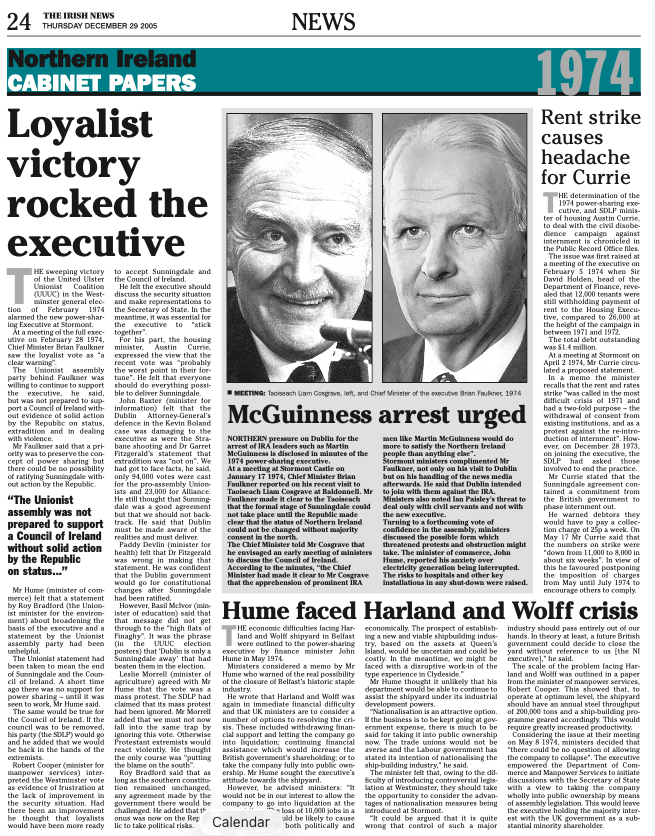
NORTHERN pressure on Dublin for the arrest of IRA leaders such as Martin McGuinness is disclosed in minutes of the 1974 power-sharing executive.
At a meeting at Stormont Castle on January 17 1974, Chief Minister Brian Faulkner reported on his recent visit to Taoiseach Liam Cosgrave at Baldonnell.
Mr Faulkner made it clear to the Taoiseach that the formal stage of Sunningdale could not take place until the Republic made clear that the status of Northern Ireland could not be changed without majority consent in the north.
The Chief Minister told Mr Cosgrave that he envisaged an early meeting of ministers to discuss the Council of Ireland. According to the minutes, “the Chief Minister had made it clear to Mr Cosgrave that the apprehension of prominent IRA men like Martin McGuinness would do more to satisfy the Northern Ireland people than anything else”.
Stormont ministers complimented Mr Faulkner, not only on his visit to Dublin but on his handling of the news media afterwards. He said that Dublin intended to join with them against the IRA. Ministers also noted Ian Paisley’s threat to deal only with civil servants and not with the new executive.
Turning to a forthcoming vote of confidence in the assembly, ministers discussed the possible form which threatened protests and obstruction might take. The minister of commerce, John Hume, reported his anxiety over electricity generation being interrupted. The risks to hospitals and other key installations in any shut-down were raised.
Rent strike causes headache for Currie
THE determination of the 1974 power-sharing executive, and SDLP minister of housing Austin Currie, to deal with the civil disobedience campaign against internment is chronicled in the Public Record Office files.
The issue was first raised at a meeting of the executive on February 5 1974 when Sir David Holden, head of the Department of Finance, revealed that 12,000 tenants were still withholding payment of rent to the Housing Executive, compared to 26,000 at the height of the campaign in between 1971 and 1972.
The total debt outstanding was £I.4 million.
At a meeting at Stormont on April 2 1974, Mr Currie circulated a proposed statement.
In a memo the minister recalls that the rent and rates strike “was called in the most difficult crisis of 1971 and had a two fold purpose – the withdrawal of consent from existing institutions, and as a protest against the re-intro-duction of internment”.
However, on December 28 1973, on joining the executive, the SDLP had asked those involved to end the practice.
Mr Currie stated that the Sunningdale agreement contained a commitment from the British government to phase internment out.
He warned debtors they would have to pay a collection charge of 25p a week. On May 17 Mr Currie said that the numbers on strike were “down from 11,000 to 8,000 in about six weeks”. In view of this he favoured postponing the imposition
Hume faced Harland and Wolff crisis
THE economic difficulties facing Harland and Wolff shipyard in Belfast were outlined to the power-sharing executive by finance minister John Hume in May 1974.
Ministers considered a memo by Mr Hume who warned of the real possibility of the closure of Belfast’s historic staple industry.
He wrote that Harland and Wolff was again in immediate financial difficulty and that UK ministers are to consider a number of options to resolving the crisis. These included withdrawing financial support and letting the company go into liquidation; continuing financial assistance which would increase the British government’s shareholding; or to take the company fully into public ownership. Mr Hume sought the executive’s attitude towards the shipyard.
However, he advised ministers: “It would not be in our interest to allow the company to go into liquidation at the present time. The loss of 10,000 jobs in a sensitive area would be likely to cause irreparable harm both politically and
economically. The prospect of establishing a new and viable shipbuilding industry, based on the assets at Queen’s Island, would be uncertain and could be costly. In the meantime, we might be faced with a disruptive work-in of the type experience in Clydeside.”
Mr Hume thought it unlikely that his department would be able to continue to assist the shipyard under its industrial development powers.
“Nationalisation is an attractive option. If the business is to be kept going at government expense, there is much to be said for taking it into public ownership now. The trade unions would not be averse and the Labour government has stated its intention of nationalising the ship building industry,” he said.
The minister felt that, owing to the difficulty of introducing controversial legislation at Westminster, they should take the opportunity to consider the advantages of nationalisation measures being introduced at Stormont.
“It could be argued that it is quite wrong that control of such a major
industry should pass entirely out of our hands. In theory at least, a future British government could decide to close the yard without reference to us [the NI executive],” he said.
The scale of the problem facing Harland and Wolff was outlined in a paper from the minister of manpower services, Robert Cooper. This showed that, to operate at optimum level, the shipyard should have an annual steel throughput of 200,000 tons and a ship building programme geared accordingly. This would require greatly increased productivity.
Considering the issue at their meeting on May 8 1974, ministers decided that “there could be no question of allowing the company to collapse”.
The executive empowered the Department of Commerce and Manpower Services to initiate discussions with the Secretary of State with a view to taking the company wholly into public ownership by means of assembly legislation. This would leave the executive holding the majority interest with the UK government as a substantial minority shareholder.