

1974 State Papers (page 4)
January 03 2005
Publication Date
Countdown to the fall of the Sunningdale executive
State Paper Snippet
Countdown to the fall of the Sunningdale executive
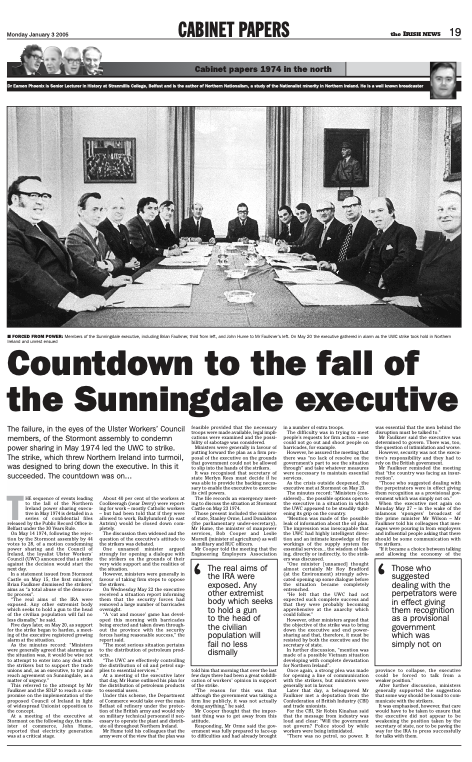
The failure, in the eyes of the Ulster Workers’ Council members, of the Stormont assembly to condemn power sharing in May 1974 led the UWC to strike. The strike, which threw Northern Ireland into turmoil, was designed to bring down the executive. In this it succeeded. The countdown was on…
THE sequence of events leading to the fall of the Northern Ireland power sharing executive in May 1974 is detailed in a series of confidential files released by the Public Record Office in Belfast under the 30 Years Rule.
On May 14 1974, following the rejection by the Stormont assembly by 44 votes to 28, of a motion condemning power sharing and the Council of Ireland, the loyalist Ulster Workers’ Council (UWC) announced that a strike against the decision would start the next day.
In a statement issued from Stormont Castle on May 15, the first minister, Brian Faulkner dismissed the strikers’ aims as “a total abuse of the democratic process”.
“The real aims of the IRA were exposed. Any other extremist body which seeks to hold a gun to the head of the civilian population will fail no less dismally,” he said.
Five days later, on May 20, as support for the strike began to harden, a meeting of the executive registered growing alarm at the situation.
As the minutes record: “Ministers were generally agreed that alarming as the situation was, it would be wise not to attempt to enter into any deal with the strikers but to support the trade unions and, as an executive, to try and reach agreement on Sunningdale, as a matter of urgency.”
This referred to the attempt by Mr Faulkner and the SDLP to reach a compromise on the implementation of the proposed Council of Ireland in light of widespread Unionist opposition to the concept.
At a meeting of the executive at Stormont on the following day, the minister of commerce, John Hume, reported that electricity generation was at a critical stage.
About 40 per cent of the workers at Coolkeeragh (near Derry) were reporting for work – mostly Catholic workers – but had been told that if they were allowed to work, Ballylumford (in east Antrim) would be closed down completely.
The discussion then widened and the question of the executive’s attitude to the strikers was debated.
One unnamed minister argued strongly for opening a dialogue with the strikers on the grounds of their very wide support and the realities of the situation.
However, ministers were generally in favour of taking firm steps to oppose the strikers.
On Wednesday May 22 the executive received a situation report informing them that the security forces had removed a large number of barricades overnight.
“A ‘cat and mouse’ game has developed this morning with barricades being erected and taken down throughout the province with the security forces having reasonable success,” the report said.
“The most serious situation pertains to the distribution of petroleum products.
“The UWC are effectively controlling the distribution of oil and petrol supplies to essential services.”
At a meeting of the executive later that day, Mr Hume outlined his plan for the distribution of petroleum products to essential users.
Under this scheme, the Department of Commerce would take over the main Belfast oil refinery under the protection of the British army and would rely on military technical personnel if necessary to operate the plant and distribute oil throughout Northern Ireland.
Mr Hume told his colleagues that the army were of the view that the plan was feasible provided that the necessary troops were made available, legal implications were examined and the possibility of sabotage was considered.
Ministers were generally in favour of putting forward the plan as a firm proposal of the executive on the grounds that government could not be allowed to slip into the hands of the strikers.
It was recognised that secretary of state Merlyn Rees must decide if he was able to provide the backing necessary to enable the executive to exercise its civil powers.
The file records an emergency meeting to discuss the situation at Stormont Castle on May 23 1974.
Those present included the minister of state, Stanley Orme, Lord Donaldson (the parliamentary under secretary), Mr Hume, the minister of manpower services, Bob Cooper and Leslie Morrell (minister of agriculture) as well as military and RUC officers.
Mr Cooper told the meeting that the Engineering Employers Association told him that morning that over the last few days there had been a great solidification of workers’ opinion in support of the strike.
“The reason for this was that although the government was taking a firm line publicly, it was not actually doing anything,” he said.
Mr Cooper thought that the important thing was to get away from this attitude.
Responding, Mr Orme said the government was fully prepared to face-up to difficulties and had already brought in a number of extra troops.
The difficulty was in trying to meet people’s requests for firm action – one could not go out and shoot people on barricades, for example.
However, he assured the meeting that there was “no lack of resolve on the government’s part to see the situation through” and take whatever measures were necessary to maintain essential services.
As the crisis outside deepened, the executive met at Stormont on May 23.
The minutes record: “Ministers (considered)… the possible options open to the executive in a situation in which the UWC appeared to be steadily tightening its grip on the country.
“Mention was made of the possible leak of information about the oil plan. The impression was inescapable that the UWC had highly intelligent direction and an intimate knowledge of the workings of the supply system for essential services… the wisdom of talking, directly or indirectly, to the strikers was discussed.
“One minister [unnamed] thought almost certainly Mr Roy Bradford (at the Environment) strongly advocated opening up some dialogue before the situation became completely entrenched.
“He felt that the UWC had not expected such complete success and that they were probably becoming apprehensive at the anarchy which could follow.”
However, other ministers argued that the objective of the strike was to bring down the executive and end powersharing and that, therefore, it must be resisted by both the executive and the secretary of state.
In further discussion, “mention was made of a possible Vietnam situation developing with complete devastation for Northern Ireland”.
Once again, a strong plea was made for opening a line of communication with the strikers, but ministers were generally not in favour.
Later that day, a beleaguered Mr Faulkner met a deputation from the Confederation of British Industry (CBI) and trade unionists.
For the CBI, Sir Robin Kinahan said that the message from industry was loud and clear: “Will the government not govern? Police stood by while workers were being intimidated.
“There was no petrol, no power. It was essential that the men behind the disruption must be talked to.”
Mr Faulkner said the executive was determined to govern. There was, too, the question of intimidation and worse.
However, security was not the executive’s responsibility and they had to rely on the British government.
Mr Faulkner reminded the meeting that “the country was facing an insurrection”.
“Those who suggested dealing with the perpetrators were in effect giving them recognition as a provisional government which was simply not on.”
When the executive met again on Monday May 27 – in the wake of the infamous ‘spongers’ broadcast of the prime minister Mr Wilson – Mr Faulkner told his colleagues that messages were pouring in from employers and influential people asking that there should be some communication with the strikers.
“If it became a choice between talking and allowing the economy of the province to collapse, the executive could be forced to talk from a weaker position.”
After further discussion, ministers generally supported the suggestion that some way should be found to communicate with the strikers.
It was emphasised, however, that care would have to be taken to ensure that the executive did not appear to be weakening the position taken by the secretary of state, nor to be paving the way for the IRA to press successfully for talks with them.