

1974 State Papers (page 2)
January 01 2005
Publication Date
Hope at year’s beginning, bloodshed at year’s end
State Paper Snippet
Hope at year’s beginning, bloodshed at year’s end
Power-sharing was attempted at Stormont for the first time, but as 1974 unfolded the glimmer of hope that brought the new year faded and vanished. The Ulster Workers’ Council strike and the Dublin and Monaghan bombings were ominous signs that things were not about to get better very quickly…
A BOLD new experiment began in Northern Ireland on January 1 1974. Power-sharing was tried for the very first time and there was a glimmer of hope that, after five years of escalating violence, a solution to the Troubles had been found.
But as the year unfolded events moved beyond the grip of the politicians. By May the executive lay in ruins and with it the policies of the British and Irish governments.
The power-sharing executive took office under Brian Faulkner, the former Unionist prime minister, as chief minister and the SDLP leader, Gerry (now Lord) Fitt as deputy chief minister.
In its first press statement the new administration declared: “Let 1974 be the year of reconciliation.”
This bold statement conflicted with messages from the experiment’s twin enemies.
The IRA looked forward to 1974 as the year “in which British rule in Ireland shall be destroyed” while the UDA declared that traditional unionism was now dead and loyalists had to shape their own destiny.
Just four days into the executive’s existence, Mr Faulkner resigned as leader of the Ulster Unionist Party following its rejection of the Sunningdale Agreement.
The resumption of the assembly on January 22 saw serious loyalist disruption and the ejection of Ian Paisley, the DUP leader, and 18 supporters.
On February 1 the first meeting between the Northern Ireland Executive and the Irish cabinet took place at Hillsborough.
Hopes that the executive was beginning to assert itself were shattered on February 28 when, in a snap general election called by Edward Heath to counter the British miners’ strike, anti-Sunningdale candidates won 11 of the north’s 12 Westminster seats. The total vote for anti-Sunningdale candidates was 59 per cent, with 41 per cent of the electorate endorsing the deal.
The incoming Labour government of Harold Wilson appointed Merlyn Rees -a former history lecturer – as the new Northern Ireland secretary of state.
The Labour government assured the executive of its support, stressing that the 11 United Ulster Unionist Council MPs were insignificant in Westminster terms.
But in a portent of things to come, on March 21 1974 the loyalist Ulster Workers’ Council (UWC) – comprising former members of the Loyalist Association of Workers, Protestant paramilitaries and politicians – warned that if Westminster policies were imposed on Northern Ireland, “grave industrial consequences would ensue”.
Meanwhile, violence continued on both sides of the Irish Sea with IRA bombings and loyalist assassinations.
With Mr Paisley demanding fresh elections and a new all-unionist executive, Mr Faulkner privately warned Mr Cosgrave of the need for a delay in ratifying the Sunningdale Agreement if the executive was to survive.
Despite the loyalist victory, the executive attempted to focus public attention on ‘bread and butter’ issues.
As violence continued, the UWC warned on May 10 that the general election result had removed the executive’s mandate and threatened a “full-scale constitutional stoppage” if its demands were ignored.
The acid test was to be an assembly vote on the Sunningdale Agreement on May 14 1974. When the executive easily won by 44 votes to 28, the UWC announced power cuts in protest.
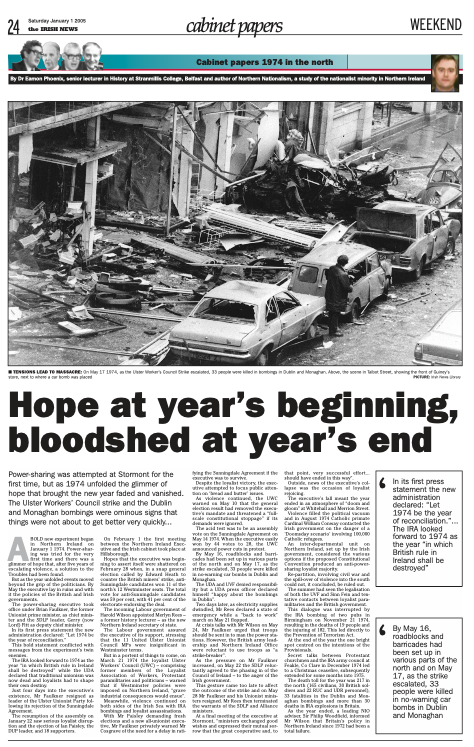
By May 16, roadblocks and barricades had been set up in various parts of the north and on May 17, as the strike escalated, 33 people were killed in no-warning car bombs in Dublin and Monaghan.
The UDA and UVF denied responsibility but a UDA press officer declared himself “happy about the bombings in Dublin”.
Two days later, as electricity supplies dwindled, Mr Rees declared a state of emergency while a “back to work” march on May 21 flopped.
At crisis talks with Mr Wilson on May 24, Mr Faulkner urged that troops should be sent in to man the power stations.
However, the British army leadership and Northern Ireland Office were reluctant to use troops as “a strike-breaker”.
As the pressure on Mr Faulkner increased, on May 22 the SDLP reluctantly agreed to the phasing in of the Council of Ireland – to the anger of the Irish government.
This gesture came too late to affect the outcome of the strike and on May 28 Mr Faulkner and his Unionist ministers resigned. Mr Rees then terminated the warrants of the SDLP and Alliance ministers.
At a final meeting of the executive at Stormont, “ministers exchanged good wishes and expressed their mutual sorrow that the great cooperative and, to that point, very successful effort-should have ended in this way”.
Outside, news of the executive’s collapse was the occasion of loyalist rejoicing.
The executive’s fall meant the year ended in an atmosphere of “doom and gloom” at Whitehall and Merrion Street.
Violence filled the political vacuum and in August 1974 Catholic primate Cardinal William Conway contacted the Irish government on the danger of a ‘Doomsday scenario’ involving 100,000 Catholic refugees.
An inter-departmental unit on Northern Ireland, set up by the Irish government, considered the various options if the proposed Constitutional Convention produced an anti-power sharing loyalist majority.
Re partition, involving civil war and the spill-over of violence into the south could not, it concluded, be ruled out.
The summer had seen the legalisation of both the UVF and Sinn Fein and tentative contacts between loyalist paramilitaries and the British government.
This dialogue was interrupted by the IRA bombing of two pubs in Birmingham on November 21 1974, resulting in the deaths of 19 people and the injuring of 182. This led directly to the Prevention of Terrorism Act.
At the end of the year the one bright spot centred on the intentions of the Provisionals.
Secret talks between Protestant churchmen and the IRA army council at Feakle, Co Clare in December 1974 led to a Christmas ceasefire, subsequently extended for some months into 1975.
The death toll for the year was 217 in the north (165 civilians, 30 British soldiers and 22 RUC and UDR personnel), 33 fatalities in the Dublin and Monaghan bombings and more than 30 deaths in IRA explosions in Britain.
As the year ended, a leading NIO adviser, Sir Philip Woodfield, informed Mr Wilson that Britain’s policy in Northern Ireland since 1972 had been a total failure.