

1974 State Papers (page 1)
January 01 2005
Publication Date
British had Doomsday withdrawal plan in ‘74
State Paper Snippet
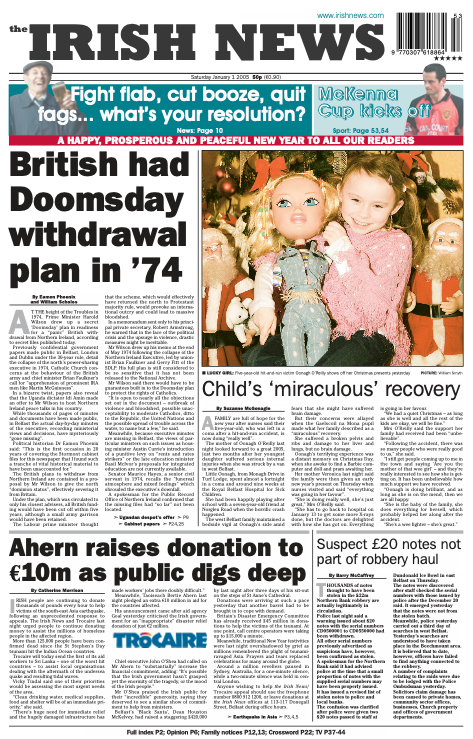
British had Doomsday withdrawal plan in ‘74
AT THE height of the Troubles in 1974, Prime Minister Harold Wilson drew up a secret ‘Doomsday’ plan in readiness for a “panic” British withdrawal from Northern Ireland, according to secret files published today.
Previously confidential government papers made public in Belfast, London and Dublin under the 30-year rule, detail the collapse of the north’s power-sharing executive in 1974, Catholic Church concerns at the behaviour of the British army and chief minister Brian Faulkner’s call for “apprehension of prominent IRA men like Martin McGuinness”.
In a bizarre twist, papers also reveal that the Uganda dictator Idi Amin made an offer to Mr Wilson to host Northern Ireland peace talks in his country.
While thousands of pages of minutes and documents have been made public, in Belfast the actual day-by-day minutes of the executive, recording ministerial views and decisions, have mysteriously “gone missing”.
Political historian Dr Eamon Phoenix said: “This is the first occasion in 20 years of covering the Stormont cabinet files for this newspaper that I found such a tranche of vital historical material to have been unaccounted for.”
The British plans to withdraw from Northern Ireland are contained in a proposal by Mr Wilson to give the north “dominion status”, effectively severing it from Britain.
Under the plan, which was circulated to only his closest advisers, all British funding would have been cut off within five years, although a small army garrison would have been retained.
The Labour prime minister thought that the scheme, which would effectively have returned the north to Protestant majority rule, would provoke an international outcry and could lead to massive bloodshed.
In a memorandum sent only to his principal private secretary, Robert Armstrong, he warned that in the face of the political crisis and the upsurge in violence, drastic measures might be inevitable.
Mr Wilson drew up his memo at the end of May 1974 following the collapse of the Northern Ireland Executive, led by unionist Brian Faulkner and Gerry Fitt of the SDLP. His full plan is still considered to be so sensitive that it has not been released to the National Archive.
Mr Wilson said there would have to be guarantees built in to the Doomsday plan to protect the rights of Catholics.
“It is open to nearly all the objections set out in the document – outbreak of violence and bloodshed, possible unacceptability to moderate Catholics, ditto to the Republic, the United Nations and the possible spread of trouble across the water, to name but a few,” he said.
Meanwhile, because executive minutes are missing in Belfast, the views of particular ministers on such issues as housing minister Austin Currie’s introduction of a punitive levy on “rents and rates strikers” or the late education minister Basil Mclvor’s proposals for integrated education are not currently available.
Senator Maurice Hayes, a senior civil servant in 1974, recalls the “funereal atmosphere and mixed feelings” which shrouded the executive’s downfall.
A spokesman for the Public Record Office of Northern Ireland confirmed that the missing files had “so far” not been located.