

1973 State Papers (page 5)
January 01 2004
Publication Date
Official fears over election in north, Controversy over Belfast shootings, Gap ‘much too wide between planter and Gael' says official, Nationalist concern at killings
State Paper Snippet
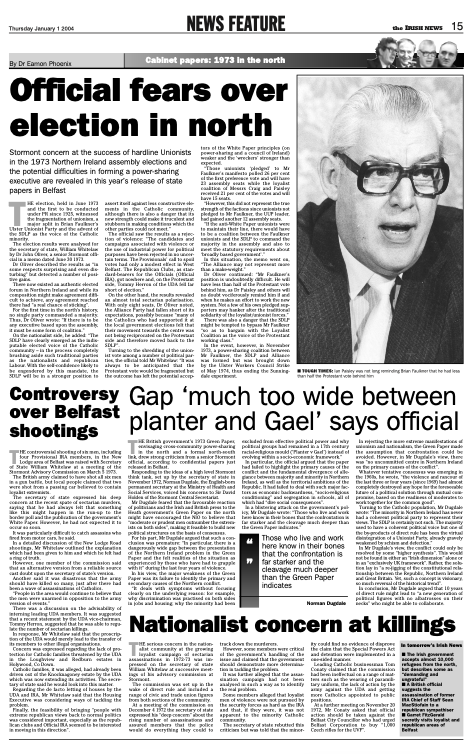
Official fears over election in north
Stormont concern at the success of hardline Unionists in the 1973 Northern Ireland assembly elections and the potential difficulties in forming a power-sharing executive are revealed in this year’s release of state papers in Belfast
THE election, held in June 1973 and the first to be conducted under PR since 1925, witnessed the fragmentation of unionism, a major split in Brian Faulkner’s Ulster Unionist Party and the advent of the SDLP as the voice of the Catholic minority.
The election results were analysed for the secretary of state, William Whitelaw by Dr John Oliver, a senior Stormont official in a memo dated June 30 1973.
Dr Oliver described the results as “in some respects surprising and even disturbing” but detected a number of positive gains.
There now existed an authentic elected forum in Northern Ireland and while its composition might make agreement difficult to achieve, any agreement reached there had “a real chance of sticking”.
For the first time in the north’s history, no single party commanded a majority. Thus, Dr Oliver wrote: “If there is to be any executive based upon the assembly, it must be some form of coalition.”
On the nationalist side, he added: “The SDLP have clearly emerged as the indisputable elected voice of the Catholic community – in the process completely brushing aside such traditional parties as the nationalists and republican Labour.
“With the self-confidence likely to be engendered by this mandate, the SDLP will be in a stronger position to assert itself against less constructive elements in the Catholic community, although there is also a danger that its new strength could make it truculent and stubborn in making conditions which the other parties could not meet.”
The official saw the results as a rejection of violence: “The candidates and campaigns associated with violence or the use of industrial power for political purposes have been rejected in no uncertain terms. The Provisionals’ call to spoil votes had only a modest effect in West Belfast. The Republican Clubs, as standard-bearers for the Officials (Official IRA), got nowhere and, on the Protestant side, Tommy Herron of the UDA fell far short of election.”
On the other hand, the results revealed an almost total sectarian polarisation. With only eight seats, Dr Oliver noted, the Alliance Party had fallen short of its expectations, possibly because “many of the Catholics who had supported it at the local government elections felt that their movement towards the centre was not being reciprocated on the Protestant side and therefore moved back to the SDLP”.
Turning to the shredding of the unionist vote among a number of political parties, the official told Mr Whitelaw: “It was always to be anticipated that the Protestant vote would be fragmented but the outcome has left the potential acceptors of the White Paper principles (on power-sharing and a council of Ireland) weaker and the ‘wreckers’ stronger than expected.
“Those unionists ‘pledged’ to Mr Faulkner’s manifesto polled 26 per cent of the first preference vote and will have 23 assembly seats while the loyalist coalition of Messrs Craig and Paisley received 21 per cent of the votes and will have 15 seats.
“However, this did not represent the true strength of the factions since unionists not pledged to Mr Faulkner, the UUP leader, had gained another 12 assembly seats.
“If the anti-White Paper unionists were to maintain their line, there would have to be a coalition between the Faulkner unionists and the SDLP to command the majority in the assembly and also to meet the statutory requirements about ‘broadly based government’.”
In this situation, the memo went on, “The Alliance may not represent more than a make-weight.”
Dr Oliver continued: “Mr Faulkner’s position is undoubtedly difficult. He will have less than half of the Protestant vote behind him, as Dr Paisley and others will no doubt vociferously remind him if and when he makes an effort to work the new system. Not a few of his own pledged supporters may hanker after the traditional solidarity of the loyalist/unionist forces.”
There was also a danger that the SDLP might be tempted to bypass Mr Faulkner “so as to bargain with the Loyalist Coalition as the voice of the Protestant working class.”
In the event, however, in November 1973, a power-sharing coalition between Mr Faulkner, the SDLP and Alliance was formed but was brought down by the Ulster Workers Council Strike of May 1974, thus ending the Sunning-dale experiment.
Controversy over Belfast shootings
THE controversial shooting of six men, including four Provisional IRA members, in the New Lodge area of Belfast was raised with Secretary of State William Whitelaw at a meeting of the Stormont Advisory Commission on March 5 1973.
The British army claimed to have shot all six men in a gun battle, but local people claimed that two were shot from a passing car believed to contain loyalist extremists.
The secretary of state expressed his deep concern at the recent spate of sectarian murders, saying that he had always felt that something like this might happen in the run-up to the border poll and the publication of the government’s White Paper. However, he had not expected it to occur so soon.
It was particularly difficult to catch assassins who fired from motor cars, he said.
In a detailed discussion of the New Lodge Road shootings, Mr Whitelaw outlined the explanation which had been given to him and which he felt had a ring of truth.
However, one member of the commission said that an alternative version from a reliable source cast doubt upon the secretary of state’s version.
Another said it was disastrous that the army should have killed so many, just after there had been a wave of assassinations of Catholics.
“People in the area would continue to believe that the men were unarmed in opposition to the army version of events.”
There was a discussion on the advisability of interning leading UDA members. It was suggested that a recent statement by the UDA vice-chairman, Tommy Herron, suggested that he was able to regulate the number of sectarian killings.
In response, Mr Whitelaw said that the proscription of the UDA would merely lead to the transfer of its members to other illegal organisations.
Concern was expressed regarding the lack of protection for Catholic families threatened by the UDA in the Loughview and Redburn estates in Holywood, Co Down.
Catholic families, it was alleged, had already been driven out of the Knocknagoney estate by the UDA which was now extending its activities. The secretary of state said he would look into this matter.
Regarding the de facto letting of houses by the UDA and IRA, Mr Whitelaw said that the Housing Executive was considering ways of tackling the problem.
Finally, the feasibility of bringing “people with extreme republican views back to normal politics was considered important, especially as the republican clubs and Official IRA seemed to be interested in moving in this direction”.
Gap ‘much too wide between planter and Gael’ says official
THE British government’s 1973 Green Paper, envisaging cross-community power-sharing in the north and a formal north-south link, drew strong criticism from a senior Stormont official, according to confidential papers just released in Belfast.
Responding to the ideas of a high level Stormont think tank, set up by the secretary of state in November 1972, Norman Dugdale, the English-born permanent secretary at the Ministry of Health and Social Services, voiced his concerns to Sir David Holden of the Stormont Central Secretariat.
Mr Dugdale feared that the favourable reaction of politicians and the Irish and British press to the Heath government’s Green Paper on the north might have encouraged the NIO to believe that “moderate or prudent men outnumber the extremists on both sides”, making it feasible to build new political structures on the basis of consensus.
For his part, Mr Dugdale argued that such a conclusion was premature: “In particular, there is a dangerously wide gap between the presentation of the Northern Ireland problem in the Green Paper and the felt realities of the situation as experienced by those who have had to grapple with it” during the last four years of violence.
In his view, the major weakness of the Green Paper was its failure to identify the primary and secondary causes of the Northern conflict.
“It deals with symptoms without focusing clearly on the underlying reason: for example, why discrimination was practised on both sides in jobs and housing; why the minority had been excluded from effective political power and why political groups had remained in a 17th century racial-religious mould (‘Planter v Gael’) instead of evolving within a socio-economic framework.”
In particular, the official argued that the paper had failed to highlight the primary causes of the conflict and the fundamental divergence of allegiance between majority and minority in Northern Ireland, as well as the territorial ambitions of the Republic. It had failed to deal with such major factors as economic backwardness, “socio-religious conditioning” and segregation in schools, all of which had “dire social consequences”.
In a blistering attack on the government’s policy, Mr Dugdale wrote: “Those who live and work here know in their bones that the confrontation is far starker and the cleavage much deeper than the Green Paper indicates.”
In rejecting the more extreme manifestations of unionism and nationalism, the Green Paper made the assumption that confrontation could be avoided. However, in Mr Dugdale’s view, there was “no uncommitted centre in Northern Ireland on the primary causes of the conflict”.
Whatever tentative consensus was emerging in the 1960s, he wrote, “the violence and rancour of the last three or four years (since 1969) had almost completely destroyed any hope for the foreseeable future of a political solution through mutual compromise, based on the readiness of moderates to work together for the common good”.
Turning to the Catholic population, Mr Dugdale wrote: “The minority in Northern Ireland has never had a coherent political party to represent their views. The SDLP is certainly not such. The majority used to have a coherent political voice but one of the by-products of direct rule has been the virtual disintegration of a Unionist Party, already gravely weakened by schism and defection.”
In Mr Dugdale’s view, the conflict could only be resolved by some “higher synthesis”. This would not be found in either an “Irish dimension” alone or in an “exclusively UK framework”. Rather, the solution lay in “a re-jigging of the constitutional relationship between the Republic, Northern Ireland and Great Britain. Yet, such a concept is visionary, so much reversal of the historical trend”.
In conclusion, Mr Dugdale argued that 10 years of direct rule might lead to “a new generation of political figures with no albatrosses on their necks” who might be able to collaborate.
Nationalist concern at killings
THE serious concern in the nationalist community at the growing loyalist campaign of sectarian assassinations in 1972-73 was impressed on the secretary of state William Whitelaw at successive meetings of his advisory commission at Stormont.
The commission was set up in the wake of direct rule and included a range of civic and trade union figures from both sections of the community.
At a meeting of the commission on December 4 1972 the secretary of state expressed his “deep concern” about the rising number of assassinations and assured members that the police would do everything they could to track down the murderers.
However, some members were critical of the government’s handling of the issue and claimed that the government should demonstrate more determination in tackling the problem.
It was further alleged that the assassination campaign had not been analysed in such a way as to identify the real problem.
Some members alleged that loyalist men of violence were not pursued by the security forces as hard as the IRA and that, if they were, it was not apparent to the minority Catholic community.
The secretary of state rebutted this criticism but was told that the minority could find no evidence of disprove the claim that the Special Powers Act and detention were implemented in a one-sided manner.
Leading Catholic businessman Tom Conaty claimed that the commission had been ineffectual on a range of matters such as the wearing of paramilitary uniform, the lack of action by the army against the UDA and getting more Catholics appointed to public positions.
At a further meeting on November 20 1972, Mr Conaty asked that official action should be taken against the Belfast City Councillor who had urged Belfast Corporation to buy “1,000 Czech rifles for the UVF”.