

1973 State Papers (page 2)
January 01 2004
Publication Date
British government tries to answer the ‘Irish question’
State Paper Snippet
British government tries to answer the ‘Irish question’
1973 was to see the most determined attempt since the 1921 treaty to settle the Irish question’ by a British government, now in close cooperation with the Fine Gael/Labour coalition government in Dublin.
On January 1, 1973 both the Republic of Ireland and the UK became members of the European Economic Community (EEC).
The Irish minister of foreign affairs, Brian Lenihan, said that cross-border cooperation within the EEC could evolve into Irish unity.
These developments had no impact on the continuing violence in the north, however.
The Provisional IRA campaign proceeded, though in a lower gear, with a series of bomb explosions in Belfast and Coleraine in which six civilians were killed. The advent of the new year saw the murder of a young worker by loyalists at the Rolls Royce factory in east Belfast and the brutal slaying of a young engaged couple in Co Donegal, just over the border. The UDA was again suspected.
On February 3 six men, including four members of the Provisional IRA, were shot dead in controversial circumstances in the New Lodge area of Belfast. The British army claimed to have shot them in a gun battle but this was disputed by local people.
The same weekend saw a further eight victims of sectarian assassinations.
The taoiseach, Jack Lynch, mirrored Catholic anger at the activities of the UDA when he asked why the British government was allowing a Protestant paramilitary force to operate freely.
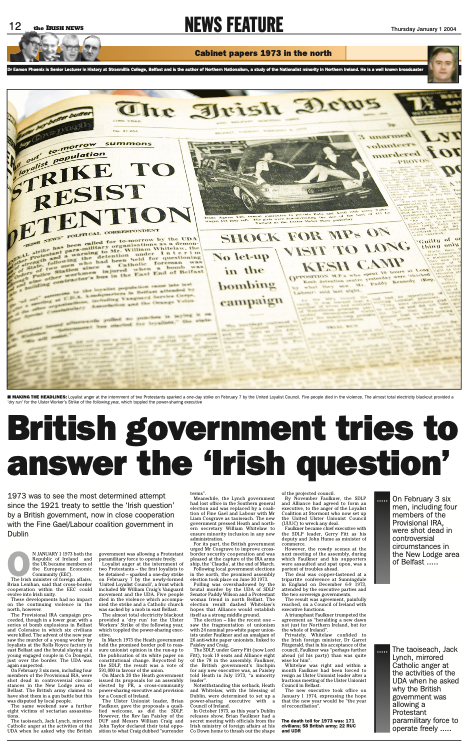
Loyalist anger at the internment of two Protestants – the first loyalists to be detained – sparked a one-day strike on February 7 by the newly-formed ‘United Loyalist Council’, a front which included Mr William Craig’s Vanguard movement and the UDA.
Five people died in the violence which accompanied the strike and a Catholic church was sacked by a mob in east Belfast.
The almost total electricity blackout provided a ‘dry run’ for the Ulster Workers’ Strike of the following year, which toppled the power-sharing executive.
In March 1973 the Heath government held the promised border poll to reassure unionist opinion in the run-up to the publication of its white paper on constitutional change. Boycotted by the SDLP, the result was a vote of 591,000 in favour of the union.
On March 20 the Heath government issued its proposals for an assembly elected by PR, a cross-community power-sharing executive and provision for a Council of Ireland.
The Ulster Unionist leader, Brian Faulkner, gave the proposals a qualified welcome, as did the SDLP. However, the Rev Ian Paisley of the DUP and Messrs William Craig and John Taylor declared their total opposition to what Craig dubbed “surrender terms”.
Meanwhile, the Lynch government had lost office in the Southern general election and was replaced by a coalition of Fine Gael and Labour with Mr Liam Cosgrave as taoiseach. The new government pressed Heath and northern secretary William Whitelaw to ensure minority inclusion in any new administration.
For its part, the British government urged Mr Cosgrave to improve cross-border security cooperation and was pleased at the capture of the IRA arms ship, the ‘Claudia’, at the end of March.
Following local government elections in the north, the promised assembly election took place on June 30 1973.
Polling was overshadowed by the brutal murder by the UDA of SDLP Senator Paddy Wilson and a Protestant woman friend in north Belfast. The election result dashed Whitelaw’s hopes that Alliance would establish itself as a strong middle ground.
The election – like the recent one -saw the fragmentation of unionism with 24 nominal pro-white paper unionists under Faulkner and an amalgam of 26 anti-white paper unionists, linked to Paisley and Craig.
The SDLP, under Gerry Fitt (now Lord Fitt), took 19 seats and Alliance eight of the 78 in the assembly. Faulkner, the British government’s linchpin for any new executive was, as Paisley told Heath in July 1973, “a minority leader”.
Notwithstanding this setback, Heath and Whitelaw, with the blessing of Dublin, were determined to set up a power-sharing executive with a Council of Ireland.
In October 1973, as this year’s Dublin releases show, Brian Faulkner had a secret meeting with officials from the Irish ministry of foreign affairs at his Co Down home to thrash out the shape of the projected council.
By November Faulkner, the SDLP and Alliance had agreed to form an executive, to the anger of the Loyalist Coalition at Stormont who now set up the United Ulster Unionist Council (UUUC) to wreck any deal.
Faulkner became chief executive with the SDLP leader, Gerry Fitt as his deputy and John Hume as minister of commerce.
However, the rowdy scenes at the next meeting of the assembly, during which Faulkner and his supporters were assaulted and spat upon, was a portent of troubles ahead.
The deal was copper-fastened at a tripartite conference at Sunningdale in England on December 6-9 1973, attended by the executive parties and the two sovereign governments.
The result was agreement, painfully reached, on a Council of Ireland with executive functions.
A triumphant Faulkner trumpeted the agreement as “heralding a new dawn not just for Northern Ireland, but for the whole of Ireland”.
Privately, Whitelaw confided to the Irish foreign minister, Dr Garret Fitzgerald, that in his acceptance of the council, Faulkner was “perhaps further ahead (of his party) than was quite wise for him”.
Whitelaw was right and within a month Faulkner had been forced to resign as Ulster Unionist leader after a fractious meeting of the Ulster Unionist Council in Belfast.
The new executive took office on January 1 1974, expressing the hope that the new year would be “the year of reconciliation”.
The death toll for 1973 was: 171 civilians; 58 British army; 22 RUC and UDR