

1973 State Papers (page 1)
January 01 2004
Publication Date
Faulkner held secret talks with Irish
State Paper Snippet
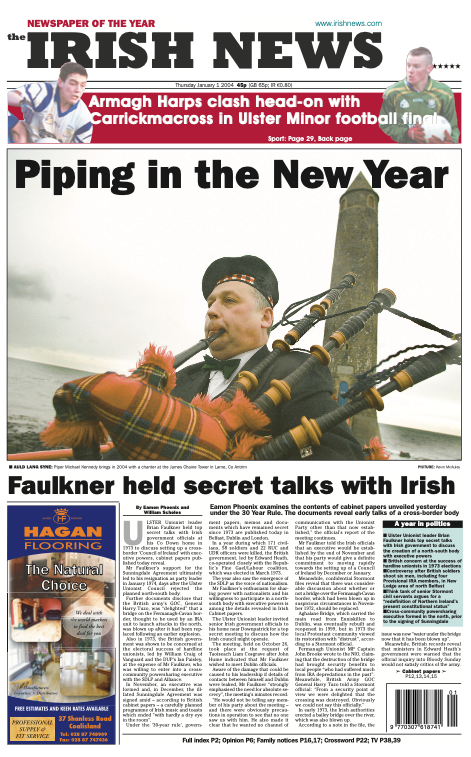
Faulkner held secret talks with Irish
ULSTER Unionist leader Brian Faulkner held top secret talks with Irish government officials at his Co Down home in 1973 to discuss setting up a cross-border ‘Council of Ireland’ with executive powers, cabinet papers published today reveal.
Mr Faulkner’s support for the Sunningdale Agreement ultimately led to his resignation as party leader in January 1974, days after the Ulster Unionist Council rejected the planned north-south body.
Further documents disclose that the British army’s GOC, General Harry Tuzo, was “delighted” that a bridge on the Fermanagh-Cavan border, thought to be used by an IRA unit to launch attacks in the north, was blown up after it had been replaced following an earlier explosion.
Also in 1973, the British government was shown to be concerned at the electoral success of hardline unionists, led by William Craig of Vanguard and the DUP’s Ian Paisley, at the expense of Mr Faulkner, who was willing to enter into a cross community power sharing executive with the SDLP and Alliance.
In November, an executive was formed and, in December, the ill-fated Sunningdale Agreement was signed amid – according to British cabinet papers – a carefully planned programme of Irish music and toasts which ended “with hardly a dry eye in the room”.
Under the ‘30-year rule’, government papers, memos and documents which have remained secret since 1973 are published today in Belfast, Dublin and London.
In a year during which 171 civilians, 58 soldiers and 22 RUC and UDR officers were killed, the British government, led by Edward Heath, co-operated closely with the Republic’s Fine Gael/Labour coalition, which was elected in March 1973.
The year also saw the emergence of the SDLP as the voice of nationalism.
Mr Faulkner’s enthusiasm for sharing power with nationalists and his willingness to participate in a northsouth body with executive powers is among the details revealed in Irish Cabinet papers.
The Ulster Unionist leader invited senior Irish government officials to his home near Downpatrick for a top secret meeting to discuss how the Irish council might operate.
The meeting, held on October 26, took place at the request of Taoiseach Liam Cosgrave after John Hume indicated that Mr Faulkner wished to meet Dublin officials.
Aware of the damage that could be caused to his leadership if details of contacts between himself and Dublin were leaked, Mr Faulkner “strongly emphasised the need for absolute secrecy”, the meeting’s minutes record.
“He would not be telling any member of his party about the meeting -and there were obviously precautions in operation to see that no one saw us with him. He also made it clear that he wanted no channel of
communication with the Unionist Party other than that now established,” the official’s report of the meeting continues.
Mr Faulkner told the Irish officials that an executive would be established by the end of November and that his party would give a definite commitment to moving rapidly towards the setting up of a Council of Ireland by December or January.
Meanwhile, confidential Stormont files reveal that there was considerable discussion about whether or not a bridge over the Fermanagh-Cavan border, which had been blown up in suspicious circumstances in November 1972, should be replaced.
Aghalane Bridge, which carried the main road from Enniskillen to Dublin, was eventually rebuilt and reopened in 1999, but in 1973 the local Protestant community viewed its restoration with “distrust”, according to a Stormont official.
Fermanagh Unionist MP Captain John Brooke wrote to the NIO, claiming that the destruction of the bridge had brought security benefits to local people “who had suffered much from IRA depredations in the past”. Meanwhile, British Army GOC General Harry Tuzo told a Stormont official: “From a security point of view we were delighted that the crossing was destroyed. Obviously we could not say this officially.”
In early 1973, the Irish authorities erected a bailey bridge over the river, which was also blown up.
According to a note in the file, the issue was now “water under the bridge now that it hsa been blown up”.
Meanwhile, British records reveal that ministers in Edward Heath’s government were warned that the official inquiry into Bloody Sunday would not satisfy critics of the army.