

1969 State Papers (page 3)
January 04 2000
Publication Date
The countdown to troops on our streets, Unease over Hunt Report, Findings on RUC opposed, Meeting with Paisley debated, Meeting acknowledges hostility to police force
State Paper Snippet
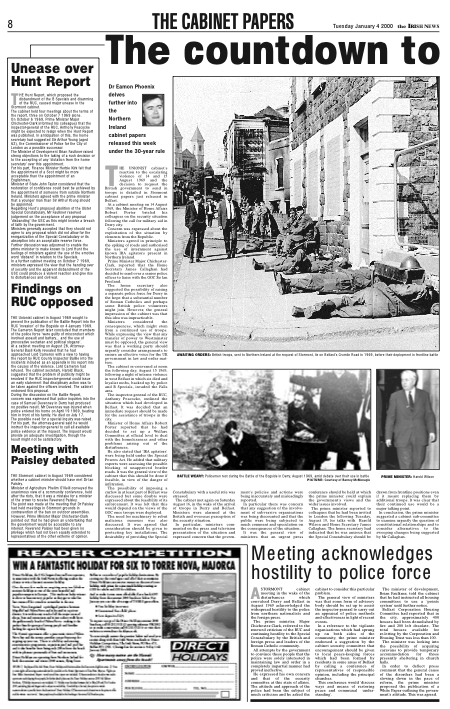
The Countdown to Troops on Our Streets
The Unionist cabinet’s reaction to the escalating violence of 14 and 15 August 1969 and the decision to request the British government to send in troops is detailed in Stormont cabinet papers just released in Belfast.
At a cabinet meeting on 14 August 1969, the Minister of Home Affairs Robert Porter briefed his colleagues on the security situation following the call for military aid in Derry city. Concern was expressed about the exploitation of the situation by elements from the Republic.
Ministers agreed in principle to the spiking of roads and authorised the use of internment against known IRA agitators present in Northern Ireland.
Prime Minister Major Chichester-Clark reported that the Home Secretary James Callaghan had decided to send over a senior police officer to liaise with the GOC, Sir Ian Freeland.
The Home Secreary also suggested the possibility of raising a separate police force for Derry in the hope that a substantial number of Roman Catholics and perhaps some British police volunteers might join. However, the general impression of the cabinet was that this idea was impracticable.
Ministers considered the consequences which might stem from a continued use of troops. While expressing the view that any transfer of power to Westminster must be opposed, the general view was that a working party should urgently consider arrangements to ensure an effective voice for the UK government in law and order matters.
The cabinet re-convened at noon the following day, August 15 1969, following a night of intense violence in west Belfast in which six died and loyalist mobs, backed up by police and B Specials, invaded the Falls area.
The inspector-general of the RUC, Anthony Peacocke, outlined the situation which had developed in Belfast. It was decided that an immediate request should be made for the assistance of troops in the city.
Minister of Home Affairs Robert Porter reported that he had decided to set up a Welfare Committee at official level to deal with the homelessness and other problems arising out of the disturbances.
He also stated that IRA agitators were being held under the Special Powers Act. He added that military experts were assessing the possible blocking of unapproved border roads. It was the general view of the cabinet that this should be done if feasible, in view of the danger of infiltration.
The possibility of imposing a curfew in at least part of Belfast was discussed but some doubts were expressed about the feasibility of its enforcement. It was felt that this would depend on the views of the GOC once troops were deployed.
The need for machinery to rebut malicious rumours was also discussed. It was agreed that consideration should be given to protecting key installations. The desirability of providing the Special Constabulary with a useful role was stressed.
The cabinet met again on Saturday August 16, in the wake of the arrival of troops in Derry and Belfast. Ministers were alarmed at the British and overseas perception of the security situation.
In particular, ministers commented on the press and television presentation of the situation and expressed concern that the government’s policies and actions were being inaccurately and misleadingly reported.
It was the general view of ministers that an urgent press conference should be held, at which the Prime Minister could explain the government’s views and the wider issues involved.
The prime minister reported to colleagues that he had been invited to London the following Tuesday, August 19, for talks with Harold Wilson and Home Secretary James Callaghan.
The home secretary had indicated that he was anxious that the Special Constabulary should be drawn from frontline positions even if it meant replacing them with additional troops. It was clear that their continued use would be a major talking point.
In conclusion, the prime minister suggested a cabinet sub-committee to examine urgently the question of constitutional relationships and to consider alternatives to the sweeping changes being suggested by Mr Callaghan.
Unease over Hunt Report
The Hunt Report, which proposed the disbandment of the B Specials and disarming of the RUC, caused major unease in the Stormont cabinet.
The cabinet held four meetings about the terms of the report, three on October 7 1969 alone. On October 6 1969, Prime Minister Major Chichester-Clark informed his colleagues that the inspector-general of the RUC, Anthony Peacocke, might be expected to resign when the Hunt Report was published. In anticipation of this, the home secretary had suggested Sir Arthur Young (aged 62), the Commissioner of Police for the City of London, as a possible successor.
The Minister of Development Brian Faulkner raised strong objections to the taking of a rush decision or to the accepting of any “dictation from the home secretary” over this appointment.
For his part, Finance Minister Herbie Kirk felt that the appointment of a Scot might be more acceptable than the appointment of an Englishman.
Minister of State John Taylor considered that the restoration of confidence could best be achieved by the appointment of someone from outside Northern Ireland. Ministers agreed with the prime minister that a younger man than Sir Arthur Young should be appointed.
Regarding Hunt’s proposed abolition of the Ulster Special Constabulary, Mr Faulkner reserved judgement on the acceptance of any proposal “disbanding” the USC as this might involve a breach of faith by the government.
Ministers generally accepted that they should not agree to any proposal which did not allow for the reorganisation of the Special Constabulary or its absorption into an acceptable reserve force. Further discussion was adjourned to enable the prime minister to make known to Lord Hunt the feelings of ministers against the use of the emotive word “disband” in relation to the Specials.
In a further cabinet meeting on October 7 1969, ministers expressed the view that the handing over of security and the apparent disbandment of the USC could produce a violent reaction and give rise to disturbances and civil war.
Findings on RUC Opposed
The Unionist cabinet in August 1969 sought to prevent the publication of the Baillie Report into the RUC “invasion” of the Bogside on 4 January 1969. The Cameron Report later concluded that members of the police force “were guilty of misconduct which involved assault and battery… and the use of provocative sectarian and political slogans.”
At a cabinet meeting on August 28, Attorney-General Basil Kelly revealed that he had approached Lord Cameron with a view to having the report by RUC County Inspector Baillie into the incidents included as an appendix in his report into the causes of the violence. Lord Cameron had refused.
The cabinet secretary, Harold Black, suggested that the problem of publicity might be resolved if the RUC inspector-general could issue an early statement that disciplinary action was to be taken against the officers involved. The cabinet endorsed this proposal.
During the discussion on the Baillie Report, concern was expressed that police inquiries into the case of Samuel Devenney in Derry had produced no positive result. Mr Devenney was injured when police entered his home on April 19 1969, beating him in front of his family. He died on July 17.
The possible need for a special inquiry was raised. For his part, the attorney-general said he would instruct the inspector-general to call all available police evidence at the inquest. The inquest would provide an adequate investigation, though the result might not be satisfactory.
Meeting with Paisley Debated
The Stormont cabinet in August 1969 considered whether a cabinet minister should have met Dr Ian Paisley.
Minister of Agriculture Phelim O’Neill conveyed the unanimous view of a community conference, held after the riots, that it was a mistake for a minister of the crown to receive Reverend Paisley.
The point was made at the meeting that Dr Paisley had held meetings in Stormont grounds in contravention of the ban on outdoor assemblies. However, Prime Minister Major Chichester-Clark pointed out that he had given an undertaking that the government would be accessible to any interest.
Reverend Paisley had been given no privilege which had not been equally extended to representatives of the other extreme of opinion.
Meeting Acknowledges Hostility to Police Force
A Stormont cabinet meeting in the wake of the disturbances which convulsed Derry and Belfast in August 1969 acknowledged the widespread hostility to the police from northern nationalists and the foreign press.
The prime minister, Major Chichester-Clark, referred to the renewed criticism of the RUC and continuing hostility to the Special Constabulary by the British and foreign press and leaders of the Roman Catholic community.
All attempts by the government to convince these people that the police were solely interested in maintaining law and order in a completely impartial manner had proved ineffective.
He expressed his own concern and that of the security committee at this state of affairs. The attitude and approach of the police had been the subject of much criticism and he asked the cabinet to consider this particular problem.
The general view of ministers was that some form of advisory body should be set up to assist the inspector-general to carry out an appraisal of police methods and effectiveness in light of recent events.
In a reference to the vigilante organisations which had sprung up on both sides of the community, the prime minister endorsed a suggestion by the cabinet security committee that encouragement should be given to local peacekeeping forces which had been formed by residents in some areas of Belfast by calling a conference of representatives of responsible opinion, including the principal churches.
This conference would “discuss ways and means of restoring peace and communal understanding.”
The minister of development, Brian Faulkner, told the cabinet that he had instructed all housing committees to use a “points system” until further notice.
Belfast Corporation Housing Committee had reported that in the city, approximately 400 houses had been demolished by fire and 200 left desolate. The total houses available for re-letting by the Corporation and Housing Trust was less than 100.
The minister was looking into the possibility of acquiring caravans to provide temporary accommodation for those presently sheltering in church halls.
In order to deflect press comment that the general cause of the disorders had been a slowing down in the pace of reform, the prime minister proposed the publication of a White Paper outlining the government’s attitude. This was agreed.