

1968 State Papers (page 2)
January 02 1999
Publication Date
Ministers bid to curb nationalist discontent, UK Government raises pressure for reform, RUC called first rights march ‘IRA gathering’, Nationalists urged deal to foil militants, Paisley - 'clergyman of some conviction'
State Paper Snippet
Ministers bid to curb nationalist discontent
THE likelihood that major concessions would have to be made to the mounting civil rights campaign was considered by the O’Neill cabinet at a meeting on November 14,1968.
The prime minister circulated a letter from Edmond Warnock, KC, MP for St Anne’s and a former attorney general, underlining the need for amnesty for those prosecuted as a result of the civil rights march in Derry on October 5 and the urgent need for radical reform. Warnock warned Captain O’Neill the prosecution of the civil rights demonstrators would be disastrous. “It will almost certainly give new life to republicanism, it will alienate all moderate opinion in the nationalist party,” he said.
Warnock, associated with the unionist right-wing in the 1950s, was openly sympathetic to the sense of injustice of the Derry marchers, telling O’Neill. “If ever a community had a right to demonstrate against a denial of civil rights, Derry is the finest example. A Roman Catholic and nationalist city has for three or four decades been administered (and none too fairly administered) by a Protestant and unionist majority, secured by manipulation of the ward boundaries for the sole purpose of retaining unionist control.”
Warnock provided a personal insight into the gerrymandering of Derry in 1936. “I was consulted by Sir James Craig, Dawson Bates and R D Megaw at the time it was done. Craig thought that the fate of our constitution was on a knife edge at that time and in the circumstances, it was defensible. It was clearly understood that the arrangement was to be a temporary measure – five years was mentioned,” he said.
On the question of an amnesty, Warnock acknowledged that “we have a number of hardliners in parliament but who would give a fig for the views of men like John Brooke or Desmond Boal. There is a pretty solid lot of moderates and the country should not be led to the brink of ruin by violent men again”.
He urged Captain O’Neill to make a bold decision.
The former attorney’s letter was raised at the cabinet meeting on November 14,1968. The prime minister stated that before the recent meeting with Mr Wilson he had urged the need to bring to Downing Street a programme of realistic reform. The cabinet had not been able to agree to any such proposals. For his part, he was not convinced that things would settle down. It was his fear that scenes of dissension and riot would be repeated. Since the entire future of Northern Ireland was at stake, the government must take the action necessary, however unpopular.
The Minister of Agriculture Major Chichester-Clark supported Mr Warnock’s view that an amnesty should be considered “in return for an undertaking by responsible nationalists to try to prevent further agitation”. In the upshot it was agreed that the Minister of Home Affairs Mr Craig and the attorney-general should explore the possibility of an adjournment of the cases and that the minister of agriculture should sound out the Nationalist Chief Whip, Mr R H O’Connor about the possibility of “taking the heat out of the situation”.
Turning to the long-term situation Major Chichester-Clark argued that it would be a grave mistake to view the situation purely in law and order terms. They must now consider a “package deal” which would address the situation. “So far the record had been one of too little conceded too late,” he said.
“They ought now to offer, not a grudging instalment of reform, but the maximum concessions compatible with their vital political interests, The Londonderry grievances were real grievances.”
The prime minister warned that further demonstrations were in prospect.
Major Chichester-Clark outlined his “package deal”. This included the establishment of a commission to report on grievances.
The minister of home affairs was attracted to the idea as a device to “cool down” the current civil rights situation. Other proposed measures included the abolition of the company vote in local elections, the settling of the dispute with the Mater hospital and measures to ensure fair allocation of public housing. Ministers failed to agree on the reform of the local government franchise. The PM reminded his code agues that their arguments in favour of the present franchise had been rejected by the British prime minister.
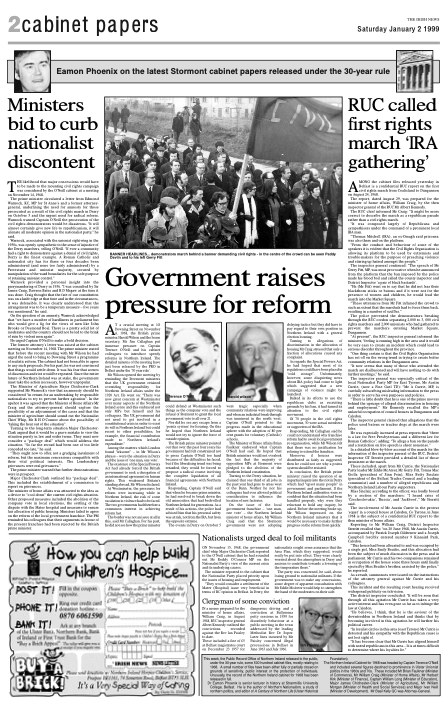
Government raises pressure for reform
AT a crucial meeting at 10 Downing Street on November 4, 1968, the British prime minister, Harold Wilson and the home secretary, Mr Jim Callaghan put immense pressure on Captain Terence O’Neill and his cabinet colleagues to introduce speedy reforms in Northern Ireland. The detailed minutes of the meeting have just been released by the PRO in Belfast under the ‘30 year rule’.
Mr Wilson opened the meeting by reminding the Stormont ministers that the UK government retained overriding responsibility for Northern Ireland affairs under the 1920 Act. He went on: “There was now great concern at Westminster over many aspects of the Northern Ireland scene and this embraced not only MPs but himself and his colleagues. The UK government did not need to get involved in a constitutional crisis in order to exert its will in Northern Ireland but could resort to other possibilities, for example, the financial contribution made to Northern Ireland’s expenditure.”
Among the matters which London found “irksome” – in Mr Wilson’s phrase – were the situation in Derry and the issue of ‘one man, one vote’.
The existence of the Special Powers Act had already forced the British government to seek a derogation of an international agreement on human rights. This weakened Britain’s standing abroad, Mr Wilson declared.
At Westminster, the pressures for reform were increasing while in Northern Ireland, the risk of some escalation in violence had to be faced. The two governments had therefore a common interest in achieving reform fast
The border was not an issue at all in this, said Mr Callaghan. For his part, he did not see how the prime minister could defend at Westminster such things as the company vote and the refusal of Stormont to grant the local government vote to all over 21.
Nor did he see any escape from a ‘points system’ for housing. On this he hoped that Northern Ireland would not try to ignore the force of outside opinion.
The British prime minister pointed out that over the past four years his government had felt constrained not to press Captain O’Neill too hard because of the difficulties he faced, but if the liberalising trend was being retarded, they would be forced to propose a radical course involving the complete liquidation of all financial agreements with Northern Ireland.
Responding, Captain O’Neill said that when he became prime minister, he had resolved to break down the old animosities that had bedevilled Northern Ireland for generations. As a result of his actions, the police had advised him that his personal safety was at risk, not from the IRA, but from the opposite extreme.
The events in Derry on October 5 were tragic especially when community relations were improving and when an industrial break-through was imminent in the north west. Captain O’Neill pointed to the progress made in the educational sphere with the adoption of 80 per cent grants for voluntary (Catholic) schools.
The Minister of Home Affairs Brian Faulkner endorsed what Captain O’Neill had said. He hoped that British ministers would not overlook the fact that the majority of opposition MPs at Stormont were pledged to the abolition of the Northern Ireland constitution.
Turning to the Derry situation, he claimed that one third of all jobs in the past year had gone to areas west of the Bann. Neither he nor his colleagues had ever allowed political consideration to influence the location of new factories.
On the issue of the local government franchise – ‘one man, one vote’ – the Northern Ireland minister of home affairs, Mr William Craig said that the Stormont government were not adopting delaying tactics but they did have to pay regard to their own position in Northern Ireland with a general election looming.
Turning to allegations of discrimination in the allocation of housing Mr Craig stressed that only a fraction of allocations caused any complaint.
As regards the Special Powers Act, he had hoped that most of its regulations could have been placed in “cold storage”. Unfortunately, however, some disquieting news about IRA policy had come to light which suggested that a new campaign of violence might be launched.
Balked in its efforts to use the republican clubs as recruiting grounds by his ban, it had turned its attention to the civil rights movement.
Of 70 people in the civil rights movement, 30 were actual members or supporters of the IRA.
Responding, Mr Callaghan said he could not understand why franchise reform had to await local government re-organisation, while Mr Wilson felt that there was no justification for refusing to extend the franchise.
Moreover, if houses were distributed as fairly as suggested, then he could not see why a points system should be resisted.
In conclusion, the British prime minister raised the question of an impartial inquiry into the riot in Derry which had “upset many people” in government and parliament. If the Northern Ireland authorities were so confident that the situation had been handled properly, why were they reluctant to hold any inquiry, he asked. Before the meeting broke up, Mr Wilson impressed on the Northern Ireland ministers that it would be necessary to make further progress on the reform front quickly.
Nationalists urged deal to foil militants
ON November 15, 1968, the government chief whip Major Chichester-Clark reported to the O’Neill cabinet that he had sounded out Mr Roddy O’Connor MP on the Nationalist Party’s view of the current crisis and its underlying causes.
The minister reported to the cabinet that the Nationalist Party placed priority upon the issues of housing and employment.
“They would consider a settlement of the Mater (Hospital) issue very beneficial in terms of RC opinion in Belfast. In Derry, the
nationalists sought some assurance that the Area Plan, which they supported, would really be put into effect. They were clearly worried about the atmosphere in Derry and anxious to contribute towards a lowering of the temperature there.”
The party was concerned, he said, about losing ground to nationalist militants. If the government was to make any concessions, some degree of apparent consultation with Mr Eddie McAteer would help to strengthen the hand of the moderates on their side.
Clergyman of some conviction
IN a memo prepared for the minister of home affairs, William Craig, in August 1968, RUC inspector general Albert Kennedy outlined the convictions recorded against the Rev Ian Paisley to date.
These included a fine of £5 at Belfast magistrates court on December 23 1957 for dangerous driving and a conviction at Ballymena petty sessions in 1959 for disorderly behaviour at a public meeting in the town addressed by the leading Methodist Rev Dr Soper. Later fines incurred by Mr Paisley concerned illegal processions in Belfast in June 1963 and July 1966.