

1967 State Papers (page 1)
January 01 1998
Publication Date
Unionist EEC fears revealed in ’ 67 files, Union flag in schools, Cabinet of high-profile unionists, Split on jobs for Derry, ‘Ulster’ favoured, ‘No’ to joint Customs, Forebodings of 30 years of turmoil.
State Paper Snippet
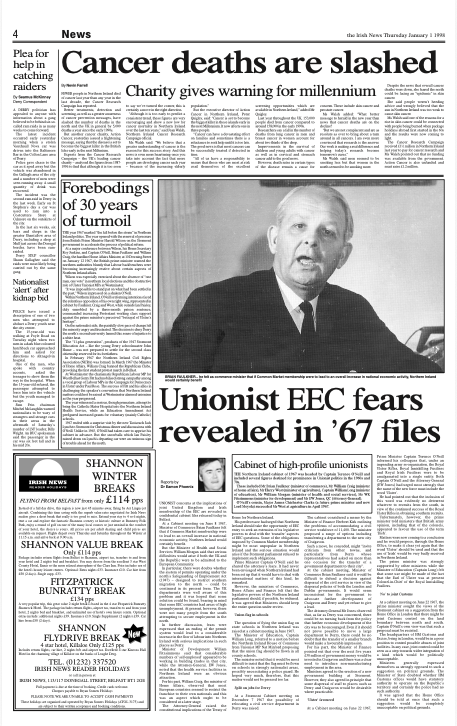
Unionist EEC fears revealed in ’ 67 files
UNIONIST concerns at the implications of joint United Kingdom and Irish membership of the EEC are revealed in confidential cabinet files released today in Belfast.
At a Cabinet meeting on June 8 1967, Minister of Commerce Brian Faulkner felt that if Common Market membership were to lead to an overall increase in national economic activity, Northern Ireland would certainly benefit.
But the Minister of Health and Social Services William Morgan said that serious difficulties would arise if both the UK and the Republic were to be admitted to the European Community.
In particular; there were doubts whether the system of permits operating under the north’s Safeguarding of Employment Act (1947) – designed to restrict southern migration to the north – could be continued in its present form.
The UK departments were well aware of this problem and it was hoped that some solution could be found, bearing in mind that some EEC countries had areas of high unemployment. At present, however; there were not many people from the south attempting to secure employment in the north.
In further discussion, fears were expressed that an ending of the permit system would lead to a considerable increase in the flow of labour into Northern Ireland with serious implications in such places as Derry.
Minister of Development William Fitzsimmons said that considerable numbers of ‘self-employed’ appeared to be working in building trades in that city, while the Attorney-General, EW Jones, noted that the health service facilities in Northern Ireland were an obvious attraction.
For his part, William Craig, the minister of Home Affairs, observed that most European countries seemed to restrict the franchise to their own nationals and this was an aspect which ought to be considered at a later stage.
The Attorney-General raised the constitutional implications of the Treaty of Rome for Northern Ireland.
His predecessor had urged that Northern Ireland should take the opportunity of EEC entry to seek an extension of its legislative powers to deal with the ‘transfer’ aspects of EEC questions.
Some of the obligations imposed by Common Market membership might be most unpopular in Northern Ireland and the serious situation would arise if the Stormont parliament refused to implement such obligations.
Prime Minister Captain O’Neill said he shared the attorney’s fears. It had never been envisaged when Northern Ireland had been set up that it would have to deal with international matters of this kind, he remarked.
However; the ministers of Commerce, Home Affairs and Finance felt that the legislative powers of the Northern Ireland parliament should, if possible, be widened. It was agreed that Ministers should keep the entire question under review.
Union flag in schools
The question of flying the union flag on state schools in Northern Ireland was raised at a cabinet meeting in June 1967.
The Minister of Education, Captain William Long, referred to a motion before the Northern Ireland House of Commons from Unionist MP Nat Minford proposing that the union flag should be flown in all county schools.
The minister noted that it would be most difficult to insist that the flag must be flown on schools in strongly nationalist areas, possibly necessitating a police guard. He hoped very much, therefore, that this matter would not be pressed too far.
Cabinet of high-profile unionists
THE Northern Ireland cabinet of 1967 was headed by Captain Terence O’Neill and included several figures destined for prominence in Unionist politics in the 1960s and 70s.
These included Mr Brian Faulkner (minister of commerce), Mr Wiliam Craig (minister of home affairs), Mr Harry West (minister of agriculture), Captain Wiliam Long (minister of education), Mr William Morgan (minister of health and social services), Mr WK Fitzsimmons (minister for development) and Mr EW Jones, QC (Attorney-General).
O’Neill’s cousin, Major James Chichester-Clarke (a future prime minister and now Lord Moyola) succeeded Mr West at agriculture in April 1967.
Split on jobs for Derry
At a Stormont Cabinet meeting on December 7 1967 the possibility of relocating a civil service department in Derry was raised.
The cabinet considered a memo by the Minister of Finance Herbert Kirk outlining the problems of accommodating a civil service workforce of 11,400. The minister proposed a range of options including transferring a department to the new city of Craigavon.
Such a move, he conceded, might “invite criticism from other towns, and particularly from Derry whose representatives had asked on more than one occasion for the transfer of a government department to their city”.
At the cabinet meeting, Minister of Commerce Brian Faulkner said it would be difficult to defend a decision against dispersal of the civil service in view of the dispersal policies of both the London and Dublin governments. It would seem inconsistent for the government to advocate further development of Craigavon and Derry and yet refuse to give a lead.
The Attorney-General Mr Jones observed that, as far as Derry was concerned, there could be no turning back from the policy that further economic development of the city was to be encouraged. Even if it should not prove possible to move a large department to Derry, there could be no doubt that the transfer of a smaller branch would make a favourable impression.
For his part, the Minister of Finance pointed out that over the next five years £30 million of government money would be invested in Craigavon and there was a clear need to introduce non-manufacturing employment in the area.
Ministers agreed to the erection of a new government building at Stormont. However; they also agreed in principle that some dispersal of staff to places such as Derry and Craigavon would be desirable where practicable.
‘Ulster’ favoured
At a Cabinet meeting on June 22 1967, Prime Minister Captain Terence O’Neill informed his colleagues that, under an impending army re-organisation, the Royal Ulster Rifles, Royal Inniskilling Fusiliers and Royal Irish Fusiliers were to be amalgamated into a single entity. Both Captain O’Neill and the Attorney-General (EW Jones) had urged most strongly that the name of the new force must include the word ‘Ulster’.
He had pointed out that the inclusion of this word was evidently no deterrent whatever to recruits from the south, in view of the continued success of the Royal Ulster Rifles in obtaining southern recruits.
Unfortunately, however, the prime minister told ministers that British army opinion, including that of the colonels, appeared to favour the use of the term ‘Irish’.
Matters were now coming to a conclusion and he would propose, through the Home Office, to make it clear yet again that the word ‘Ulster’ should be used and that the use of ‘Irish’ would be very badly received in Northern Ireland.
The prime minister was strongly supported by other ministers while the Minister of Education (Captain Long) felt that some use might be made of the fact that the Earl of Ulster was at present Colonel-in-Chief of the Royal Inniskilling Fusiliers.
‘No’ to joint Customs
At a cabinet meeting on June 22 1967, the prime minister sought the views of the Stormont cabinet on a suggestion from the Home Office in London that there might be joint Customs control on the land boundary between north and south. Captain O’Neill’s own view was that such a proposal must be resisted.
The headquarters of HM Customs and Excise, being in London, would be in a poor position to control possible abuses of joint facilities. In any case, joint control could be seen as a step towards wider integration of a kind which would be politically unacceptable.
Ministers generally expressed themselves as strongly opposed to such a suggestion on political grounds. The Minister of State doubted whether HM Customs offices would have statutory authority to operate on the Republic’s territory and certainly the police had no such authority.
It was agreed that the Home Office should be told at once that such a suggestion would be completely unacceptable on political grounds.
Forebodings of 30 years of turmoil
THE year 1967 marked “the lull before the storm” in Northern Ireland politics. The year opened with the renewal of pressure from British Prime Minister Harold Wilson on the Stormont government to accelerate the process of political reform.
At a major conference between Wilson, his Home Secretary Roy Jenkins, and Captain O’Neill, Brian Faulkner and William Craig, the hardline Home Affairs Minister; at 10 Downing Street on January 12 1967, the British prime minister warned the northern authorities bluntly that Labour backbenchers were becoming increasingly restive about certain aspects of Northern Ireland affairs.
Wilson was especially exercised about the absence of “one man, one vote” in northern local elections and the obstructive role of Ulster Unionist MPs at Westminster.
“It was impossible to stand pat on what had been settled in the past,” Wilson impressed on a shaken O’Neill.
Within Northern Ireland, O’Neill’s reforming intentions faced the relentless opposition of his own right wing, represented in cabinet by Faulkner Craig and West, while outside Ian Paisley, duly ennobled by a three-month prison sentence, commanded increasing Protestant working class support against the prime minister’s perceived “betrayal of Ulster’s heritage”.
On the nationalist side, the painfully slow pace of change left the minority angry and frustrated. The decision to deny Derry the north’s second university fanned this sense of injustice to a white heat.
The “11-plus generation”, products of the 1947 Stormont Education Act – like the young Derry schoolmaster John Hume – was not prepared to settle for the second class citizenship reserved for its forefathers.
In February 1967 the Northern Ireland Civil Rights Association (NICRA) was formed. In March 1967 the Minister of Home Affairs, William Craig banned the Republican Clubs, provoking the first student protest march in Belfast.
At Westminster, the charismatic Republican Labour MP for West Belfast, Gerry Fitt, had mobilised strong sympathy among a vocal group of Labour MPs in the Campaign for Democracy in Ulster under Paul Rose. The success of Fitt and his allies in challenging the speaker’s convention that Northern Ireland matters could not be raised at Westminster alarmed unionism as the year progressed.
The year witnessed a serious, though premature, attempt to bring the Catholic Mater Hospital into the Northern Ireland Health Service, while an Education Amendment Act prefigured increased grants for voluntary (mainly Catholic) schools.
1967 aided with a surprise visit by the new Taoiseach Jack Lynch to Stormont for Christmas dinner and discussions with O’Neill. Unlike in 1965, O’Neill had taken care to apprise his cabinet in advance. But the snowballs which fan Paisley rained down on Lynch’s departing car were an ominous sign of trouble ahead for the north.