

1965 State Papers (page 1)
January 01 1996
Publication Date
Papers reveal unionist alarm over civil rights, Casement’s body barred from North, Cabinet files on 1965 are released
State Paper Snippet
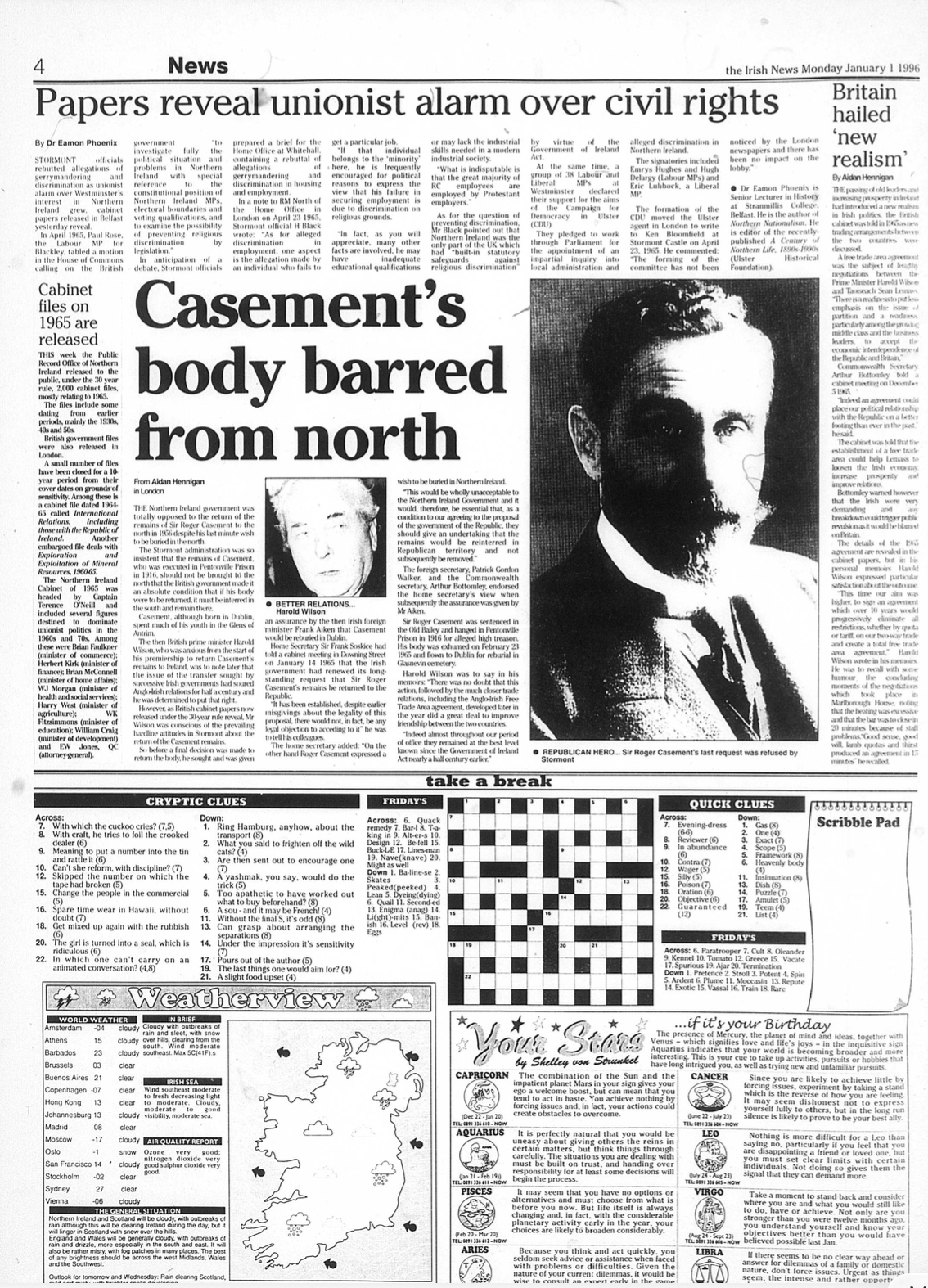
Papers reveal unionist alarm over civil rights
STORMONT officials rebutted allegations of gerrymandering and discrimination as unionist alarm over Westminster’s interest in Northern Ireland grew, cabinet papers released in Belfast yesterday reveal.
In April 1965, Paul Rose, the Labour MP for Blackley, tabled a motion in the House of Commons calling on the British government “to investigate fully the political situation and problems in Northern Ireland with special reference to the constitutional position of Northern Ireland MPs, electoral boundaries and voting qualifications, and to examine the possibility of preventing religious discrimination by legislation.”
In anticipation of a debate, Stormont officials prepared a brief for the Home Office at Whitehall containing a rebuttal of allegations of gerrymandering and discrimination in housing and employment.
In a note to RM North of the Home Office in London on April 23, 1965, Stormont official H. Black wrote:
“As for alleged discrimination in employment, one aspect is the allegation made by an individual who fails to get a particular job.
“If that individual belongs to the ‘minority’ here, he is frequently encouraged for political reasons to express the view that his failure in securing employment is due to discrimination on religious grounds.
“In fact, as you will appreciate, many other factors are involved, he may have inadequate educational qualifications or may lack the industrial skills needed in a modern industrial society.
“What is indisputable is that the great majority of RC employees are employed by Protestant employers.
As for the question of preventing discrimination, Mr. Black pointed out that Northern Ireland was the only part of the UK which had “built-in statutory safeguards against religious discrimination by virtue of the Government of Ireland Act.”
At the same time, a group of 38 Labour and Liberal MPs at Westminster declared their support for the aims of the Campaign for Democracy in Ulster (CDU).
They pledged to work through Parliament for the appointment of an impartial inquiry into local administration and alleged discrimination in Northern Ireland.
The signatories included Emrys Hughes and Hugh Delargy (Labour MPs) and Eric Lubbock, a Liberal MP.
The formation of the CDU moved the Ulster Agent in London to write to Ken Bloomfield at Stormont Castle on April 23, 1965. He commented:
“The forming of the committee has not been noticed by the London newspapers and there has been no impact on the lobby.”
Casement’s body barred from North
THE Northern Ireland government was totally opposed to the return of the remains of Sir Roger Casement to the North in 1956 despite his last-minute wish to be buried there.
The Stormont administration was so insistent that the remains of Casement, who was executed in Pentonville Prison in 1916, should not be brought to the North that the British government made it an absolute condition that if his body were to be returned, it must be interred in the South and remain there.
Casement, although born in Dublin, spent much of his youth in the Glens of Antrim.
The then British Prime Minister Harold Wilson, who was anxious from the start of his premiership to return Casement’s remains to Ireland, was to note later that the issue of the transfer, sought by successive Irish governments, had soured Anglo-Irish relations for half a century and he was determined to put that right.
However, as British Cabinet papers now released under the 30-year rule reveal, Mr. Wilson was conscious of the prevailing hardline attitudes in Stormont about the return of the Casement remains.
So before a final decision was made to return the body, he sought and was given an assurance by the then Irish Foreign Minister Frank Aiken that Casement would be reburied in Dublin.
Home Secretary Sir Frank Soskice had told a Cabinet meeting in Downing Street on January 14, 1965, that the Irish government had renewed its long standing request that Sir Roger Casement’s remains be returned to the Republic.
“It has been established, despite earlier misgivings about the legality of this proposal, there would not, in fact, be any legal objection to acceding to it,” he was to tell his colleagues.
The Home Secretary added: “On the other hand, Roger Casement expressed a wish to be buried in Northern Ireland.
This would be wholly unacceptable to the Northern Ireland government and it would, therefore, be essential that, as a condition to our agreeing to the proposal of the government of the Republic, they should give an undertaking that the remains would be reinterred in Republican territory and not subsequently be removed.”
The Foreign Secretary, Patrick Gordon Walker, and the Commonwealth Secretary, Arthur Bottomley, endorsed the Home Secretary’s view when subsequently the assurance was given by Mr. Aiken.
Sir Roger Casement was sentenced in the Old Bailey and hanged in
Pentonville Prison in 1916 for alleged high treason. His body was exhumed on February 23, 1965, and flown to Dublin for reburial in Glasnevin Cemetery.
Harold Wilson was to say in his memoirs: “There was no doubt that this action, followed by the much closer trade relations, including the Anglo-Irish Free Trade Area Agreement developed later in the year, did a great deal to improve friendship between the two countries.
Cabinet files on 1965 are released
THIS week, the Public Record Office of Northern Ireland released to the public, under the 30 year rule, 2,000 cabinet files, mostly relating to 1965.
The files include some dating from earlier periods, mainly the 1930s, 40s, and 50s.
British government files were also released in London.
A small number of files have been closed for a 10 year period from their cover dates on grounds of sensitivity. Among these is a Cabinet file dated 1964-65 called International Relations, including those with the Republic of Ireland. Another embargoed file deals with Exploration and Exploitation of Mineral Resources, 1960-65.
The Northern Ireland Cabinet of 1965 was headed by Captain Terence O’Neill and included several figures destined to dominate unionist politics in the 1960s and 70s. Among these were Brian Faulkner (Minister of Commerce), Herbert Kirk (Minister of Finance), Brian McConnell (Minister of Home Affairs), W. J. Morgan (Minister of Health and Social Services), Harry West (Minister of Agriculture), W. K. Fitzsimmons (Minister of Education), William Craig (Minister of Development), and E. W. Jones, QC (Attorney-General).