

1964 State Papers (page 2)
January 03 1995
Publication Date
‘Help to the Mater’ Split Unionists, Tunnel Link with Scotland under ReviewColeraine University Campus Plan ‘Would Cause Alarm’, South Africa embarrassed Britain with use of special powers act, Religious Discrimination under Tory Microscope, O'Neill Feared the Nationalists as Stormont Opposition
State Paper Snippet
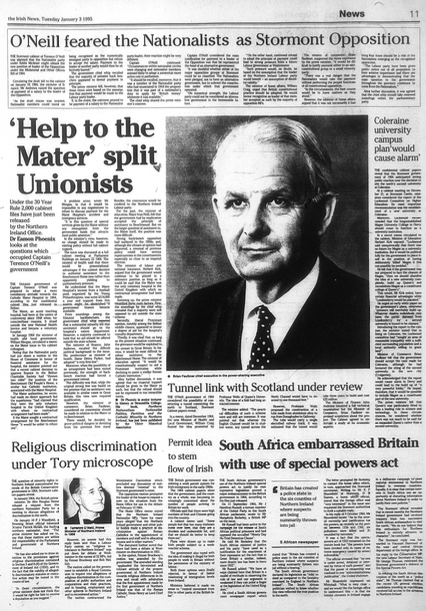
‘Help to the Mater’ Split Unionists
Under the 30-Year Rule, 2,000 cabinet files have just been released by the Northern Ireland Office. Dr. Eamon Phoenix looks at the questions which occupied Captain Terence O’Neill’s government.
THE Unionist government of Captain Terence O’Neill was prepared to adopt a more conciliatory attitude towards the Catholic Mater Hospital in 1964, according to the confidential cabinet files just released in Belfast.
The Mater, an acute teaching hospital, had been at the centre of controversy since 1948 when, for conscientious reasons, it stood outside the new National Health Service and became a voluntary hospital.
In January 1964, the Minister of Health and Local Government, William Morgan, circulated a memo on the Mater issue to his cabinet colleagues.
Noting that the Nationalist Party had put down a motion in the House of Commons in favour of financial assistance for the hospital, the minister pointed out that a recent cabinet decision to approve finance for the Belfast Charitable Society had “thrown into relief the position of the Beechmount Old People’s Home,” a similar but Catholic institution associated with the Mater Hospital.
The Mater authorities, he wrote, had made no direct approach, but the superioress “had claimed that they were the only voluntary hospital in the United Kingdom with whom contractual arrangements had been made.”
If the Mater sought a contractual arrangement for the Beechmount Home, “it would be unfair to refuse one.”
A problem arose, wrote Mr. Morgan, in that it would be impossible in any negotiations to refuse to discuss payment for the Mater Hospital’s accident and emergency services.
“It is this question of special services given by the Mater without any recoupment from government funds that attracts most public attention.”
In the minister’s view, however, no change should be made in existing policy without full cabinet support.
The issue was discussed at a full cabinet meeting at Parliament Buildings on January 22, 1964. The Minister of Health said that there would be presentational advantages if the cabinet decided to authorise assistance to the Beechmount Home now, rather than appear to yield to parliamentary pressure.
He understood that the Mater Hospital’s income from a football pool, organised by the Young Philanthropists, was about £114,000 a year, and support from this source might be diminished “if government finance became available.”
From soundings among the Unionist backbenchers, the government chief whip reported that a substantial minority felt that assistance should go to the hospital’s extern department. However, a majority continued to hold that no aid should be offered outside the state scheme.
The Minister of Finance, John Andrews, recalled the difficult political background to the issue. His predecessor as Minister of Health, Dame Debra Parker, had adopted “a very firm line.”
Moreover, when the possibility of an arrangement had been muted previously, the strength of backbench reaction had forced a government retreat.
The difficulty was that, while the original strong line was based on the premise that no assistance was available in similar cases in Great Britain, this view now required qualification.
However, the Minister of Commerce, Brian Faulkner, considered no concession should be made in relation to the Mater or to Beechmount.
“There would, he decided be grave political dangers in deviating from the previous firm stand. Besides, the concession would be credited to the Northern Ireland Labour Party.”
For his part, the Minister of Education, Major Ivan Neill, felt that the government had, by implication, accepted the principle of assistance to Beechmount. But on the larger question of assistance to the Mater itself, the position was more difficult.
Strong backbench opposition had surfaced in the 1950s; and although the climate of opinion had improved, a reversal of previous policy could have serious repercussions in the constituencies, especially so close to an imperial election.
The Minister of Labour and National Insurance, Herbert Kirk, argued that the government would continue to be placed in a defensive position as long as it could be said that the Mater was the only voluntary hospital in the United Kingdom with which no contractual arrangement had been made.
Summing up, the Prime Minister identified three main factors: first, the chief whip’s soundings revealed that a majority were still opposed to aid outside the state scheme.
Secondly, liberal Protestant opinion, notably among the Belfast middle classes, appeared to favour a degree of aid for the hospital’s casualty department.
Thirdly, it was clear that, as long as the present situation continued, the grievance would be exploited to the utmost in Great Britain. In his view, it would be most difficult to refuse assistance to the Beechmount Home. The Minister of Education agreed: “It would be constitutionally suspect to aid a Protestant institution while declining to assist a similar Roman Catholic institution.”
After further discussion, it was agreed that no financial support should be given to the Mater as such, but that the refusal should not be expressed in too intractable terms.
Dr. Eamon Phoenix is a senior lecturer in history at Stranmillis College. His book Northern Nationalism: Nationalist Politics, Partition and the Catholic Minority in Northern Ireland has just been published by the Ulster Historical Association.
Tunnel Link with Scotland under Review
The O’Neill government of 1964 considered the possibility of constructing a tunnel connecting the North to Scotland, Stormont Cabinet papers reveal.
In a memo dated December 1964, the new Minister of Health and Local Government, William Craig, floated the idea promoted by Professor Wells of Queen’s University. The idea of a link had long attracted interest.
The minister added: “The practical difficulties of such a scheme were and still are immense. It was pointed out that whereas the English Channel would be in shallow water, any tunnel across the North Channel would have to descend to one thousand feet.”
However, Professor Wells proposed the construction of a tube made from aluminium alloy to run from Donaghadee to Galloway.
The tube would carry a single electrified railway track. It was estimated that the tunnel would take three years to build and cost £35 million.
The Minister of Finance, John Andrews, favoured a full technical examination, but the Minister of Commerce, Brian Faulkner, expressed scepticism about the project. The Cabinet agreed to undertake a study of its economic aspects.
Coleraine University Campus Plan ‘Would Cause Alarm’
THE Confidential cabinet papers reveal that the Stormont government of 1964 anticipated strong public reaction over the decision to site the North’s second university at Coleraine.
At a cabinet meeting on December 21 at Stormont Castle, ministers considered the report of the Lockwood Committee on Higher Education. Its most important recommendation was the establishment of a new university at Coleraine.
Moreover, Lockwood recommended that the long-established Magee University College in Derry should cease to function as a university institution.
In a secret memo circulated to the cabinet, Minister of Education Herbert Kirk warned: “Lockwood said unequivocally that there was no future for Magee as a university institution. But it would be political folly for the government to place itself in the position of having deliberately ‘killed’ Magee if this can possibly be avoided.”
He felt that if the government was not prepared to face the closure of Magee, “then we should abandon the idea of a new university completely, build up Queen’s, and reconstitute Magee as a constituent college of Queen’s.”
This would, Mr. Kirk noted, have certain financial advantages while “Londonderry would be placated.”
He urged an early white paper on the government’s plans, otherwise, “pressure will inevitably build up. Whatever doubts individuals may have, the public demand from Londonderry for a second university is bound to be clamant.”
Introducing the report to the cabinet, the minister stated that in fixing on Coleraine, the Lockwood Committee had “sought an area of reasonable tranquility with a sufficient surrounding population and a local authority willing to grant land.”
Minister of Commerce Brian Faulkner felt that the government should accept the case made for Coleraine, although he had favoured the siting of the second university in the new city of (Craigavon).
He acknowledged that the report would cause alarm in Derry and could lead to the build-up of “a very powerful lobby.” He hoped, therefore, that it would be possible to include Magee as a constituent part of the new university.
The Prime Minister felt that Queen’s was particularly fitted to take a leading role in science and technology. In these circumstances, he wondered whether there was not much to be said for an expanded Queen’s rather than a second university.
South Africa embarrassed Britain with use of special powers act
THE South African government’s use of the Northern Ireland Special Powers Act to justify its own repressive legislation proved a major embarrassment to the British government in 1964, according to newly released files.
On 11 September 1964, Mr. J. Hamilton Russell, a former member of the United Party in the South African parliament, wrote to Mr. Humphrey Berkeley, a British MP, on the issue.
Mr. Russell, who had been active in the campaign for the release of South African political prisoners and had opposed the so called “Ninety-Day No-Trial Detention Clause,”
He told Mr Berkeley that the South African minister of justice and his party have used as justification for the enactment of their repressive act the fact that in Great Britain a similar, indeed more drastic, law has been in force since 1922.”
Mr Russell “We have always claimed here that Britain is a model of rectitude in observing the rule of law, and our argument is weakened if they can point a finger at the legislation of the United Kingdom.”
He cited a South African government newspaper report which stated that: “Britain has created a police state in the six counties of Northern Ireland where suspects are being summarily thrown into jail without a hearing.”
The South African government declared its legislation as “mild indeed as compared to the brutality exercised by England in Northern Ireland.” Mr. Russell wished to know whether this view reflected the true position in the North.
The letter prompted Mr. Berkeley to contact the Home Office, which, in turn, approached the Stormont secretariat. Writing to Mr. K.P. Bloomfield at Stormont, D.B. Staines, a Home Office official, stated that the Foreign Office was “very interested” in the issue and requested the Stormont authorities to draft a suitable reply.
In his reply of 9 October 1964, Mr. Bloomfield wrote: “As to the overall necessity and justification for the powers, as recently as the period between 1956 and 1962, six policemen were killed and 30 wounded by terrorists.”
It was a fact that the Special Powers Act of 1922 remained on the statute book but: “The powers have been invoked only in cases of extreme emergency caused by armed subversion.”
The officials stressed that “no one is under arrest, detained, or interned by virtue of such powers” and that the power of censorship was confined to one “anti-constitutional publication,” The United Irishman.
Mr. Bloomfield impressed on Whitehall: “What is very clear and we would like the Foreign Office to understand this is that extremist elements in Ireland engage in a deliberate campaign to plant material detrimental to Northern Ireland in overseas countries. Equally, it is clear that certain interests in South Africa see an opportunity of distorting information about Northern Ireland in order to justify their own policies.”
The Stormont official revealed that in recent months, the Northern Ireland government had received requests from two successive South African ambassadors to visit the North. “We do not believe that this enthusiasm for Northern Ireland is entirely altruistic in character,” he concluded.
The Stormont reply was forwarded to Viscount Dunrossil of the West and Central African Department of the Foreign Office. In his reply to the Conservative MP, the new Labour Secretary of State, Mr. George Thomas, reiterated the Stormont government’s defence of the Special Powers Act.
In refuting the South African description of the North as a “police state,” Mr. Thomas claimed that at the recent UK general election, candidates standing as republicans received full access to the airwaves in Northern Ireland.
Permit Idea to Stem Flow of Irish
The British government was considering a work permit system for Irish immigrants in the early 1960s.
The 1964 cabinet papers show that the government, and the country as a whole, was becoming increasingly concerned about the number of people arriving in Britain for work.
Officials said that there were high numbers of Irish and Chinese going into the country.
A cabinet memo stated: “Some people feel that too many Irishmen come over here, that they are a drunken and undesirable lot, and that we should do better to keep them out.”
Plans were drawn up to make Irish people subject to a work-voucher scheme.
The government also considered making it illegal for Irish people to work in Britain without the permission of the Ministry of Labour.
Both these options were eventually rejected in favour of better monitoring of immigration levels from Ireland.
Ministers believed it made no sense to “control movement from this to other parts of the British Isles.”
Religious Discrimination under Tory Microscope
THE question of minority rights in Northern Ireland occupied the minds of the British Conservative government in 1964, Stormont cabinet papers reveal.
In January 1964, the British Prime Minister, Sir Alec Douglas-Home, refused a request from the northern Nationalist Party for a meeting to discuss allegations of discrimination in the North.
On January 10, P.J. Woodfield, a Downing Street official, informed Senator Patrick McGill, the leading northern nationalist, that: “The prime minister has asked me to say that these matters are within the responsibility of the Parliament and government of Northern Ireland.
He has also asked me to draw attention to the provisions against religious discrimination contained in Sections 5 and 8(6) of the Government of Ireland Act (1920), and to the fact that the validity of allegedly discriminatory statutes or executive action may be tested in the courts of law.
In these circumstances, the prime minister does not think that it would be right for him to receive a deputation as you suggest.”
However, no sooner after this reply was sent, a Labour Party motion on “religious intolerance in Northern Ireland” was tabled at Westminster by 52 MPs, led by Fenner Brockway and Bob Mellish.
The motion called on the government to establish a Royal Commission to inquire into allegations of religious discrimination in the composition of public authorities and corporations, and their practices in housing, employment, and other spheres in Northern Ireland, and to recommend action.
The motion contravened the Westminster Convention, which precluded any discussion of matters deemed “internal” to the Stormont government’s remit.
The opposition motion prompted the Leader of the House to request a note from the Home Office for use in the debate on February 13, 1964.
The Home Office memo stated that Northern Ireland Nationalist MPs “have for many years alleged that the Northern Ireland government and other public bodies made a practice of discrimination against Roman Catholics in the appointment of members and staff, and in allocating houses and in other matters.”
In the upshot, Fenner Brockway’s motion was amended by the government. The amended wording “applauded the fair-minded and tolerant attitude of the present government of Northern Ireland towards religious differences in its area and recalled with admiration that the first appointment made by the first government of Northern Ireland was that of the Roman Catholic Denis Henry as Lord Chief Justice.”
ß
O’Neill Feared the Nationalists as Stormont Opposition
THE Stormont Cabinet of Terence O’Neill was alarmed that Nationalist party under Eddie McAteer might obtain the new position of Leader of the Opposition under the Ministerial and Other Offices Bill of 1964.
Circulating the draft bill to the Cabinet on January 16, 1964, the Minister of Finance, Mr. Andrews, raised the question of payment of a salary to the Leader of the Opposition.
“As the draft clause was worded, Nationalist members could insist on being recognised as the numerically strongest party in opposition but so accept the salary. Payment to the leader of another party would then be effectively barred.”
The Government Chief Whip recalled that the majority of Unionist backbenchers appeared to favour payment in principle.
The Prime Minister, however, felt that these views were based on the assumption that payment would be made to the Labour Party leader.
If, in the event, the outcome proved to be payment of a salary to the Nationalist Party leader, their reaction might be very different.
Captain O’Neill continued: “Circumstances within Nationalist circles were changing, and Nationalist members seemed likely to adopt a somewhat more active role in Parliament.
It should be recalled, moreover, that it was a member of the Nationalist Party who had enunciated in 1948 the proposition that it was part of a Nationalist’s duty to apply for British money whenever it was available.”
The Chief Whip shared the Prime Minister’s concern. Captain O’Neill considered that the main justification for payment as Leader of the Opposition was that he represented the head of an alternative government.
“It was doubtful whether either of the major opposition groups at Stormont could be so classified “The Nationalists were pledged not to form an alternative government but to subvert the constitution under which that government operated.
On numerical strength, the Labour Party could not be considered an alternative government in the foreseeable future.”
“On the other hand, “continued refusal to adopt the principle of payment could lead to strong pressure from a future Labour government at Westminster.
Such pressure would, no doubt, be based on the assumption that the Labour Party would benefit, an assumption of doubtful validity.”
The Minister of Home Affairs, William Craig, urged that British constitutional practice should be adopted. He would favour recognition as Leader of that member accepted as such by the majority of opposition MPs.
The Minister of Commerce, Brian Faulkner, supported the views expressed by the Prime Minister. “It would be difficult to justify payment either to an anti-constitutional group or a small minority party,
“There was a real danger that the Nationalists would take the payment without performing the proper functions of a constitutional opposition.”
“In the circumstances, the best course would be to leave matters as they stood.”
However, the Minister of Home Affairs argued that it was not necessarily a bad thing that there should be a risk of the Nationalists emerging as the recognised opposition.
“The Labour Party have been given public notice out of all proportion to their relative importance, and there are advantages in demonstrating that the main opposition throughout the province continues to come from the Nationalists.”
After further discussion, it was agreed that the Chief Whip should take renewed soundings within the Parliamentary Party.