

1961 State Papers (page 2)
January 02 1992
Publication Date
Stormont fears of southern invasion, BBC chief denied bias charge, Westminster avoids clash over vote clause, Ploughmen argue over partition, Housing report sparked land secrecy worry for Cabinet
State Paper Snippet
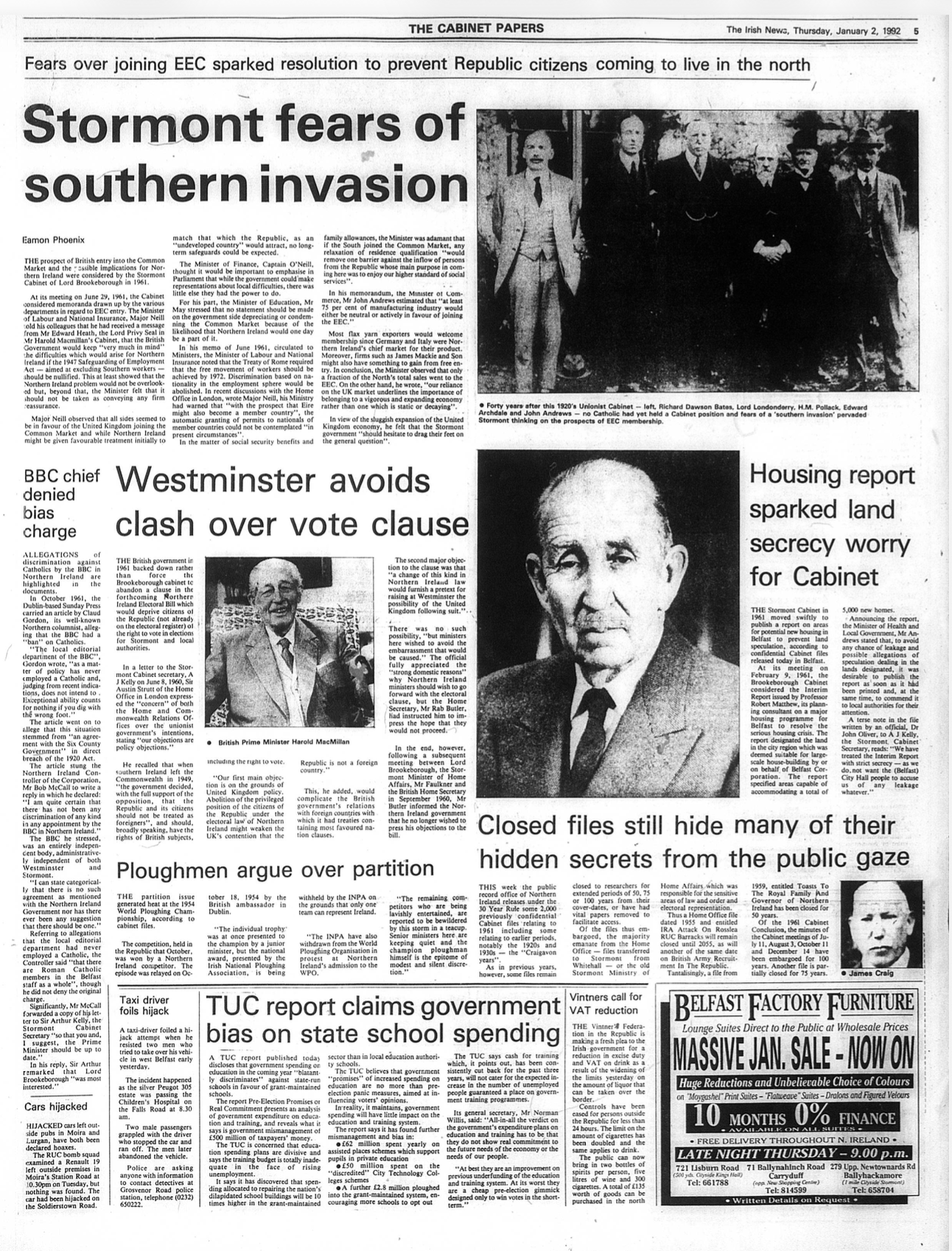
Stormont fears of southern invasion
Fears over joining EEC sparked resolution to prevent Republic citizens coming to live in the north
THE prospect of British entry into the Common Market and the possible implications for Northern Ireland were considered by the Stormont Cabinet of Lord Brookcborough in 1961.
At its meeting on June 29, 1961, the Cabinet considered memoranda drawn up by the various departments in regard to EEC entry.
The Minister of Labour and National Insurance, Major Neill told his colleagues that he had received a message from Mr Edward Heath, the Lord Privy Seal in Mr Harold Macmillan’s Cabinet, that the British Government would keep “very much in mind” he difficulties which would arise for Northern Ireland if the 1947 Safeguarding of Employment Act — aimed at excluding Southern workers — should be nullified.
This at least showed that the Northern Ireland problem would not be overlooked but, beyond that, the Minister felt that it should not be taken as conveying any firm reassurance.
Major Neill observed that all sides seemed to be in favour of the United Kingdom joining the Common Market and while Northern Ireland might be given favourable treatment initially to match that which the Republic, as an “undeveloped country” would attract, no long-term safeguards could be expected.
The Minister of Finance, Captain O’Neill, thought it would be important to emphasise in Parliament that while the government could make representations about local difficulties, there was little else they had the power to do.
For his part, the Minister of Education, Mr May stressed that no statement should be made on the government side depreciating or condemning the Common Market because of the likelihood that Northern Ireland would one day be a part of it.
In his memo of June 1961, circulated to Ministers, the Minister of Labour and National Insurance noted that the Treaty of Rome required that the free movement of workers should be achieved by 1972. Discrimination based on nationality in the employment sphere would be abolished.
In recent discussions with the Home Office in London, wrote Major Neill, his Ministry had warned that “with the prospect that Eire might also become a member country”, the automatic granting of permits to nationals of member countries could not be contemplated “in present circumstances”.
In the matter of social security benefits and family allowances, the Minister was adamant that if the South joined the Common Market, any relaxation of residence qualification “would remove one barrier against the inflow of persons from the Republic whose main purpose in coming here was to enjoy our higher standard of social services”.
In his memorandum, the Minister of Commerce, Mr John Andrews estimated that “at least 75 per cent of manufacturing industry would either be neutral or actively in favour of joining the EEC.”
Most flax yarn exporters would welcome membership since Germany and Italy were Northern Ireland’s chief market for their product. Moreover, firms such as James Mackie and Son might also have something to gain from free entry.
In conclusion, the Minister observed that only a fraction of the North’s total sales went to the EEC.
On the other hand, he wrote, “our reliance on the UK market underlines the importance of belonging to a vigorous and expanding economy rather than one which is static or decaying”.
In view of the sluggish expansion of the United Kingdom economy, he felt that the Stormont government “should hesitate to drag their feet on the general question”.
Closed files still hide many of their hidden secrets from the public gaze
THIS week the public record office of Northern Ireland releases under the 30 Year Rule some 2,000 previously confidential Cabinet files relating to 1961 including some relating to earlier periods, notably the 1920s and 1930s — the “Craigavon years.”
As in previous years, however, some files remain closed to researchers for extended periods of 50, 75 or 100 years from their cover-dates, or have had vital papers removed to facilitate access.
Of the files thus embargoed, the majority emanate from the Home Office — files transferred to Stormont from Whitehall — or the old Stormont Ministry of Home Affairs which was responsible for the sensitive areas of law and order and electoral representation.
Thus a Home Office file dated 1955 and entitled IRA Attack On Rosslea RUC Barracks will remain closed until 2055, as will another of the same date on British Army Recruitment In The Republic.
Tantalisingly, a file from 1959, entitled Toasts To The Royal Family And Governor of Northern Ireland has been closed for 50 years.
Of the 1961 Cabinet Conclusion, the minutes of the Cabinet meetings of July 11, August 3, October 11 and December 14 have been embargoed for 100 years. Another file is partially closed for 75 years.
BBC chief denied bias charge
ALLEGATIONS of discrimination against Catholics by the BBC in Northern Ireland are highlighted in the documents.
In October 1961, the Dublin-based Sunday Press carried an article by Claud Gordon, its well-known Northern columnist, alleging that the BBC had a “ban” on Catholics.
‘‘The local editorial department of the BBC”, Gordon wrote, “as a matter of policy has never employed a Catholic and, judging from recent indications, does not intend to. Exceptional ability counts for nothing if you dig with the wrong foot.”
The article went on to allege that this situation stemmed from “an agreement with the Six County Government” in direct breach of the 1920 Act.
The article stung the Northern Ireland Controller of the Corporation, Mr Bob McCall to write a reply in which he declared: “I am quite certain that there has not been any discrimination of any kind in any appointment by the BBC in Northern Ireland.”
The BBC he stressed, was an entirely independent body, administratively independent of both Westminster and Stormont.
“I can state categorically that there is no such agreement as mentioned with the Northern Ireland Government nor has there ever been any suggestion that there should be one.”
Referring to allegations that the local editorial department had never employed a Catholic, the Controller said “that there are Roman Catholic members in the Belfast staff as a whole”, though he did not deny the original charge.
Significantly, Mr McCall forwarded a copy of his letter to Sir Arthur Kelly, the Stormont Cabinet Secretary “so that you and, I suggest, the Prime Minister should be up to date.”
In his reply. Sir Arthur remarked that Lord Brookeborough “was most interested.”
Westminster avoids clash over vote clause
THE British government in 1961 backed down rather than force the Brookcborough cabinet to abandon a clause in the forthcoming Northern Ireland Electoral Bill which would deprive citizens of the Republic (not already on the electoral register) of the right to vote in elections for Stormont and local authorities.
In a letter to the Stormont Cabinet secretary, A J Kelly on June 8,1960, Sir Austin Strutt of the Home Office in London expressed the “concern” of both the Home and Commonwealth Relations Offices over the unionist government’s intentions, stating “our objections are policy objections.”
He recalled that when southern Ireland left the Commonwealth in 1949, “the government decided, with the full support of the opposition, that the Republic and its citizens should not be treated as foreigners”, and should, broadly speaking, have the rights of British subjects including the right to vote.
“Our first main objection is on the grounds of United Kingdom policy. Abolition of the privileged position of the citizens of the Republic under the electoral law of Northern Ireland might weaken the UK’s contention that the Republic is not a foreign country.”
This, he added, would complicate the British government’s relations with foreign countries with which it had treaties containing most favoured nation clauses.
The second major objection to the clause was that “a change of this kind in Northern Ireland law would furnish a pretext for raising at Westminster the possibility of the United Kingdom following suit.”
There was no such possibility, “but ministers here wished to avoid the embarrassment that would be caused.” The official fully appreciated the “strong domestic reasons” why Northern Ireland ministers should wish to go forward with the electoral clause, but the Home Secretary, Mr Rab Butler, had instructed him to impress the hope that they would not proceed.
In the end, however, following a subsequent meeting between Lord Brookcborough, the Stormont Minister of Home Affairs, Mr Faulkner and the British Home Secretary in September 1960, Mr Butler informed the Northern Ireland government that he no longer wished to press his objections to the bill.
Housing report sparked land secrecy worry for Cabinet
THE Stormont Cabinet in 1961 moved swiftly to publish a report on areas for potential new housing in Belfast to prevent land speculation, according to confidential Cabinet files released today in Belfast.
At its meeting on February 9, 1961, the Brookcborough Cabinet considered the Interim Report issued by Professor Robert Matthew, its planning consultant on a major housing programme for Belfast to resolve the serious housing crisis.
The report designated the land in the city region which was deemed suitable for large-scale house-building by or on behalf of Belfast Corporation. The report specified areas capable of accommodating a total of 5,000 new homes.
Announcing the report, the Minister of Health and Local Government, Mr Andrews stated that, to avoid any chance of leakage and possible allegations of speculation dealing in the lands designated, it was desirable to publish the report as soon as it had been printed and, at the same time, to commend it to local authorities for their attention.
A terse note in the file written by an official, Dr John Oliver, to A J Kelly, the Stormont. Cabinet Secretary, reads: “We have treated the Interim Report with strict secrecy — as we do not want the (Belfast) City Hall people to accuse us of any leakage whatever.”
Ploughmen argue over partition
THE partition issue generated heat at the 1954 World Ploughing Championship, according to cabinet files.
The competition, held in the Republic that October, was won by a Northern Ireland competitor. The episode was relayed on October 18, 1954 by the British ambassador in Dublin.
“The individual trophy was at once presented to the champion by a junior minister, but the national award, presented by the Irish National Ploughing Association, is being withheld by the INPA on the grounds that only one team can represent Ireland.
“The INPA have also withdrawn from the World Ploughing Organisation in protest at Northern Ireland’s admission to the WPO.
“The remaining competitors who are being lavishly entertained, are reported to be bewildered by this storm in a teacup. Senior ministers here are keeping quiet and the champion ploughman himself is the epitome of modest and silent discretion.”