

1959 State Papers (page 2)
January 02 1990
Publication Date
All-Ireland Free Trade zone gets Stormont snub, Whicker report causes storm, Schools tendering change considered, UTV permit dilemma, Unionists 'in a tizzy’ over Education Bill, Brookeborough presses London for court powers
State Paper Snippet
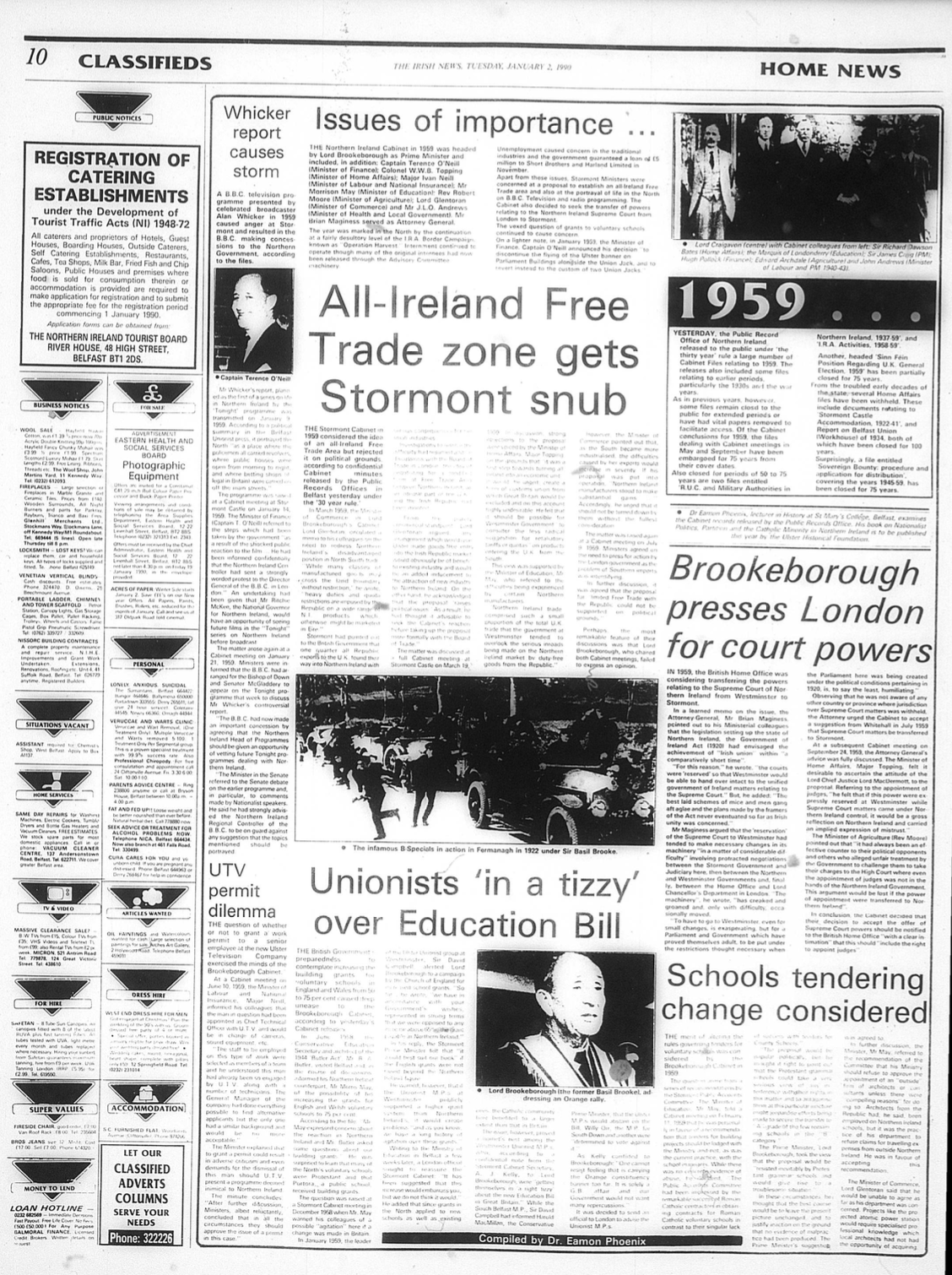
All-Ireland Free Trade zone gets Stormont snub
THE Stormont Cabinet in 1959 considered the idea of an all Ireland Free Trade Area but rejected it on political grounds, according to confidential Cabinet minutes released by the Public Records Offices in Belfast yesterday under the ’30 year rule.’
In March 1959, the Minister of Commerce in Lord Brookeborough’s Cabinet, Lord Glentoran, circulated a memo to his colleagues on the need to redress Northern Ireland’s disadvantaged position in North-South trade. “While, many classes of manufactured goods may cross the land boundary without restriction,” he wrote, “heavy duties and quota restrictions are imposed by the Republic on a wide range of N.I. products which, otherwise, might be marketed in Eire.”
Stormont had pointed out to the British Government that one quarter all Republic exports to this U.K. found their way into Northern Ireland with serious consequences for her small industries.
Investigations to resolve the difficulty had resumed and, in discussions with the Board of Trade in London, the idea of negotiating for a modified form of Free Trade Area between Northern Ireland, as an integral part of the U.K., and the Irish Republic had been mooted
“From the purely commercial standpoint,” Lord Glentoran argued, “any arrangement which would give Ulster-made goods free entry into the Irish Republic market would obviously be of benefit to existing industry and would be an added inducement to the attraction of new industry to Northern Ireland. On the other hand, he acknowledged that the -proposal ‘raises political issues.’ As a result, he had thought it advisable to seek the Cabinet’s reaction before taking up the proposal more formally with the Board of Trade.”
The matter was discussed at a full Cabinet meeting at Stormont Castle on March 19, 1959. In discussion, strong objections- to the proposal were voiced by the Minister of Home Affairs, Major Topping, on the grounds that “it was a first step towards turning all-Ireland into an economic unit.” It would, he urged, create a form of customs union from which Great Britain would be excluded and on this account highly undesirable. He felt that it should be possible for Westminster Government “to consider the less radical suggestion for retaliatory tariffs or quotas” on products entering the U.K. from the South.
This view was supported by the Minister of Education, Mr May, who referred to the difficulties being experienced by certain Northern manufacturers.
“Northern Ireland trade comprised such a small proportion of the total U.K. trade that the government at Westminster tended to overlook the serious inroads being made on the Northern Ireland market bv duty-free goods from the Republic.”
However, the Minister of Commerce pointed out that, as the South became more industrialised, the difficulties caused by her exports would increase in severity. If his proposal was put into operation, “Northern Ireland manufacturers stood to make substantial gains
Accordingly, he urged that it should not be turned down by them without the fullest consideration.
The matter was raised again at a Cabinet meeting on July 9, 1959. Ministers agreed on the need to press for action by the London government as the problem of Southern imports was intensifying.
“In further discussion, it was agreed that the proposal for “limited Free Trade with the Republic could not be supported on political grounds.”
Perhaps, the most remarkable feature of their discussions was that Lord Brookeborough, who chaired both Cabinet meetings, failed to express an opinion.
1959…
YESTERDAY, the Public Record Office of Northern Ireland released to the public under the thirty year rule a large number of Cabinet Files relating to 1959. The releases also included some files relating to earlier periods, particularly the 1930s and the war years.
As in previous years, however, some files remain closed to the public for extended periods or have had vital papers removed to facilitate access. Of the Cabinet conclusions for 1959, the files dealing with Cabinet meetings in May and September have been embargoed for 75 years from their cover dates.
Also closed for periods of 50 to 75 years are two files entitled ‘R.U.C. and Military Authorities in Northern Ireland, 1937 59, and ‘I.R.A. Activities, 1958-59’.
Another, headed ‘Sinn Fein Position Regarding U.K. General Election, 1959’ has been partially closed for 75 years.
From the troubled early decades of the state, several Home Affairs files have been withheld. These include documents relating to ‘Stormont Castle Accommodation, 1922 41, and Report on Belfast Union (Workhouse) of 1934, both of which have been closed for 100 years.
Surprisingly, a file entitled ‘Sovereign Bounty: procedure an application for distribution’, covering the years 1945-59, has been closed for 75 years.
Issues of importance …
THE Northern Ireland Cabinet in 1959 was headed by Lord Brookeborough as Prime Minister and included, in addition: Captain Terence O’Neill (Minister of Finance!; Colonel W.W.B. Topping (Minister of Home Affairs); Major Ivan Neill (Minister of Labour and National Insurance); Mr Morrison May (Minister of Education); Rev Robert Moore (Minister of Agriculture); Lord Glentoran (Minister of Commerce) and Mr J.L.O. Andrews (Minister of Health and Local Government). Mr Brian Maginess served ait Attorney General.
The year was marked in the North by the’ continuation at a fairly desultory level of the IRA Border Campaign, known as “Operation Harvest”. Internment continued to operate though many of the original internees had now been released through the Advisory Committee machinery.
Unemployment caused concern in the traditional industries and the government guaranteed a loan of £5 million to Short Brothers and Harland Limited in November.
Apart from these issues, Stormont Ministers were concerned at a proposal to establish an aIl Ireland Free Trade area and also at the portrayal of life in the North on B B C, Television and radio programming. The Cabinet also decided to seek the transfer of powers relating to the Northern Ireland Supreme Court from London to Stormont.
The vexed question of grants to voluntary schools continued to cause concern.
Whicker report causes storm
A BBC television programme presented by celebrated broadcaster Alan Whicker in 1959 caused anger at Stormont and resulted in the B.B.C. making concessions to the Northern Government according to the files.
Mr Whicker’s report, planned as the first of a series on life in Northern Ireland by the ‘Tonight’ programme was transmitted on January 9, 1959. According to a political summary in the Belfast Unionist press, it portrayed the North “as a place where the policemen all carried revolvers, where public houses were open from morning to night, and where betting shops (illegal in Britain) were carried on off the main streets.”
The programme was raised at a Cabinet meeting at Stormont Castle on January 14, 1959. The Minister of Finance (Captain T. O’Neill) referred to the steps which had been taken by the government “as a result of the shocked public reaction to the film … He had been informed confidentially that the Northern Ireland Controller had sent a strongly worded protest to the Director General of the B.B.C. in London.”
An undertaking had been given that Mr Ritchie McKee, the National Governor for Northern Ireland, would have an opportunity of seeing future films in the “Tonight” series on Northern Ireland before broadcast.
The matter arose again at a Cabinet meeting on January 21,1969. Ministers were informed that the BBC had arranged for the Bishop of Down end Senator McGladdery to appear on the Tonight programme that week to discuss Mr Whicker’s controversial report.
“The BBC had now made an important concession by agreeing that the Northern Ireland Head of Programmes should be given an opportunity of vetting future Tonight programmes dealing with Northern Ireland.
“The Minister in the Senate referred to the Senate debate on the earlier programme and, in particular, to comments made by Nationalist speakers. He said he had strongly advised the Northern Ireland Regional Controller of the B B C to be on guard against any suggestion that the topics mentioned should be portrayed.
Schools tendering change considered
THE merit of altering the rules governing tenders for voluntary schools was considered by the Brookeborough Cabinet in 1959.
The question arose from a series of recommendations by the Stormont Public Accounts Committee. The Minister of Education, Mr May, told a Cabinet meeting on February 11,1959 that he was personally in favour of a recommendation that tenders for building projects should be lodged with the Ministry and not, as was the current practice, with the school managers.
While there was no concrete evidence of abuse, he declared, “The Public Accounts Committee had been impressed by the remarkable success of Roman Catholic contractors in obtaining contracts for Roman Catholic voluntary schools in contrast to their singular lack of success with tenders for County Schools.”
“The proposal would be popular politically, but he thought it right to point out that the Protestant grammar schools could take a very ‘ serious view of any interference with their rights in this matter and to antagonise them at this particular juncture might jeopardise efforts being made to secure the transfer to “A” grade of the few remaining schools in the “B” category.”
The Prime Minister, Lord Brookeborough, took the view that the proposal would be “resisted inevitably by Protestant grammar schools and would give rise to a troublesome situation.”
In these circumstances, he thought that the best course would be to leave the present picture unchanged, and to justify inaction on the ground that no evidence of malpractice had been produced. The Prime Minister’s suggestion was agreed to.
In further discussion, the Minister, Mr May, referred to the recommendation of the Committee that his Ministry should refuse to approve the appointment of an “outside/’ firm of architects or consultants unless there were* “compelling reasons” for doing so. Architects from the Republic had, he said, been4 employed on Northern Ireland, schools, but it was the practice of his department |p refuse claims for travelling expenses from outside Northern Ireland. He was in favour of accepting this recommendation.
The Minister of Commers Lord Glentoran said that he would be unable to agree as far as his department was concerned. Projects like the projected atomic power station would require specialised professional knowledge which local architects had not had the opportunity of acquiring.
UTV permit dilemma
THE question of whether or not to grant a work permit to a senior employee at the new Ulster Television Company exercised the minds of the Brookeborough Cabinet.
At a Cabinet meeting on June 10,1959, the Minister of Labour and National Insurance, Major Neill, informed his colleagues that the man in question had been appointed as Chief Technical Officer with U.T.V. and would be in charge of cameras, sound equipment, etc.
“The staff to be employed on this type of work were selected as members of a team and he understood this man had already been so engaged by U.T.V. along with a number of technicians. The General Manager of the company had done everything possible to find alternative applicants but the only one had a similar background and would >be no more acceptable.”
The Minister explained that to grant a permit could result In adverse criticism and even demands for the dismissal of this man should U.T.V. present a programme deemed inimical to Northern Ireland.
The minute concludes: “After further discussion, Ministers, albeit reluctantly concluded that in all the circumstances they should approve the issue of a permit in this case.”
Unionists ‘in a tizzy’ over Education Bill
THE British Government’s preparedness to contemplate increasing the building grants for voluntary schools in England and Wales from 50 to 75 per cent caused deep unease to the Brookeborough Cabinet, according to yesterday’s ^Cabinet releases.
In June 1958, the Conservative Education Secretary and architect of the 1944 ‘Butler Act’, Mr. R. A. Butler, visited Belfast and, in the course of discussions, informed his Northern Ireland counterpart, Mr Morris May, of the possibility of his increasing the grants for English and Welsh voluntary schools to 75 per cent.
According to the file: “Mr. May expressed concern about the reaction in Northern Ireland and Mr. Butler asked some questions about our building grants.” He was surprised to |earn that many of the North’s voluntary schools were Protestant and that Portora, a public school, received building grants.
The question was raised at a Stormont Cabinet meeting in December 1958 when Mr. May warned his colleagues of a possible “agitation” here if a change was made in Britain.
In January 1959, the leader of the Ulster Unionist group at Westminster, Sir David Campbell, alerted Lord Brookeborough to a campaign by the Church of England for increased school grants. “So far”, he wrote, “we have in accordance with your Government’s wishes, represented in strong terms that we were opposed to any increase above 65%, the grant payable in Northern Ireland.”
In his reply, the Stormont Prime Minister felt that “it would best suit our book” if the English grants were not raised beyond the Northern Ireland figure.
He warned, however, that if the Unionist M.P.s at Westminster publicly supported a higher grant system than Northern Ireland’s, it would create problems “and as you know, we have a long history of agitation over these grants.”
Writing to the Ministry of Education in Belfast a few weeks later, a London official sought to reassure the Stormont Cabinet: “It has been suggested that this increase would embarrass you, but we do not think it would.” He added that since grants in the North applied to new schools, as well as existing ones, the Catholic community here benefited to a larger extent than that in Britain.
The issue, however, proved a hornet’s nest among the Westminster Unionist M.P.s, who, according to a confidential note from the Stormont Cabinet Secretary, A. J. Kelly, to Lord Brookeborough, were “getting themselves in ‘a right tizzy’ about the new Education Bill in Great Britain.” While the South Belfast M.P., Sir David Campbell had informed Harold MacMillan, the Conservative Prime Minister, that the Ulster M.P.s would abstain on the Bill, Willy Orr, the M.P. for South Down and another were “determined to vote against it.”
As Kelly confided to Brookeborough: “One cannot resist feeling that is carrying the Orange constituency banner too far. It is solely a GB. affair and our Government would not want many repercussions.”
It was decided to send an official to London to advise the Unionist M.P.s.
Brookeborough presses London for court powers
IN 1959, the British Home Office was considering transferring the powers relating to the Supreme Court of Northern Ireland from Westminster to Stormont.
In a learned memo on the issue, the Attorney-General, Mr Brian Maginess, pointed out to his Ministerial colleagues that the legislation setting up the state of Northern Ireland, the Government of Ireland Act (1920) had envisaged the achievement of “Irish union” within “a comparatively short time.”
“For this reason,” he wrote, “the courts were ‘reserved’ so that Westminster would be able to hand over intact to the unified government of Ireland matters relating to the Supreme Court.” But, he added: “The best laid schemes of mice and men gang aft aglae and the plans made by the framers of the Act never eventuated so far as Irish unity was concerned.”
Mr Maginess argued that the reservation’ of the Supreme Court to Westminster had tended to make necessary changes in its machinery “in a matter of considerable difficulty” involving protracted negotiations between the Stormont Government and Judiciary here and, finally, between the Northern and Westminster Governments and, Lord Chancellor s Department in London. “The machinery , he wrote, “has creaked and groaned and only with difficulty, occasionally moved.
“To have to go to Westminster, even for small changes, is exasperating, but for a Parliament and Government which have proved themselves adult, to be put under the restrictions thought necessary when the Parliament here was being created under the political conditions pertaining in 1920, is, to say the least, humiliating.”
Observing that he was not aware of any other country or province where jurisdiction over Supreme Court matters was withheld, the Attorney urged the Cabinet to accept a suggestion from Whitehall in July 1959 that Supreme Court matters be transferred to Stormont.
At a subsequent Cabinet meeting on September 24,1959, the Attorney General’s advice was fully discussed. The Minister of Home Affairs, Major Topping, felt it desirable to ascertain the attitude of the Lord Chief Justice Lord MacDermott, to the proposal. Referring to the appointment of judges, “he felt that if this power were expressly reserved at Westminster while Supreme Court matters came under Northern Ireland control, it would be a gross reflection on Northern Ireland and carries an implied expression of mistrust.”
The Minister of Agriculture (Rev Moore) pointed out that “it had always been an effective counter to their political opponents and others who alleged unfair treatment by the Government to challenge them to take their charges to the High Court where even the appointment of judges was not in the hands of the Northern Ireland Government. This argument would be lost if the power of appointment were transferred to Northern Ireland”.
In conclusion, the Cabinet decided that their decision to accept the offer of Supreme Court powers should be notified to the British Home Office “with a clear intimation” that this should “include the right to appoint judges”.