

1959 State Papers (page 1)
January 02 1990
Publication Date
Protestant Churches aided Catholic schools
State Paper Snippet
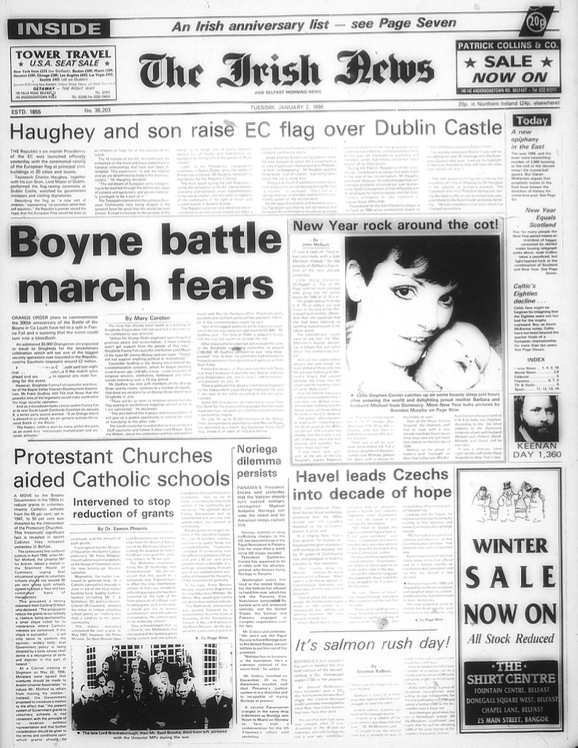
Protestant Churches aided Catholic schools
A MOVE by the Brooke Government in the 1950s to reduce grants to voluntary (mainly Catholic) schools from the 65 per cent, set in 1917, to 50 per cent was thwarted by the intervention of the Protestant Churches. This historically significant fact is revealed in secret Cabinet files releases yesterday in Belfast.
The controversy first surfaced publicly in April 1956, when Mr. Nat Minford, the Unionist MP for Antrim, tabled a motion in the Stormont House of Commons urging that educational grants to voluntary schools should not exceed 50 per cent unless such schools agreed to adopt a four and two committed’ basis of management.
This provoked a strong statement from Cardinal D’Alton who declared: “The proposal to reduce the grants to our Schools is, I believe, being sponsored by a small clique noted for its intolerance where Catholic interests are concerned. If this clique is successful … it will only serve to confirm the opinion, widely held, that Government policy is being dictated by a body whose chief desire is a resurgence of strife and disorder in this part of Ireland.”
At a Cabinet meeting at Stormont on May 22, 1956, Ministers were agreed that overtures should be made to Antrim Unionist Association “to induce Mr. Minford to refrain ‘(from moving his motion.” Instead, the Government proposed to introduce a motion to the effect that “the present system of Government grants to voluntary schools is not consistent with the principle of no taxation without representation and that further consideration should be given to the terms and conditions upon which grants should be continued, and the amount of such grants.”
It was agreed that the Minister of Education (the former Labour politicians, Mr Harry Midgley) should submit recommendations to the House of Commons when the new leaving-age became operative.
Meanwhile, the matter continued to generate heat. At a Catholic carnival in Limavady in June in aid of. the local school building fund, leading Catholic laymen including Mr C A Nicholson, QC and Lieutenant-Colonel McCausland, attacked the move to reduce voluntary school grants as “nothing less than a calamity to the whole community.”
The matter remained unresolved for over a year. In May 1957, however, the Prime Minister, Sir Basil Brooke (later Lord Brookeborough) received a letter from the Board of Education of the Methodist Church attacking the proposal to reduce the 65 per cent grant for voluntary schools to 50 per cent.
The Methodist churchmen, led by Rev Dr Northridge, told Brookeborough: “We are convinced that this would be a retrograde step. It would mainly affect the new intermediate schools. In that case, an extended building programme has been launched on the faith of the state provision of a 65 per cent building grant, and, in our view, it would give rise to serious questioning if, while the scheme is in progress, the scheme were to be materially altered.”
They acknowledged that, as a Church, the Methodists had not availed of the building grants being content with the schools provided by the Local Education Authorities. “But, as we all know, a numerically important section of the community will not do so. The agitation about Family Allowances will be remembered and we view with apprehension any renewal of controversy.”
Recalling that the largest element in the education budget, the cost of teachers’ salaries, was borne by public funds, the concluded bluntly: “To provoke a renewal of controversy over the difference between a 50 per cent and a 65 per cent grant would be most undesirable. It is, we hope, unnecessary, to assure you of our wholehearted sympathy and support for the policy of the Government generally.”
In his reply, Prime Minister Brooke, assured the Board that the new Education Minister, Mr Morris May would give careful weight t their representations.
The Methodists’ intervention was quickly followed by a remonstrance from the Clerk of Assembly of the Presbyterian Church, V Rev J H R Gibson to the Prime Minister. On the proposal for a reduction in grants to voluntary schools Dr Gibson expressed the considered view of the Education Board of the General Assembly:
“We are aware that political considerations have been strongly urged in favour of the suggested reduction. Concerning these, we as a Church do not wish to speak, except in so far as we would deplore any action of the Government which might lend even the semblance of truth to the charge of victimisation which would immediately follow upon any decision to reduce this grant.
“This is not the time to exacerbate party divisions in Northern Ireland, nor should the enemies of this state be presented with arguments to fortify their hostility.”
“In this state”, the Presbyterian spokesman went on, “we have much to gain, even politically, from securing adequate education at every stage… for every section of the community. The education are the less likely to be unaware of their privileges in Northern Ireland.”
In a reference to the large-scale school building programme launched by the Catholic Church in the early’ 1950s, the spokesman concluded tellingly:
“Those who seek the reduction of the grant point to the extent to which one section of the community have made use of it for building purposes and wish to curtail their use.”
Pointing out that the building programme had already passed its peak, the Clerk of the General Assembly added that “to apply the proposed reduction to schemes already past the initial planning stage would be a breach of*faith.”
In his reply of June 20, 1957, the Minister, Mr May, assured the Presbyterian Church that its representation would merit his “most sympathetic consideration”.
The subsequent Education (Amendment) Bill, as approved by the Cabinet in October 1957, contained no reference to the reduction of grants to Voluntary schools. Clearly, the timely intervention of the Methodist and Presbyterian Churches had secured for Catholic schools the concessions won under the 1947 Education Act.