

1957 State Papers (page 1)
January 03 1988
Publication Date
Nuclear power plan for North revealed, RUC escort for De Valera sparked row, Secrecy advised after Windscale, Attacks on Catholics were played down by minister, Religious make-up of police shown, Dismissals proposed, New light thrown on school battle, Attempts to bar SF candidates
State Paper Snippet
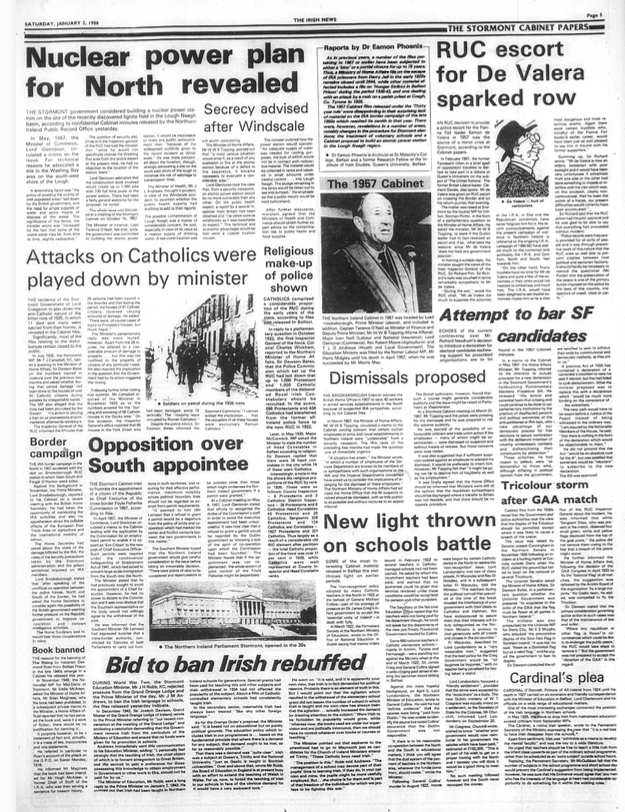
Looking back … the 1957 State Papers
As in previous years, a number of the files pertaining to 1957 or earlier have been subjected to either a “bloc’ or a partial closure for up to 75 years. Thus, a Ministry of Home Affairs file on the escape of IRA prisoners from Derry Jail in the early 1920s remains closed until 2044, while other material affected includes a file on ‘Hunger Strikes in Belfast Prison during the period 1936-43, and one dealing with an attack by a mob on a parish priest at Coagh. Co. Tyrone in 1935.
The 1957 Cabinet files released under the “Thirty year rule’ were disappointing in their surprising lack of material on the IRA border campaign of the late 1950s which reached its zenith in the year. There were, however, revelations in a number of areas, notably changes in the procedure for Stormont election’. The treatment of voluntary schools and a Cabinet proposal to build an atomic power station in the Lough Neagh region.
The 1957 Cabinet
THE Northern Ireland Cabinet in 1957 was headed by Lord Brookeborough, Prime Minister and included in addition, Captain Terence O’Neil as Minister of Finance and Deputy Prime Minister; Mr W W B Topping (Home Affairs); Major Ivan Neill (Labour and National Insurance); Lord Glentoran (Commercial); Rev. Robert Moore (Agriculture); and T. L. O. Andrews (Health and Local Government). The Education Ministry was filled by the former Labour MP, Mr. Harry Midgley, until his death in April 1967, when he was succeeded by Mr. Morris May.
– Dr Eamon Phoenix is Archivist at St Malachy’s College, Belfast and a former Research Fellow at the Institute of Irish Studies, Queen’s University, Belfast.
Nuclear power plan for North revealed
THE STORMONT government considered building a nuclear power station on the site of the recently discovered lignite field in the Lough Neagh basin, according to confidential Cabinet minutes released by the Northern Ireland Public Record Office yesterday.
In May 1957, the Minister of Commerce, Lord Glentoran, circulated a memo on the issue. For technical reasons, he advocated a site in the Washing Bay area on the southwest shore of the Lough.
A determining factor was the policy of avoiding the vicinity of populated areas, laid down by the British government, and the need for ample supplies of water and some means of disposal of the waste. The significance of this factor, the Minister wrote, was increased by the fact that some of the waste water might, from time to time, be slightly radioactive.
The question of security also arose, and the Inspector General of the RUC had told the minister that while he would not specifically choose the Washing Bay area from the police aspect at the present time, he had no objection to the location of the station there.
Lord Glentoran estimated that the construction work involved would create up to 1,000 jobs, with 130 full time posts at the power station. There had been fairly general support for the proposal, he noted.
The whole issue was discussed at a meeting of the Cabinet on October 11, 1957.
The Minister of Finance, Capt. Terence O’Neill, felt that, while the government was committed to building the atomic power station, it would be inadvisable to make any public announcement then because of the widespread publicity given to the recent accident at Wind scale. He was more concerned about the location, however, strongly advocating a site to the Southeast shore of the lough to minimize the risk of sabotage to transmission lines.
The Minister of Health, Mr. J L Andrews, thought it prudent, in view of the Windscale accident, to ascertain whether public health experts had anything to add to their reports.
The possible contamination of Lough Neagh was a matter of considerable concern, he said, especially in view of its value as a reserve supply of drinking water. A sea coast location was still worth considering.
Secrecy advised after Windscale
The Minister of Home Affairs, Mr. W W. B. Topping, pointed out that “a most serious situation would arise if, as a result of any explosion or fire at the atomic station because a defect in the apparatus, it became necessary to evacuate a considerable area.’’
Lord Glentoran took the view that, from a security viewpoint, an atomic power station would be no more vulnerable than any other. On the public health aspect, a report by a special inspector from Britain had been obtained and “he’s view were as satisfactory as it was reasonable to expect. “The technical and economic advantages would be lost were a coastal location chosen.
The minister outlined how the power station would operate: “An adequate supply of water was needed for cooling purposes, the bulk of which would not be in contact with radioactive material. The material would be collected in tanks and released in small amounts under careful control into Lough Neagh. The sludge remaining in the tanks would be taken out to sea and dumped.” He emphasized that a public inquiry would be held beforehand.
After further discussion, ministers agreed that the Ministers of Health and Commerce should obtain further expert advice on the contamination risk to public health and food supplies.
RUC escort for De Valera sparked row
AN RUC decision to provide a police escort for the Fianna Fail leader Eamon de Valera in 1957 was the source of a minor crisis at Stormont, according to the Cabinet papers.
In February 1957, the former Taoiseach (then in a brief spell of opposition) travelled to Belfast to take part in a debate at Queen’s University on the subject of “The United Nations”. The former British Liberal leader, Clement Davies, also spoke. Mr de Valera was given an RUC escort on crossing the Border and on his return journey that evening.
The matter was raised at Stormont by the loyalist MP for Clifton, Norman Porter, in the form of a parliamentary question to the Minister of Home Affairs. He asked the minister, Mr W. W. B. Topping, to state if the Dublin leader had in fact received an escort and, if so, “what were the reasons” since “Mr de Valera does not hold any government position.”
In framing a suitable reply, the minister sought the views of the then Inspector-General of the RUC, Sir Richard Pim. Sir Richard’s reply was cautiously but remarkably sympathetic to Mr de Valera.
“During the war’’, wrote the RUC chief “Mr de Valera did much to suppress the activities of the I.R.A. in Eire and the Republican extremists have never forgiven him for it. His recent pronouncements against the present campaign of violence in Northern Ireland (a reference to the ongoing I.R.A. campaign of 1956–62) have added much to the contempt and animosity the extremists of Sinn Fein, North and South, feel towards him.”
“On the other hand, many loyalists have no time for Mr de Valera and quite a few of the extremists in their ranks would not hesitate to embarrass and insult him. The I.R.A. would have been delighted to see loyalist extremists molest him as their most dangerous and most relentless enemy. Again there were certain loyalists who, mindful of the Fianna Fail leader’s earlier career, would have been just as well pleased to see him in trouble with his former supporters.”
Summing up, Sir Richard wrote: “Mr de Valera is now an elderly statesman with poor eyesight and it would have been very unfortunate if extremists from one side or the other had done something to impede or interfere with his visit which was, on this occasion, clearly noncontroversial. Had he been the victim of a fracas, our present difficulties would certainly have been accentuated.”
Sir Richard said that the RUC action had his prior approval and he was glad to be able to say that everything had proceeded without incident.
“Police escorts were frequently provided for all sorts of people and it was through preventive work of this nature that the RUC were so well able to prevent clashes between rival political and sectarian factions. It should hardly be necessary to remind the questioner (Mr Porter) that the preservation of the peace is one of the primary duties imposed on the police by the laws of this country, irrespective of creed, class or party.”
Attacks on Catholics were played down by minister
THE tendency of the Stormont Government of Lord Craigavon to play down the anti-Catholic nature of the bitter riots of 1935, in which 11 died and many were ejected from their homes, is revealed in the Cabinet files.
Significantly, most of the files relating to the disturbances remain closed to the public.
In July 1935, the Nationalist MP, Mr T.J. Campbell K.C. tabled a question to the Minister of Home Affairs, Sir Dawson Bates, on the numbers injured in violence over the previous two months and asked whether during that period damage had been done to the houses of over 40 Catholic citizens during parades by irresponsible bands. The MP also alleged that the riots had been provoked by the Government’s action in placing a ban on all processions and immediately afterwards revoking it.
The Inspector General of the RUC informed the Minister that 26 persons had been injured in the disorder and that during the period, the houses of 91 Catholic citizens received varying amounts of damage. He added “There were, of course cases of injury to Protestant houses, but much fewer.”
The Minister’s parliamentary reply was more muted, however. Apart from the 26 injuries, he referred to a considerable amount of damage to property but this was not confined to the property of citizens of any particular creed. He also rejected the implication in the question that the Government had by its action triggered the rioting.
Following further bitter rioting that summer, Mr Campbell inquired of the Minister in November 1935 as to the numbers arrested for the “burning and wrecking of 56 Catholic houses in the Docks area.” On this occasion, the Inspector General’s office reported that 60 houses in the York Street area had been damaged, some 19 seriously. The “majority were occupied by Roman Catholics.”
Despite the police advice, Sir Dawson Bates informed the Stormont Commons: “I cannot accept the implication…that the occupiers of all these houses were exclusively Roman Catholics.”
Religious make-up of police shown
CATHOLICS comprised a considerable proportion of the RUC during the early years of the state, according to files just released in Belfast.
In reply to a parliamentary question in October 1922, the first Inspector General of the force, Colonel Charles Wickham, reported to the Northern Minister of Home Affairs, Sir Dawson Bates, that the Police Commission which set up the RUC had laid down that up to 1,000 Protestant and 1,000 Catholic members of the disbanded Royal Irish Constabulary should be recruited. In the event, 896 Protestants and 434 Catholics had transferred from the former all-Ireland police force to the new RUC in 1922.
Later, in May 1935, Major McCormick, MP, asked the Minister to state the number of Head Constables in Belfast according to religion. Sir Dawson replied that there were 36 Head Constables in the city, 14 of these were Catholics.
Interestingly, a note in the file shows the religious proportions of the RUC by rank in 1935. These were as follows: County Inspectors – 6 Protestants and 3 Catholics; District Inspectors – 36 Protestants and 6 Catholics; Head Constables – 45 Protestants and 25 Catholics; Sergeants – 328 Protestants and 134 Catholics; and Constables – 1,927 Protestants and 321 Catholics. Thus, largely as a result of a considerable RIC element after partition, the total Catholic proportion of the force was over 17 per cent in 1935, while Catholics were well represented at County Inspector and Head Constable ranks.
Dismissals proposed
THE BROOKEBOROUGH Cabinet advised the British Home Office in 1957 to sack 40 workers in armed services establishments in the North because of suspected IRA sympathies, according to the Cabinet files.
In March 1957, the Minister of Home Affairs MR W W B Topping, circulated a memo to the Cabinet voicing concern that certain civilian employees in army and naval establishments in Northern Ireland were “undesirable from a security viewpoint. The IRA raids of the preceding few months had made the question one of immediate urgency
“A situation has arisen, the Minister wrote. “in which a number of employees of the Services Department are known to be members of or sympathisers with such organisations as the IRA.’’ and the Imperial Departments concerned have asked us to consider the implications of arranging for the dismissal of these employees The Northern Ministry of Home Affairs had advised the Home Office that the 40 suspects involved should be dismissed, with little publicity as possible and without recourse to an appeal tribunal.
The British authorities, however, feared that such a course might generate considerable publicity and the issue might be raised in Parliament at Westminster.
At a Stormont Cabinet meeting on March 20, 1957, Mr Topping said the police were pressing for the dismissals and he was prepared to risk the adverse publicity.
He was warned of the possibility of unfavourable criticism and trade union action of the employee – the many of whom might be ex-servicemen – were dismissed on suspicion and without means of redress. But those concerns wore over-ridden.
It was also suggested that if sufficient suspicion existed against an employee to warrant his dismissal, it would be preferable to intern him However, Mr Topping felt that it might be going too far to deprive him of ha liberty as well as his employment.”
It was finally agreed that the Home Office should be informed that Ministers were still of the opinion that the republican sympathisers should be discharged where a transfer to Britain was not feasible, and that there should be no appeals procedure.
New light thrown on school battle
SOME of the most interesting Cabinet material released in Belfast this year throws light on earlier periods.
The ‘non-recognition’ policy adopted by many Catholic teachers in the North in 1922, at the behest of General Michael Collins—part of his strategy of pressure on Sir James Craig’s infant government to accept the essential unity of Ireland—is dealt with fully.
In March 1922, the Permanent Secretary at the Northern Ministry of Education wrote to the Office of National Education in Dublin saying that money orders issued in February 1922 to several teachers in Catholic-managed schools had not been cashed. He asked by whom the recalcitrant teachers had been paid and warned that no guarantee could be given that services rendered under these conditions would be recognised for pension and other purposes.
The Secretary at the National Education Office replied that the teachers were not being paid by his department, though he could not speak for the departments of the new Pro-Treaty Provisional Government headed by Collins.
Some 500 Catholic elementary schools—mainly in Antrim, Tyrone, and Fermanagh—were standing out against the Ministry when, at the end of March 1922, Sir James Craig and General Collins signed a wide-ranging pact aimed at ending the sectarian bloodletting in Belfast.
Against this more hopeful background, on April 5, Lord Londonderry, the Northern Minister of Education, wrote to General Collins. He said he had definite evidence that the salaries were being paid from Dublin. He was able to identify the source but noted Collins’s assurance that the Dublin Government was not reasonable.
“If there is to be reasonable co-operation between the north and the south in educational matters, “I think you will agree that the dual system of payment of teachers in the Northern area, wherever the funds come from, should cease,” wrote the Minister.
Following General Collins’s murder in August 1922, moves were begun by Certain Catholic clerics in the North to resolve the non-recognition “issue. Lord Londonderry met two of this priests Fr. Macaulay and Rev. Dr. Handley. In a subsequent letter, Fr. Macaulay told the Minister: “The teachers, during the political turmoil that prevailed at the time of the break, dreaded the interference of your Government with their ideals as Catholics and Irishmen. We have endeavoured to assure them that their interests will be fully safeguarded, as the Northern Ministry is anxious to deal generously with all creeds and classes in the six countries.”
Fr. Macaulay, described by Lord Londonderry as a “very reasonable man,” suggested that the best policy for the Craig Government would be to “let bygones be bygones’ ‘with no teachers being penalized for having taken a stand.
Lord Londonderry favoured a friendly settlement, provided that the terms were accepted by the recalcitrant as a body. The new Dublin Ministry of W. T. Cosgrave was equally intent on a settlement agreement, as the secretary of state of the colonies, Mr Churchill, informed Lord Londonderry on September 20.
Mr. Cosgrave ,” Churchill wrote, wished to know whether your Government would now reimburse to his government the salary which have been paid, “estimated at £152,000“This is all part of his wish to get on a proper footing with the North, “and I daresay you will think it would be a good thing to meet him.”
No such meeting followed, however, and the South never recovered the money.
Attempts to bar SF candidates
ECHOES of the current controversy over MR Richard Needham’s decision to introduce a declaration for electoral candidates making support for proscribed organisations are to be found in 1957 Cabinet minutes.
In a memo to the Cabinet in May 1957, the Home Affairs Minister, Mr. Topping, referred to his intention to include provision for a new declaration in the Stormont Government’s forthcoming Parliamentary Elections Procedure Bill. He stressed the actual and potential harm that “is being and could continue to be done to our parliamentary institutions by the practice of disaffected persons and political extremists of the anti-partitionist or IRA type, who take advantage of our democratic process for free elections to secure nomination with the deliberate intention of causing unnecessary contest and disenfranchising their constituents by abstention.”
These activities, he had reason to believe, were distasteful to those who, although differing in political opinion from the Government, are satisfied to seek to achieve their ends by constitutional and democratic methods, as they are to us.
A previous Act of 1934 had contained a declaration of a candidate’s intention to take seat if elected, but this had failed to curb abstentionism. What the Minister proposed was to replace this with a declaration which “would be much more binding on the conscience of the extremists.”
The new oath would have to be sworn before a Justice of the Peace instead of being witnessed in the ordinary way.
“I am assured by the Nationalist Members of the House,” he said, “that there is nothing in the form of the declaration which would be objectionable to them.”
He did not pretend that the Act would be an absolute cure for the ill, but was satisfied that extremist would be reluctant to subscribe to the new declaration.
The Bill was approved.
Tricolour storm after GAA match
Cabinet files from the 1930s reveal that the Government and police authorities took the view that the display of the Tricolour should be permitted except where it was likely to cause a breach of the peace.
The issue was raised by Senator Joseph Cunningham in the Northern Senate in November 1933 following an incident at a hurling match at Corrody, outside Derry, when the RUC visited the ground but failed to insist on the removal of several Tricolours.
The Unionist Senator asked the Minister of Home Affairs, Dawson Bates, in a parliamentary question whether the Unionist Government was prepared to acquiesce in the order of the GAA that the flag must be flown at all games in Northern Ireland.
The Minister was also pressed by the Unionist MP for Derry City, Mr. E.S. Murphy, who attacked the provocative display of the Sinn Fein flag in Northern Ireland. It was not, he said, sown as a Dominion flag but as a rebel flag, and he urged the Government should ban its display.
Sir Dawson consulted the office of the RUC Inspector General about the incident, he was informed that while Sergeant Shea, who was present at the match, observed four small green, white, and yellow flags displayed from the top of the goalposts, the police did not remove them owing to the fear that a breach of the peace might occur.
He further informed the Minister of Home Affairs that following the decision of the GAA Congress in April 1933 to fly the National Flag at all matches, the suggestion was defeated by the Antrim Board of the organisation by a large majority “No Gaelic team,” he added, “was compelled to fly the Tricolour.
Sir Dawson stated that the primary consideration governing police action in such cases was the maintenance of law and order.
“Where any republican or other flag is flown in circumstances which could be likely to endanger the public peace, the RUC would take steps to remove it. But the Government was not prepared to accept the dictation of the GAA in this regard.
Cardinal’s plea
Cardinal O’Donnell, Primate of All Ireland from 1924 until his death in 1927, carried on an extensive and friendly correspondence with the Minister of Education in Belfast, Lord Charlemont, and his officials on a wide range of educational matters.
One of the most interesting exchanges concerned the position of the Irish language in Northern schools.
In May 1925, the move to drop Irish from mainstream education evoked criticism from Nationalist MPs.
The Cardinal, a native Irish speaker, wrote to the Permanent Secretary of the Ministry expressing the view that it was a real loss to have Irish disappear from the schools.
Apart from sentiment, Irish was “admirable as a means to develop the mental faculty” and was “the key to a wider literature.”
He urged that teachers should be free to teach a little Irish from the infant class upwards as part of the ordinary school programme rather than scheduled as an extra subject outside school hours.
Replying, the Permanent Secretary, Mr. McQuibban, felt that the number of subjects in the school programme and the short school day would prevent the Cardinal’s suggestion from being implemented. However, he was sure that His Eminence would agree that any man who had the interests of the language at heart had considerable opportunity to do something for it within the existing rules.
Opposition over South appointee
THE Stormont Cabinet tried to frustrate the appointment of a citizen of the Republic as Chief Executive of the cross-border Foyle Fisheries Commission in 1957, according to files.
In April 1957, the Minister of Commerce, lord Glentoran, circulated a memo Cabinet dealing with the application by the Commission for an employment permit to enable it to appoint Eire citizen to the new post of Chief Executive Officer. Such permit were required under the controversial safeguarding of employment of Act 1947, which had aimed to prevent large-scale immigration from the South into the North.
The Minister stated that he had previously sought to avoid the appointment of a Chief Executive, however he had no power to dictate to the Commission and it was now obvious that the Southern representative would “not willingly agreement to the withdrawal of the post”
He was informed that the Southern Minister (Mr Lemass) had expressed surprise that a trans-border authority, constituted by Statutes of both parliaments to carry out functions in both territories, and requiring to have the effective performance, maximum mobility across political boundary lines should not be regarded as exempt from permit requirement.
“It seemed to him (Mr Lemass) that a refusal to grant a permit would be a departure from the policy of amity and cooperation which had marked the earlier and fruitful contracts between the TWO governments in the matter.’’
The Southern Ministers hoped that the Northern Ireland government would give careful consideration to the issue before taking an irreversible decision. “They were point of view to be a considered and repercussions to be avoiding other than those which might embarrass the Northern Ireland government if a permit were granted.
At The Cabinet meeting on May 8 1957, lord Glentoran started the efforts to reorganise the duties of the Commission’s staff in order to avoid the executive appointment had been unsuccessful. It was now clear that a refusal to grant a permit would be regarded by the Dublin government as showing lack of the spirit of co-operation upon which the Commission had been founded. The Minister feared that if the appointment was not implemented, the whole system of joint control of the Foyle Fisheries might be jeopardised.
Bid to ban Irish rebuffed
DURING World War Two, the Stormont Education Minister, Mr J H Robb, KC, rejected pressure from the Grand Orange Lodge and the Prime Minister of the day, Mr J M Andrews, to ban the Irish language in schools. The files released yesterday indicated.
In December 1942, sir joseph Davison grand master of the grand orange lodge of Ireland wrote to the prime minister referring to our recent conversation at the meeting of the grand lodge and enclosing a resolution demanding that the government remove Irish from the curriculum of the ministry of education and ensure that no funds were given for its promotion in school.
Andrew immediately sent this communication to his educational Minister, adding ‘’I, personally feel strongly that the teaching of Irish, the chief object of which is to foment antagonism to Great Britain, and the second to gain a preference of those possessing the knowledge to obtain employment in government or other work in Eire, should not be paid for by us.”
The minister of education Mr Robb, sent a long reply to the prime minister on January 7, 1943.he pointed out that Irish had been taught in Northern Ireland schools for generations. Special grants had been paid for the teaching this and other subjects, and their withdrawal in 1934 had not affected the popularity of the subject. About a fifth of Catholic controlled elementary schools had consistently taught Irish.
In the secondary sector, meanwhile, Irish had always been treated “like any other foreign language.”
As for the Orange Order’s proposal, the Minister said: “It is based not on educational but on purely political grounds. The education policy which includes Irish in our programmes is based on the fundamental principle that where there is a demand for any subject, that demand ought to be met, as far as reasonably possible.”
That there was a demand was “quite clear.” Irish was a subject at Queen’s, Trinity, and the National University, “just as Gaelic is taught in Scottish universities.” Over and above that, wrote Mr. Robb, the Board of Education in England is at present busy with an effort to extend the teaching of Welsh in Wales. “For us now to forbid the teaching of Irish in our schools, in the face of the obvious demand for it, would have a very awkward look.”
He went on: “It is said, and it is apparently your own view, that Irish is in fact demanded for political reasons. Probably there is an element of truth in this. But I would point out that the agitation which resulted in the withdrawal of the elementary school grant did not lessen the number of schools in which Irish is taught, and my own view has always been that the agitation actually increased the demand by drawing attention to the subject. Were Irish to be forbidden, its popularity would grow, whereas now the books used are under our supervision and are politically innocuous; then we should have no control whatever over books or courses or teaching.”
The Minister pointed out that aspirants to the priesthood had to go to Maynooth, just as candidates for the Church of Ireland ministry attended Trinity. “These Catholic boys need Irish.”
“The position is this,” Robb told Andrews. “The management of a school may devote part of their pupils’ time to learning Irish. If they do, in your opinion and mine, the pupils might be more usefully employed. But the choice is for them, and is part of that freedom of the individual for which we profess to be fighting this war.”
Border Campaign
The IRA border campaign in the North in 1957 escalated with the raid on Brookeborough RUC station in which Sean South and Fergal O’Hanlon were killed.
Against this background, in November, the Prime Minister, Lord Brookeborough, reported to his Cabinet on a recent meeting with the British Home Secretary. He had taken the opportunity of mentioning the IRA activities and also his apprehension about the possible effects of the European Free Trade Area on agriculture and the international mobility of Labour.
The Home Secretary had asked about the costs of the damage inflicted by the IRA; the costs of the security precautions taken by the Stormont administration; and the prison sentences imposed on IRA members.
Lord Brookeborough stated that, after speaking of the unofficial co-operation between the police forces North and South of the border, he had asked the Home Secretary to consider again the possibility of the British Government exerting further pressure on the Republic’s Government to improve co-operation and concert intelligence activities.
The Home Secretary said he would bear these considerations in mind.
Book Banned
The reasons for the banning of The Rising by historian Desmond Ryan from Belfast Prison in the late 1940s emerge in a Cabinet file released this year.
In November 1949, the Nationalist MP for Mid-Derry at Stormont, Mr. Eddie McAteer, asked the Minister of Home Affairs, Mr. Brian Maginess, why the book had been prohibited. In a subsequent private memo to the Minister, a Home Affairs official reported that he had perused the book and, were it a work of fiction, there would be no justification for banning it.
“It purports, however, to be a statement of fact and, actually, it is a mass of lies, inaccuracies, and misstatements.”
He referred in particular to Ryan’s account of the attack on the G.P.O. on Easter Monday, 1916.
He informed Mr. Maginess that the book had been intended for Mr. Hugh McAteer, a former Chief of Staff of the I.R.A., who was then serving a sentence for treason felony.