On This Day / April 29, 1921

Go Back

Reproduced with permission from The Irish News.

19210429

Reference Date

19210429

Publication Date

Summary: On This Day – 29th April 1921 court hearings examined the Rosslea burnings, exposing cycles of reprisal killings and destruction along the Fermanagh–Monaghan border. Edited by Éamon Phoenix. 

Rosslea Tragedies Recalled | On This Day – 29th April 1921

COUNTY Court Judge Johnston, KC was engaged for several days at Newtownbutler Quarter Sessions in Enniskillen in investigating claims for compensation for the burning of houses in Rosslea on February 21st and the burning of other homes in the district on March 22nd.

On the morning of 21st February a Unionist named Lester was shot and seriously wounded while taking off his shutters and that night a large number of houses occupied by Catholics were burned.

On March 22nd houses occupied by Unionists were burned [in what] was regarded as a counter-reprisal.

One witness stated that Mr Lester was shot in the morning and later in the day some police came into the town and told the people that they could not be responsible for what might happen.

Evidence was given that some people left the town.

A witness was asked by the Judge who were the men who committed this destruction and he replied that they were supposed to be from [Ulster] Volunteers.

Major Falls, solicitor for Fermanagh County Council said there were counter-reprisals in March.

Two men named Gordon and Nixon were shot dead and a great number of houses burnt.

Colonel Madden [a Monaghan landlord] said that no portion of the compensation for the burnings should be levied off the County Monaghan.

He quoted from an article in the Impartial Reporter (a Unionist paper) after the Rosslea burnings: ‘It was well known that in County Fermanagh the resolve of the county was three for one – three lives should be taken if one were taken and three houses burned if one were burnt’.

Replying, Major Falls described Fermanagh as one of the most peaceable and law-abiding counties in the whole of Ireland while Monaghan simply reeked with blood and burnings.

The evidence showed that, on the night the Rosslea houses were burned, two bodies of armed men, marching in military order, were seen coming along the Monaghan Road into Rosslea and that night a man named Finnegan, from Smithboro, County Monaghan, was accidentally killed.

Judge Johnston said: ‘As regards the [February] event the attacking party were friends or sympathisers with Lester who had been shot earlier.

‘I have come to the conclusion that they came from County Monaghan.

‘In the various cases one-sixth of the compensation is to be levied on Fermanagh and five-sixths on Monaghan.

(Éamon Phoenix editor’s note: This case gives a remarkable insight into the nature of the bitter sectarian violence which erupted around Rosslea involving both the UVF and the local IRA.

A peace conference in Clones is said to have finally quelled the violence.)

On This Day – 29th April 1921

Further Reading on Irish History:

List of other On This Day columns

Other resources: National Library of Ireland Irish News CAIN Archive

About Eamon Phoenix

About the Eamon Phoenix Foundation

19210429

Reference Date

19210429

Publication Date

Summary: On This Day – 29th April 1921 court hearings examined the Rosslea burnings, exposing cycles of reprisal killings and destruction along the Fermanagh–Monaghan border. Edited by Éamon Phoenix. 

Rosslea Tragedies Recalled | On This Day – 29th April 1921

COUNTY Court Judge Johnston, KC was engaged for several days at Newtownbutler Quarter Sessions in Enniskillen in investigating claims for compensation for the burning of houses in Rosslea on February 21st and the burning of other homes in the district on March 22nd.

On the morning of 21st February a Unionist named Lester was shot and seriously wounded while taking off his shutters and that night a large number of houses occupied by Catholics were burned.

On March 22nd houses occupied by Unionists were burned [in what] was regarded as a counter-reprisal.

One witness stated that Mr Lester was shot in the morning and later in the day some police came into the town and told the people that they could not be responsible for what might happen.

Evidence was given that some people left the town.

A witness was asked by the Judge who were the men who committed this destruction and he replied that they were supposed to be from [Ulster] Volunteers.

Major Falls, solicitor for Fermanagh County Council said there were counter-reprisals in March.

Two men named Gordon and Nixon were shot dead and a great number of houses burnt.

Colonel Madden [a Monaghan landlord] said that no portion of the compensation for the burnings should be levied off the County Monaghan.

He quoted from an article in the Impartial Reporter (a Unionist paper) after the Rosslea burnings: ‘It was well known that in County Fermanagh the resolve of the county was three for one – three lives should be taken if one were taken and three houses burned if one were burnt’.

Replying, Major Falls described Fermanagh as one of the most peaceable and law-abiding counties in the whole of Ireland while Monaghan simply reeked with blood and burnings.

The evidence showed that, on the night the Rosslea houses were burned, two bodies of armed men, marching in military order, were seen coming along the Monaghan Road into Rosslea and that night a man named Finnegan, from Smithboro, County Monaghan, was accidentally killed.

Judge Johnston said: ‘As regards the [February] event the attacking party were friends or sympathisers with Lester who had been shot earlier.

‘I have come to the conclusion that they came from County Monaghan.

‘In the various cases one-sixth of the compensation is to be levied on Fermanagh and five-sixths on Monaghan.

(Éamon Phoenix editor’s note: This case gives a remarkable insight into the nature of the bitter sectarian violence which erupted around Rosslea involving both the UVF and the local IRA.

A peace conference in Clones is said to have finally quelled the violence.)

On This Day – 29th April 1921

Further Reading on Irish History:

List of other On This Day columns

Other resources: National Library of Ireland Irish News CAIN Archive

About Eamon Phoenix

About the Eamon Phoenix Foundation

19210429

Reference Date

April 29, 2021

Publication Date

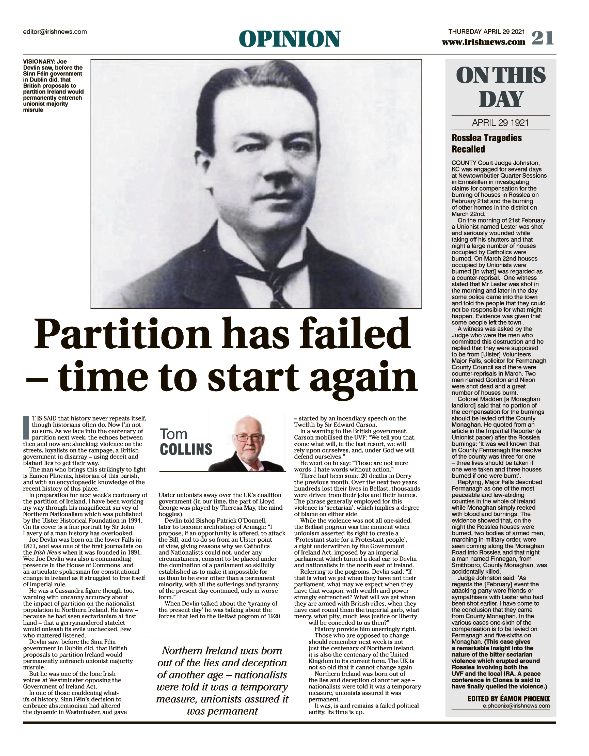
Thumbnail of PDF of Irish News page containing the Eamon Phoenix On This Day column dated 29th April 2021, detailing events reported on 29th April 1921

Summary: On This Day – 29th April 1921 court hearings examined the Rosslea burnings, exposing cycles of reprisal killings and destruction along the Fermanagh–Monaghan border. Edited by Éamon Phoenix. 

Rosslea Tragedies Recalled | On This Day – 29th April 1921

COUNTY Court Judge Johnston, KC was engaged for several days at Newtownbutler Quarter Sessions in Enniskillen in investigating claims for compensation for the burning of houses in Rosslea on February 21st and the burning of other homes in the district on March 22nd.

On the morning of 21st February a Unionist named Lester was shot and seriously wounded while taking off his shutters and that night a large number of houses occupied by Catholics were burned.

On March 22nd houses occupied by Unionists were burned [in what] was regarded as a counter-reprisal.

One witness stated that Mr Lester was shot in the morning and later in the day some police came into the town and told the people that they could not be responsible for what might happen.

Evidence was given that some people left the town.

A witness was asked by the Judge who were the men who committed this destruction and he replied that they were supposed to be from [Ulster] Volunteers.

Major Falls, solicitor for Fermanagh County Council said there were counter-reprisals in March.

Two men named Gordon and Nixon were shot dead and a great number of houses burnt.

Colonel Madden [a Monaghan landlord] said that no portion of the compensation for the burnings should be levied off the County Monaghan.

He quoted from an article in the Impartial Reporter (a Unionist paper) after the Rosslea burnings: ‘It was well known that in County Fermanagh the resolve of the county was three for one – three lives should be taken if one were taken and three houses burned if one were burnt’.

Replying, Major Falls described Fermanagh as one of the most peaceable and law-abiding counties in the whole of Ireland while Monaghan simply reeked with blood and burnings.

The evidence showed that, on the night the Rosslea houses were burned, two bodies of armed men, marching in military order, were seen coming along the Monaghan Road into Rosslea and that night a man named Finnegan, from Smithboro, County Monaghan, was accidentally killed.

Judge Johnston said: ‘As regards the [February] event the attacking party were friends or sympathisers with Lester who had been shot earlier.

‘I have come to the conclusion that they came from County Monaghan.

‘In the various cases one-sixth of the compensation is to be levied on Fermanagh and five-sixths on Monaghan.

(Éamon Phoenix editor’s note: This case gives a remarkable insight into the nature of the bitter sectarian violence which erupted around Rosslea involving both the UVF and the local IRA.

A peace conference in Clones is said to have finally quelled the violence.)

On This Day – 29th April 1921

Further Reading on Irish History:

List of other On This Day columns

Other resources: National Library of Ireland Irish News CAIN Archive

About Eamon Phoenix

About the Eamon Phoenix Foundation

On This Day is a daily column in the Irish News looking back either 50 or 100 years. The column was compiled by Dr Éamon Phoenix from the mid 1980s until autumn, 2022. The Foundation is very grateful to the Irish News for giving permission to reproduce Eamon’s columns. Funding gratefully received from Ireland’s Department of Foreign Affairs and the Magill Trust.

Visit Irish News

* The Foundation has worked hard to recreate Eamon’s distinctive voice through AI. Since this is an emerging technology, occasional imperfections may be audible.