On This Day / March 22, 1921
Go BackReproduced with permission from The Irish News.
19210322
Reference Date
19210322
Publication Date
Summary: On This Day – 22nd March 1921, the underground Dáil met in secret to advance the Belfast Boycott while reprisals devastated Clifden and British ministers continued to defend their Irish policy. Edited by Éamon Phoenix.
Dáil Meets in Secret | On This Day – 22nd March 1921
THE Irish Bulletin states that a session of Dail Eireann was held during the second week of March.
[Members] noted that the Belfast Boycott had made great progress all over the country. The stoppage of Belfast goods was rapidly becoming absolute.
A scheme for the creation of Conciliation Boards for the amicable settlement of disputes between employers and employed was approved.
Leave was given for the initiation of an intensive campaign for the development of Irish manufactures and the fostering of industries essential for the employment of Irishmen…
The progressive exclusion of certain articles of British manufacture is to be undertaken, the prohibition to last until the British war of aggression upon the Irish people ceases …
A decree was passed authorising the Minister of Home Affairs [Arthur Griffith] to forbid the census proposed to be taken by the British Government…
Parish Priest Describes Burning of Clifden
REPRISALS have continued in Clifden, County Galway, the native place of Thomas Wheelan who was executed last week.
No less than sixteen houses have been burned and 300 persons have been accommodated in the Workhouse.
Monsignor McAlpine, the parish priest, said he went to see ‘if he could save any of poor Clifden’.
A man who had been firing the houses came towards him and demanded: ‘What brings you here?’
The priest replied: ‘This is sad work … I am awfully sorry for the whole business.’
The man replied: ‘You get away out of here – we do not want your sort here.’
The priest continued: ‘I came down towards the barracks and was speaking to one of the police when the same man came towards me again and said: “You are here again. I will give you while I count to four and if you are not out of it by that time, you will never get out of it.”
At the same time he pointed his rifle at my breast. One of the Irish police interfered and said: “The Monsignor is a good man and a good priest.” I then left..’
Ex-Chief Secretary Defends Reprisals
Mr Edward Shortt, Home Secretary, had a lively reception in addressing a Coalition Liberal Meeting in his constituency, Newcastle-on-Tyne.
He defended the policy of the British government and said Ireland was a paradise compared with Russia where there was death punishment for every offence.
(Éamon Phoenix editor’s note: Following its suppression by the British authorities in September 1919, the Dail was forced to meet in secret.
It continued to Issue decrees regarding Republican Courts and ‘Belfast Boycott’.
The British government continued to defend its indiscriminate ‘Reprisals’ policy despite mounting condemnation in Britain and the US.)
On This Day – 22nd March 1921
Further Reading on Irish History:
List of other On This Day columns
Other resources: National Library of Ireland Irish News CAIN Archive
19210322
Reference Date
19210322
Publication Date
Listen Along in Éamons Voice
Summary: On This Day – 22nd March 1921, the underground Dáil met in secret to advance the Belfast Boycott while reprisals devastated Clifden and British ministers continued to defend their Irish policy. Edited by Éamon Phoenix.
Dáil Meets in Secret | On This Day – 22nd March 1921
THE Irish Bulletin states that a session of Dail Eireann was held during the second week of March.
[Members] noted that the Belfast Boycott had made great progress all over the country. The stoppage of Belfast goods was rapidly becoming absolute.
A scheme for the creation of Conciliation Boards for the amicable settlement of disputes between employers and employed was approved.
Leave was given for the initiation of an intensive campaign for the development of Irish manufactures and the fostering of industries essential for the employment of Irishmen…
The progressive exclusion of certain articles of British manufacture is to be undertaken, the prohibition to last until the British war of aggression upon the Irish people ceases …
A decree was passed authorising the Minister of Home Affairs [Arthur Griffith] to forbid the census proposed to be taken by the British Government…
Parish Priest Describes Burning of Clifden
REPRISALS have continued in Clifden, County Galway, the native place of Thomas Wheelan who was executed last week.
No less than sixteen houses have been burned and 300 persons have been accommodated in the Workhouse.
Monsignor McAlpine, the parish priest, said he went to see ‘if he could save any of poor Clifden’.
A man who had been firing the houses came towards him and demanded: ‘What brings you here?’
The priest replied: ‘This is sad work … I am awfully sorry for the whole business.’
The man replied: ‘You get away out of here – we do not want your sort here.’
The priest continued: ‘I came down towards the barracks and was speaking to one of the police when the same man came towards me again and said: “You are here again. I will give you while I count to four and if you are not out of it by that time, you will never get out of it.”
At the same time he pointed his rifle at my breast. One of the Irish police interfered and said: “The Monsignor is a good man and a good priest.” I then left..’
Ex-Chief Secretary Defends Reprisals
Mr Edward Shortt, Home Secretary, had a lively reception in addressing a Coalition Liberal Meeting in his constituency, Newcastle-on-Tyne.
He defended the policy of the British government and said Ireland was a paradise compared with Russia where there was death punishment for every offence.
(Éamon Phoenix editor’s note: Following its suppression by the British authorities in September 1919, the Dail was forced to meet in secret.
It continued to Issue decrees regarding Republican Courts and ‘Belfast Boycott’.
The British government continued to defend its indiscriminate ‘Reprisals’ policy despite mounting condemnation in Britain and the US.)
On This Day – 22nd March 1921
Further Reading on Irish History:
List of other On This Day columns
Other resources: National Library of Ireland Irish News CAIN Archive
19210322
Reference Date
March 22, 2021
Publication Date
Listen Along in Éamons Voice *
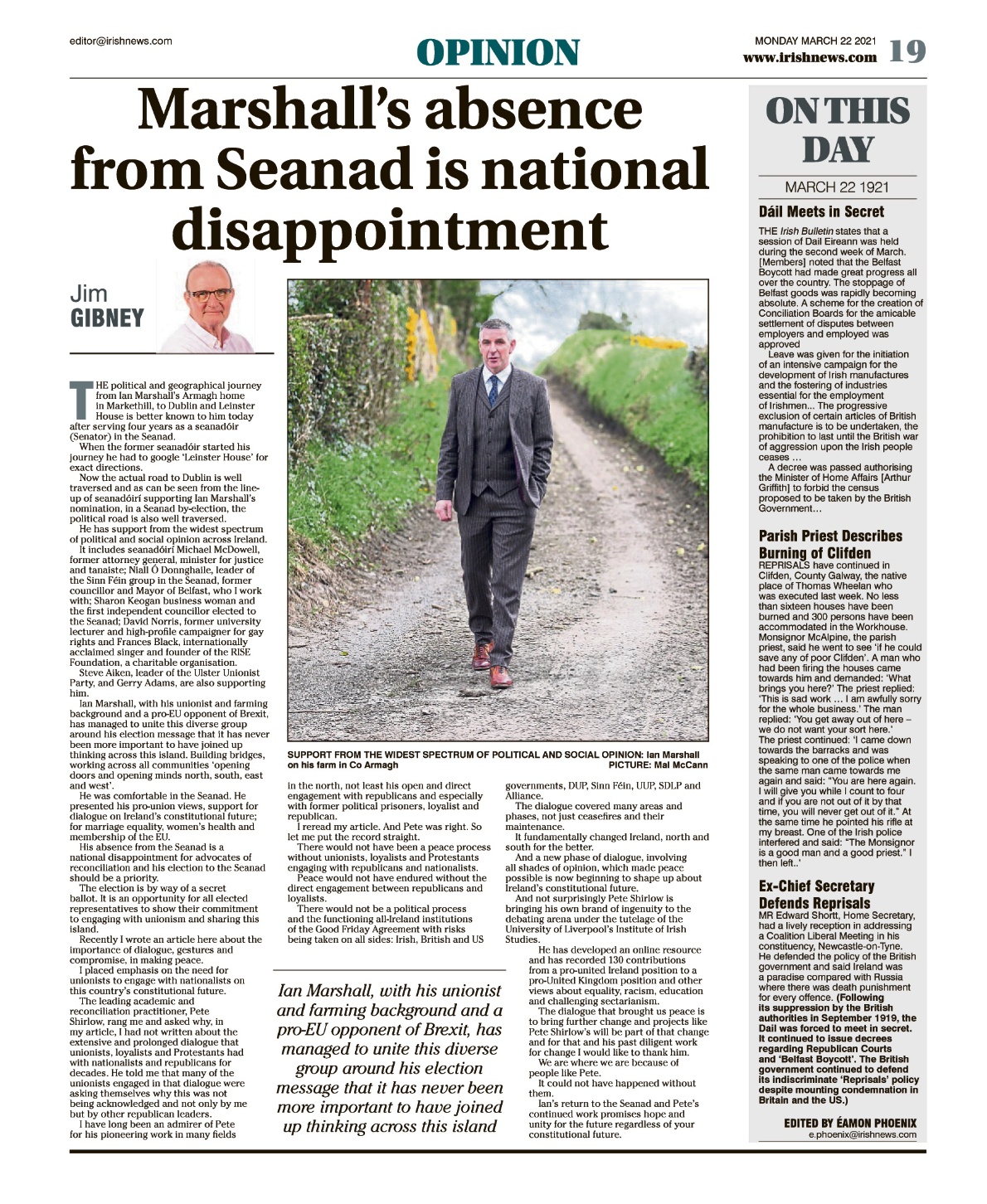
Summary: On This Day – 22nd March 1921, the underground Dáil met in secret to advance the Belfast Boycott while reprisals devastated Clifden and British ministers continued to defend their Irish policy. Edited by Éamon Phoenix.
Dáil Meets in Secret | On This Day – 22nd March 1921
THE Irish Bulletin states that a session of Dail Eireann was held during the second week of March.
[Members] noted that the Belfast Boycott had made great progress all over the country. The stoppage of Belfast goods was rapidly becoming absolute.
A scheme for the creation of Conciliation Boards for the amicable settlement of disputes between employers and employed was approved.
Leave was given for the initiation of an intensive campaign for the development of Irish manufactures and the fostering of industries essential for the employment of Irishmen…
The progressive exclusion of certain articles of British manufacture is to be undertaken, the prohibition to last until the British war of aggression upon the Irish people ceases …
A decree was passed authorising the Minister of Home Affairs [Arthur Griffith] to forbid the census proposed to be taken by the British Government…
Parish Priest Describes Burning of Clifden
REPRISALS have continued in Clifden, County Galway, the native place of Thomas Wheelan who was executed last week.
No less than sixteen houses have been burned and 300 persons have been accommodated in the Workhouse.
Monsignor McAlpine, the parish priest, said he went to see ‘if he could save any of poor Clifden’.
A man who had been firing the houses came towards him and demanded: ‘What brings you here?’
The priest replied: ‘This is sad work … I am awfully sorry for the whole business.’
The man replied: ‘You get away out of here – we do not want your sort here.’
The priest continued: ‘I came down towards the barracks and was speaking to one of the police when the same man came towards me again and said: “You are here again. I will give you while I count to four and if you are not out of it by that time, you will never get out of it.”
At the same time he pointed his rifle at my breast. One of the Irish police interfered and said: “The Monsignor is a good man and a good priest.” I then left..’
Ex-Chief Secretary Defends Reprisals
Mr Edward Shortt, Home Secretary, had a lively reception in addressing a Coalition Liberal Meeting in his constituency, Newcastle-on-Tyne.
He defended the policy of the British government and said Ireland was a paradise compared with Russia where there was death punishment for every offence.
(Éamon Phoenix editor’s note: Following its suppression by the British authorities in September 1919, the Dail was forced to meet in secret.
It continued to Issue decrees regarding Republican Courts and ‘Belfast Boycott’.
The British government continued to defend its indiscriminate ‘Reprisals’ policy despite mounting condemnation in Britain and the US.)
On This Day – 22nd March 1921
Further Reading on Irish History:
List of other On This Day columns
Other resources: National Library of Ireland Irish News CAIN Archive
On This Day is a daily column in the Irish News looking back either 50 or 100 years. The column was compiled by Dr Éamon Phoenix from the mid 1980s until autumn, 2022. The Foundation is very grateful to the Irish News for giving permission to reproduce Eamon’s columns. Funding gratefully received from Ireland’s Department of Foreign Affairs and the Magill Trust.
* The Foundation has worked hard to recreate Eamon’s distinctive voice through AI. Since this is an emerging technology, occasional imperfections may be audible.